

Key Takeaways
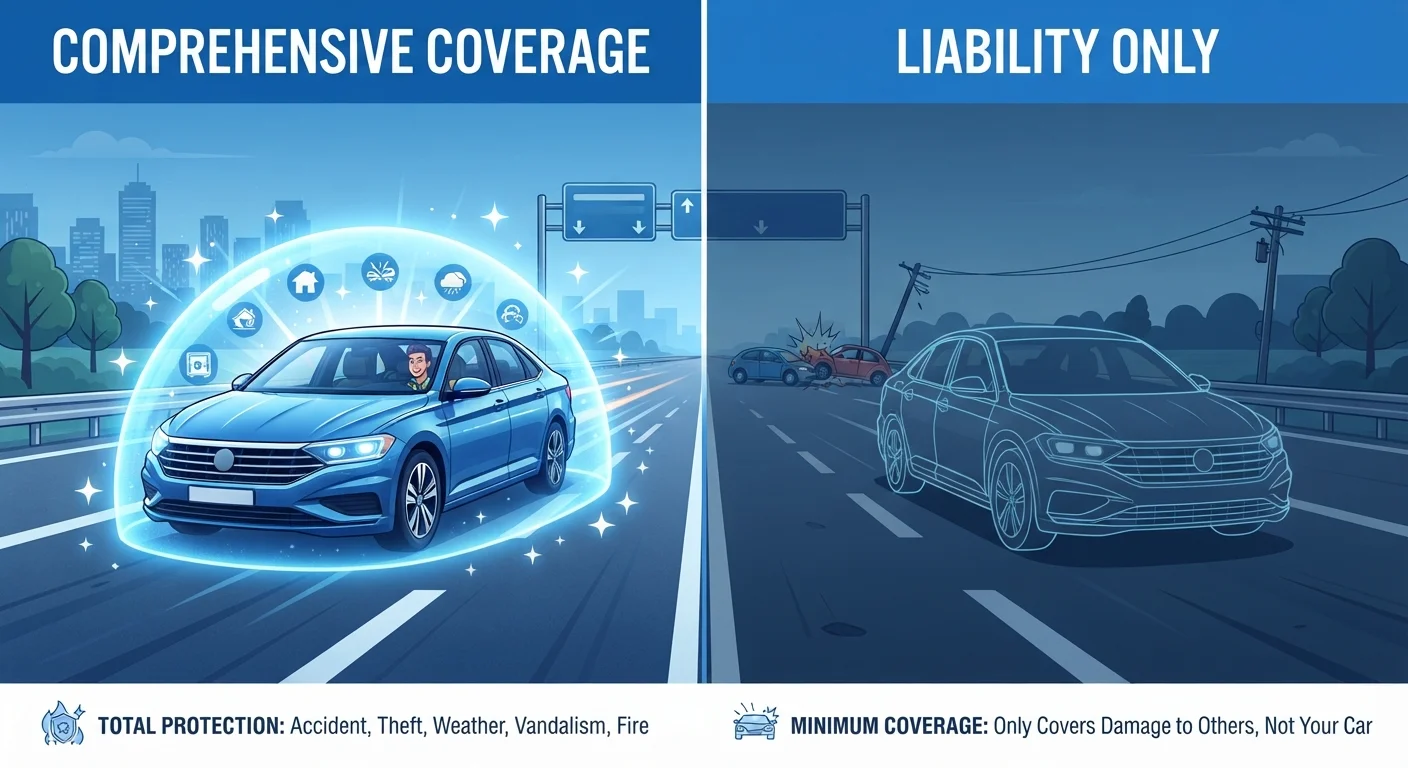
- Liability-only coverage pays for damage and injuries you cause to others - it does not cover your own vehicle.
- Comprehensive and collision (often bundled as 'full coverage') also protect your car from theft, weather, accidents, and more.
- Lenders and leasing companies almost universally require full coverage when you finance or lease a vehicle.
- Whether full coverage is worth the cost often hinges on your vehicle's current market value versus the annual premium difference.
- State minimum liability limits vary and may leave significant financial gaps after a serious accident.
Option A
Comprehensive Coverage (Full Coverage)
The broad, vehicle-protecting policy option.
Best for: Drivers with newer, financed, or higher-value vehicles who want protection against damage to their own car as well as third-party liability.
Option B
Liability-Only Coverage
The legally required, damage-to-others baseline.
Best for: Drivers of older or fully paid-off vehicles with lower market values who want to minimize monthly premium costs.
If you have a financed or leased vehicle
Comprehensive Coverage (Full Coverage)
Lenders require it. Without it, you risk breaching your loan or lease terms, and you'd owe the remaining balance even if your car were totaled.
If your car's market value is low relative to premium costs
Liability-Only Coverage
When a vehicle's actual cash value is modest, the annual premium increase for full coverage may outweigh the maximum payout you could receive.
If you drive in an area prone to severe weather, theft, or flooding
Comprehensive Coverage (Full Coverage)
Comprehensive coverage specifically protects against non-collision events like hail, flooding, and theft - risks that liability-only policies ignore entirely.
If you drive an older paid-off vehicle with minimal savings
Liability-Only Coverage
Maintaining legal minimum liability protects you from claims against you, and keeping premiums low can free cash for an emergency repair fund.
What Each Policy Actually Covers
The term liability-only coverage refers to the legally mandated minimum most U.S. states require. It has two components: bodily injury liability, which pays for medical costs of people you injure in an at-fault accident, and property damage liability, which covers repair or replacement costs for the other party's vehicle or property. Critically, neither component touches your own car - if you cause a collision, your vehicle repairs are entirely your financial responsibility.
Comprehensive coverage - commonly paired with collision coverage and marketed as "full coverage" - adds a second layer. Collision coverage pays to repair or replace your vehicle after an accident regardless of fault. Comprehensive coverage addresses non-collision losses: theft, vandalism, fire, flooding, hail, and animal strikes. Together, they close the gap that liability-only leaves wide open.
To understand how these costs fit into your broader budget, see the full breakdown of car ownership costs, which places insurance alongside fuel, depreciation, and maintenance.
| Criterion | Comprehensive (Full) Coverage | Liability-Only Coverage |
|---|---|---|
| Covers damage to your own vehicle | Yes (collision + comprehensive) | No |
| Covers damage/injury to others | Yes | Yes |
| Covers theft of your vehicle | Yes (comprehensive component) | No |
| Covers weather and flood damage | Yes (comprehensive component) | No |
| Required by lenders/lessors | Yes | No |
| Meets state legal minimum | Yes | Yes (if at state minimums) |
| Typical annual premium | Higher (varies by vehicle and driver) | Lower |
| Deductible applies | Yes (collision and comprehensive) | No (liability pays third parties) |
The Cost Gap - and How to Think About It
Premium differences between the two options are real and meaningful. According to the National Association of Insurance Commissioners (NAIC), the average annual expenditure for liability coverage has historically been several hundred dollars less than policies that include comprehensive and collision components. That gap varies significantly based on vehicle value, driver history, location, and chosen deductibles.
~$700+
Average annual gap between full and liability-only coverage
The NAIC reports that the average combined comprehensive and collision expenditure adds several hundred dollars annually above liability-only costs, though figures vary widely by state and driver profile.
50 states
States requiring minimum liability insurance
Every U.S. state except New Hampshire mandates some form of liability insurance, though minimum required limits differ significantly across the country.
$25,000
Common minimum bodily injury limit per person
Many states set per-person bodily injury liability minimums at $25,000 - a threshold that may be insufficient in accidents involving serious injuries or hospitalization.
The key financial question is whether the premium difference justifies the protection. A commonly cited rule of thumb in insurance planning - though not a guarantee of any specific outcome - is to reconsider full coverage when annual premiums for the additional components approach 10% of the vehicle's current actual cash value (ACV). However, that calculation should also factor in your ability to absorb a total loss out of pocket. How premiums are calculated explains the many variables insurers weigh - from credit history to ZIP code - that influence what you actually pay.
State minimum liability limits also deserve scrutiny. Many states set minimums such as $25,000/$50,000 for bodily injury - figures that can be exhausted quickly in a serious accident involving multiple injuries or expensive vehicles. Selecting coverage limits above the state minimum is worth considering regardless of which policy type you hold.
When You May Not Have a Choice
If you're financing or leasing your vehicle, full coverage is not optional - it's a contractual requirement. Lenders require it because the car serves as collateral for the loan. If you allow coverage to lapse, the lender may purchase force-placed insurance on your behalf - typically at a higher cost and with coverage that primarily protects the lender, not you.
Once a loan is paid off, the requirement disappears and the coverage decision becomes yours. That transition point is a logical time to reassess. Use a structured review - such as the checklist in our annual vehicle expense audit - to evaluate whether your current policy still matches your vehicle's value and your financial situation.
It's also worth noting that comprehensive and collision are sold with deductibles - the amount you pay out of pocket before insurance applies. Choosing a higher deductible lowers your premium but increases your exposure after a claim. That tradeoff should reflect how much you could realistically cover without financial strain.
This article is for general informational purposes only and does not constitute personalized insurance or financial advice. Coverage requirements, terms, and costs vary by state and insurer. Consult a licensed insurance professional for guidance specific to your situation.