

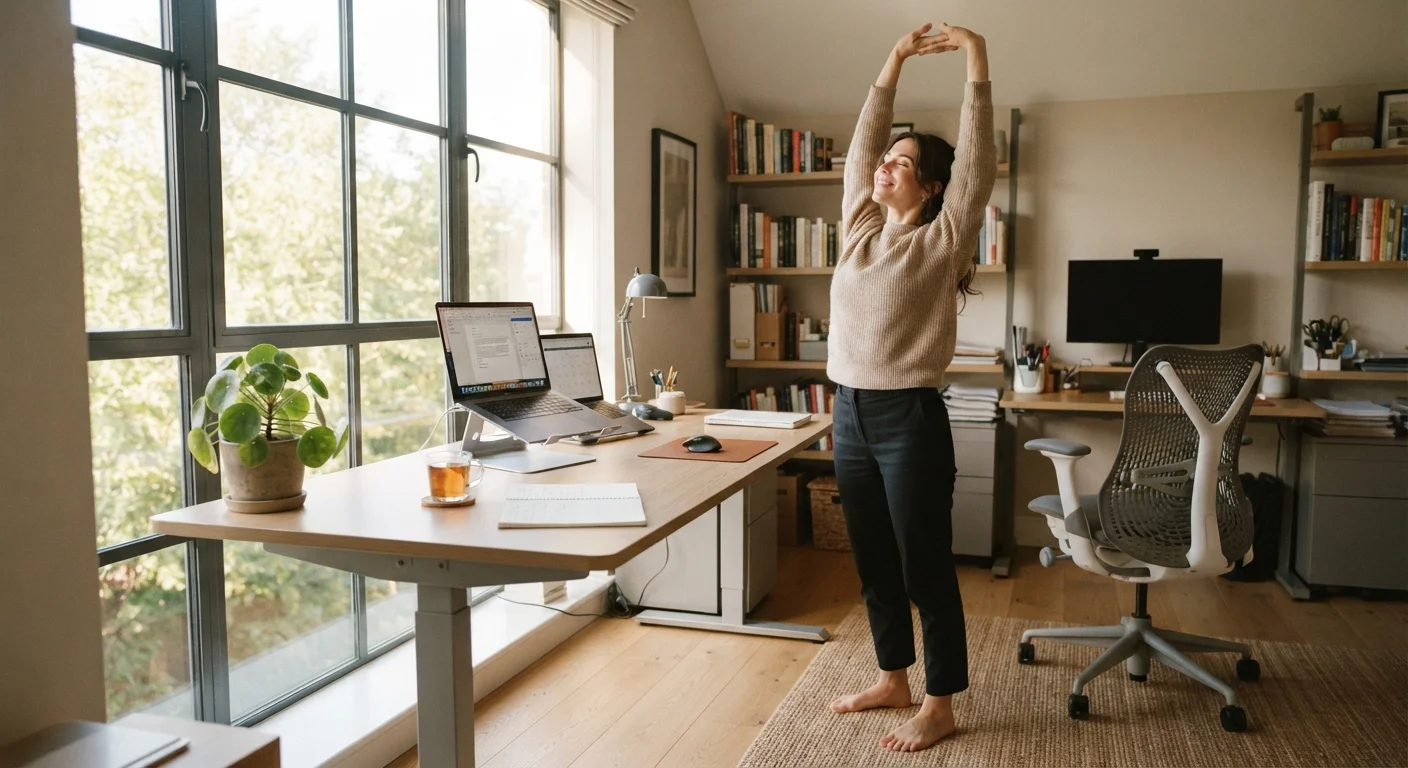
Key Takeaways
- Prolonged sitting is associated with measurable cardiovascular, metabolic, and musculoskeletal health risks.
- Breaking up sitting time with short movement bursts is more effective than one long workout session alone.
- Simple strategies like movement cues, walking meetings, and desk stretches fit any schedule.
- Consistency over intensity is what makes workplace movement habits durable.
- Consult a healthcare professional before starting a new exercise routine if you have existing health concerns.
What you will need
Why Desk Workers Need More Than a Weekly Workout
Public health research has increasingly distinguished between sedentary time - hours spent sitting still - and overall physical activity levels. Notably, studies have found that the health risks associated with prolonged uninterrupted sitting persist even in people who exercise regularly outside of work hours. This matters for desk workers because a one-hour gym session doesn't fully undo six or eight hours of near-continuous sitting.
The physiological effects of prolonged sitting include reduced circulation in the lower limbs, decreased insulin sensitivity, and altered activation patterns in postural muscles. Over months and years, these effects are associated with elevated risk for cardiovascular disease, type 2 diabetes, and chronic musculoskeletal issues - particularly in the lower back, hips, and neck. This is not meant to alarm, but to clarify the specific challenge desk workers face.
The practical implication: frequency of movement throughout the day matters alongside total exercise volume. Short, regular breaks in sitting are more effective at mitigating these effects than a single extended session. That reframing is empowering - it means meaningful change doesn't require a gym membership or large blocks of free time. It requires building small habits into the structure of an existing workday.
Start Small and Build Gradually
If you currently move very little during the workday, adding even one or two intentional movement breaks is a meaningful step. Research on habit formation suggests that small, consistent behaviors compound over time - so resist the urge to overhaul your entire day at once. For a deeper look at building from scratch, see our guide on building a weekly movement routine.
How to Build Movement Into Your Workday
The steps below are designed to be layered progressively - start with what's realistic and add from there. You'll need the tools listed and the prerequisites in place before beginning.
What you will need
Interval Timer App
Sets recurring reminders to prompt movement breaks at regular intervals throughout the workday.
Resistance Band
Enables seated or standing strength exercises that require minimal space and no gym equipment.
Standing Desk or Desk Riser
Allows alternating between sitting and standing positions without interrupting focused work.
Comfortable Walking Shoes
Supports walking breaks and lunchtime walks without discomfort or foot strain.
Audit Your Current Sitting Time
Before changing anything, get a realistic picture of how long you currently sit uninterrupted. Track one typical workday by noting the time you sit down and the time you next stand or walk. Most desk workers are surprised to find they sit for stretches of two to four hours without any meaningful break. This baseline makes the problem concrete and motivates specific changes - rather than vague intentions to "move more."
Schedule Movement Cues Into Your Calendar
Relying on willpower alone rarely works. Instead, set a recurring alarm or calendar block every 45-60 minutes labeled something like "Stand and move." When it fires, your only obligation is to stand up. What you do after that - stretch, walk to the water cooler, do a few calf raises - matters less than the act of breaking the sitting position consistently. Over time, these cues become automatic.
Incorporate Walking Into Existing Work Tasks
Walking is one of the most accessible and well-supported forms of physical activity available. Convert one-on-one phone calls or virtual audio-only meetings into walking meetings. Take the long route to the printer, bathroom, or kitchen. Walk during your lunch break rather than scrolling at your desk. These micro-walks accumulate without requiring any change to your schedule. For a fuller look at what regular walking can do for your body and mind, see the evidence behind walking as exercise.
Add Desk-Friendly Strength and Mobility Exercises
You don't need a gym to build muscle activation and joint mobility during the workday. A few effective options that require little or no equipment:
- Seated spinal rotations: Sit tall, place your right hand on your left knee, and gently rotate your torso to the left. Hold briefly, then switch sides.
- Standing calf raises: Rise onto your toes while holding the desk for balance, then lower slowly. Repeat 10-15 times.
- Wall sits: Find a clear wall, slide your back down until your thighs are roughly parallel to the floor, and hold for 20-30 seconds.
- Shoulder rolls and neck stretches: Roll shoulders backward 10 times; tilt your ear toward your shoulder and hold gently for 20 seconds each side.
Integrate one or two of these into each movement break rather than trying to do all of them at once.
Experiment With a Standing or Alternating Desk Setup
If your employer or budget allows, a standing desk or an adjustable desk riser can make it easier to alternate between sitting and standing throughout the day. Research suggests that standing alone isn't the goal - the benefit comes from alternating positions rather than substituting one static posture for another. Aim for roughly equal periods of sitting and standing, and listen to your body for signs of fatigue in your feet or lower back.
Track Progress and Adjust Over Time
After two weeks, revisit your original baseline audit. Has the length of your unbroken sitting stretches decreased? Are your movement cues becoming habitual rather than requiring conscious effort? Use what you learn to refine the approach - perhaps adding a longer lunchtime walk, trying a new desk exercise, or adjusting reminder frequency. If you're returning to movement after a period of inactivity, the realistic re-entry plan for exercise offers a structured progression suited to that starting point.
This article is for general informational and educational purposes only and does not constitute medical advice. Consult a qualified healthcare professional before making changes to your physical activity routine, particularly if you have any health conditions or concerns.
Making the Habit Stick Long-Term
The most common reason workplace movement habits fail is that they're treated as all-or-nothing. A meeting runs long, a deadline arrives, and the movement break gets skipped - then skipping becomes the norm. A more durable approach treats movement cues as flexible defaults rather than rigid obligations. Missed a break? Simply restart at the next interval without judgment.
It also helps to connect workplace movement to a broader sense of purpose - not weight loss or aesthetic goals, but sustained energy, reduced afternoon fatigue, and clearer thinking. Many desk workers report that regular movement breaks improve their concentration and mood during work, not just after it. Managing workday stress is another dimension of this: the daily stress management habits that tend to stick share the same design principles as movement habits - small, consistent, and tied to existing routines.
If you're building broader life habits alongside this - such as fitting learning into a full-time work schedule - the same principle applies: protecting small pockets of time consistently outperforms sporadic large efforts.