

Key Takeaways
- Fiberglass batts are the most DIY-friendly option and work well in open, standard-framed wall and ceiling cavities.
- Spray foam delivers the highest R-value per inch and doubles as an air and moisture barrier, but requires professional installation.
- Blown-in insulation excels at covering irregular spaces like attics, achieving consistent coverage without cutting or fitting.
- R-value measures thermal resistance - higher numbers mean better insulating performance per inch of thickness.
- Local building codes and climate zone requirements should guide your minimum R-value targets before choosing a material.
Our Verdict
No single insulation type wins for every situation. Fiberglass batts suit DIY-minded homeowners working in open, regularly framed spaces. Spray foam is the right call when air sealing is a top priority or when tight, unusual cavities need coverage. Blown-in is the standout choice for attic top-ups and irregularly shaped areas. Matching the material to the location, climate, and project scope will always deliver better results than defaulting to one product across the board.
| Best for | Recommended |
|---|---|
| DIY homeowners insulating standard wall and floor cavities | Fiberglass Batts |
| Sealing rim joists, crawl spaces, or areas requiring air barrier performance | Spray Foam |
| Attic insulation upgrades and hard-to-reach or irregular spaces | Blown-In |
| Budget-conscious projects with accessible, open framing | Fiberglass Batts |
What R-Value Actually Means
Before comparing materials, it helps to understand the metric that ties them all together. R-value measures a material's resistance to heat flow - the higher the number, the more effective the insulation. Every climate zone in the U.S. has recommended minimum R-values, set by the Department of Energy, for different parts of a home: attics, walls, floors, and crawl spaces.
R-value is additive, meaning layering materials increases total performance. However, compressed insulation loses effective R-value, which is a common mistake during DIY installation. The target R-value for your project should always be checked against local building codes, not just general guidelines, since requirements vary by region and structure type.
R-38 to R-60
Recommended attic R-value in colder U.S. climate zones
According to the U.S. Department of Energy's climate zone recommendations for existing homes in zones 4 through 8.
~15%
Typical home heat loss through the attic
The U.S. DOE estimates that inadequate attic insulation is among the most common sources of home energy loss.
Fiberglass Batts: The DIY Standard
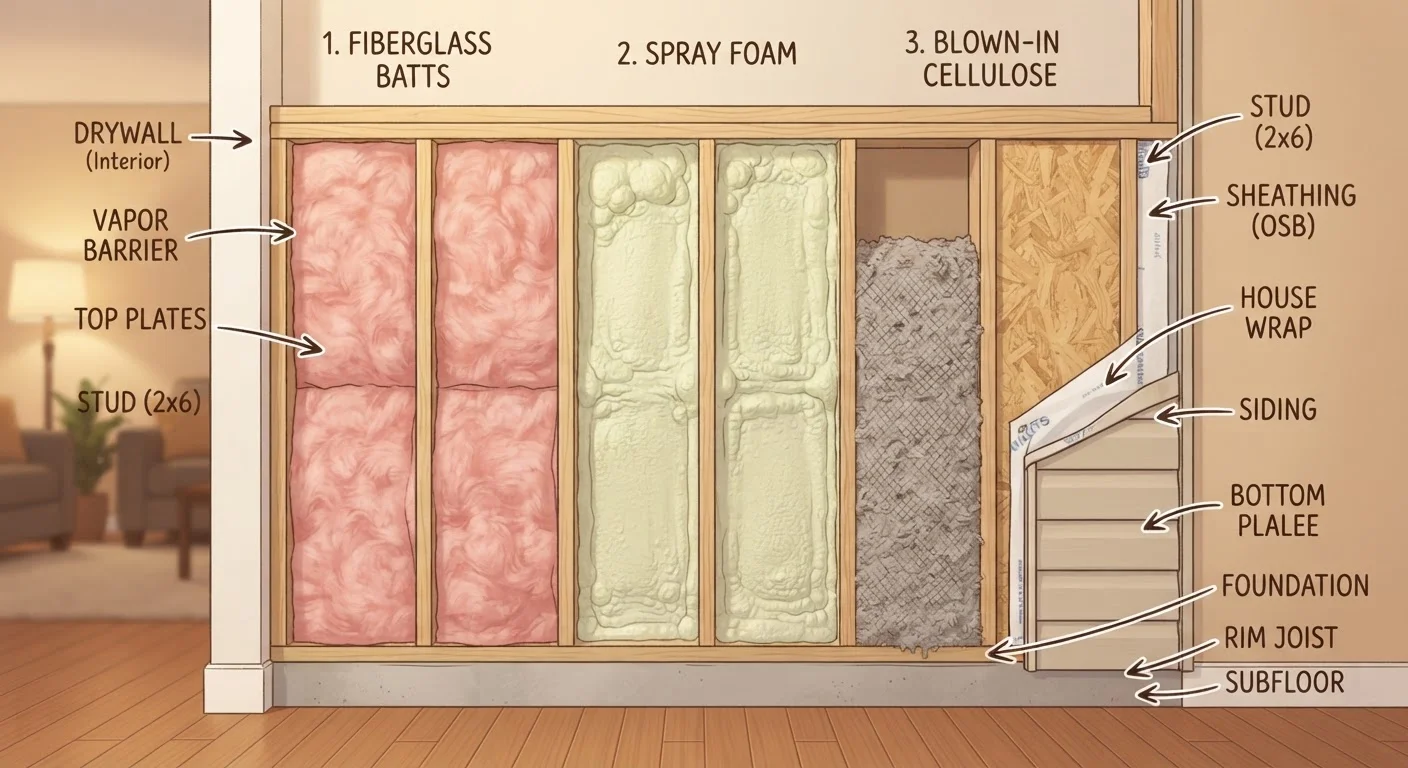
Fiberglass batts are pre-cut panels of spun glass fibers, typically available in widths designed to fit standard 16-inch and 24-inch stud spacing. They're the most widely available insulation product and the most accessible for homeowners comfortable with basic safety precautions.
Strengths
- Sold in most home improvement stores in a range of thicknesses and R-values (commonly R-11 to R-38)
- No special equipment needed - a utility knife, straightedge, and stapler are sufficient
- Manageable cost per square foot compared to other options
Limitations
- Must be cut carefully to fill irregular spaces; gaps dramatically reduce performance
- Does not provide air sealing - drafts can still move around batts
- Requires protective gear: gloves, safety glasses, and a dust mask during handling
Fiberglass batts work best in new construction or renovation projects where wall and floor cavities are fully exposed with consistent framing.
Fit Batts Snugly - Don't Compress Them
Fiberglass batts perform best when they fill the cavity without being compressed. Squishing a batt into a thinner space physically reduces its effective R-value. If a cavity is shallower than the batt thickness, use a lower-rated product sized for that depth rather than forcing a thicker batt to fit.
Spray Foam: High Performance, Professional Installation
Spray polyurethane foam (SPF) is applied as a liquid that expands and hardens, conforming to any shape. It comes in two primary forms: open-cell foam, which is softer and more vapor-permeable, and closed-cell foam, which is denser, more rigid, and significantly more moisture-resistant.
Strengths
- Closed-cell foam delivers R-values in the range of R-6 to R-7 per inch - the highest of the three types
- Acts as both an air barrier and insulator simultaneously, reducing infiltration that batts cannot address
- Effective in tight, irregular, or hard-to-reach cavities like rim joists and crawl space walls
Limitations
- Requires licensed professional installation for full two-component systems - improper mixing creates health hazards
- Significantly higher cost per square foot than batts or blown-in
- Closed-cell foam is not vapor-permeable, which can trap moisture in certain wall assemblies if not properly designed
Spray foam justifies its cost in areas where air sealing provides measurable energy savings, or where no other material can adequately fill the space.
Blown-In Insulation: Flexible Coverage for Attics and More
Blown-in insulation - typically made from cellulose (recycled paper fiber) or loose-fill fiberglass - is installed using a blower machine that distributes material across a surface. Cellulose is treated with fire retardants and borate compounds for pest resistance. Both types settle into irregular shapes and around obstructions naturally.
Strengths
- Ideal for attic floors where even, consistent coverage across joists and blocking is needed
- Handles obstructions like wiring and junction boxes without cutting or fitting
- Cellulose has a lower embodied energy than fiberglass, making it appealing for sustainability-minded projects
Limitations
- Blower equipment rental is required; installation in enclosed wall cavities requires holes drilled and patched
- Cellulose can settle over time, reducing effective R-value - installation depth should account for settling
- Moisture management is critical: cellulose absorbs water and must be kept dry
Many home improvement stores offer blower machine rentals alongside bulk bag purchases, making blown-in a realistic DIY option for open attic applications specifically.
| Fiberglass Batts | Spray Foam (Closed-Cell) | Blown-In (Cellulose) | |
|---|---|---|---|
| R-Value per Inch | R-2.9 to R-3.8 | R-6 to R-7 | R-3.2 to R-3.8 |
| Air Sealing | None | Excellent | Minimal |
| DIY Feasibility | High | Low (professional required) | Moderate (attics only) |
| Best Application | Open wall/floor cavities | Rim joists, crawl spaces | Attics, enclosed walls (retrofit) |
| Relative Cost | Lower | Higher | Moderate |
| Moisture Resistance | Low | High | Low - must stay dry |
Choosing the Right Insulation for Your Project
The right insulation type follows from the specific location in your home and the nature of the project - not from a one-size-fits-all recommendation.
- Open wall cavities during renovation: Fiberglass batts are practical, cost-effective, and installable without special equipment.
- Attic upgrades or top-offs: Blown-in insulation achieves uniform depth across the entire floor, including around obstructions.
- Rim joists, band joists, crawl space walls: Spray foam (particularly closed-cell) provides air sealing and moisture resistance in these exposed areas.
- Enclosed existing walls: Blown-in, installed through drilled holes, is often the only practical retrofit option without opening walls.
Before beginning any insulation project, verify local permit requirements. Some jurisdictions require permits for insulation work exceeding certain thresholds, and finished work may need to meet specific code minimums. When in doubt, consult a licensed contractor or your local building department to confirm what applies in your area.