

Key Takeaways
- The 50/30/20 rule splits after-tax income into needs, wants, and savings or debt payoff.
- Needs include housing, utilities, groceries, and minimum debt payments - not lifestyle extras.
- Wants cover discretionary spending like dining out, subscriptions, and entertainment.
- The 20% savings slice can target an emergency fund, retirement contributions, or extra debt payments.
- The rule is a starting framework, not a rigid requirement - adjust percentages to fit your income and goals.
- High-cost-of-living areas often push needs above 50%, requiring adaptation.
The 50/30/20 Rule
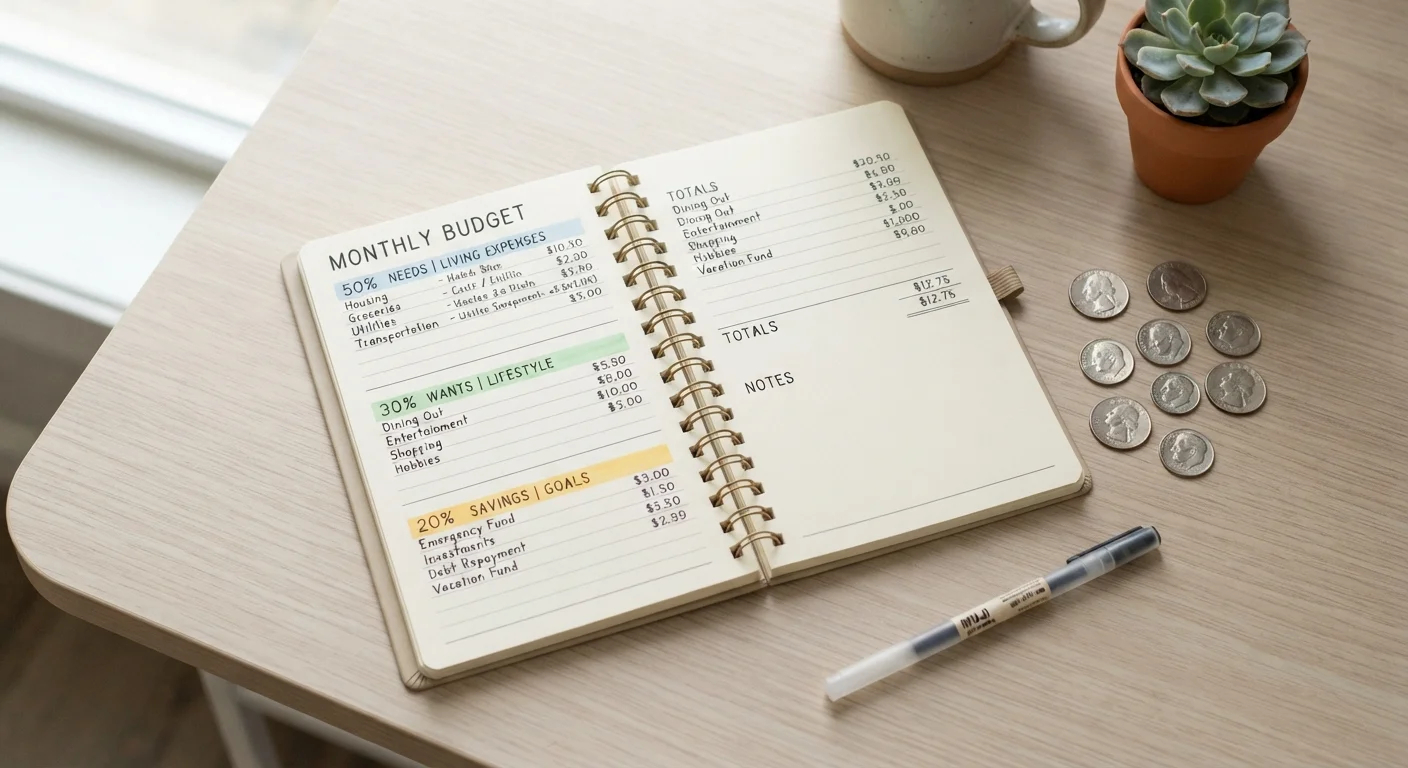
The 50/30/20 rule is a percentage-based budgeting framework that divides your after-tax income into three categories: 50% for needs, 30% for wants, and 20% for savings and debt repayment. It gives households a straightforward starting point without requiring detailed expense tracking. The goal is to build financial balance by ensuring essential spending doesn't crowd out saving.
The framework was popularized by U.S. Senator Elizabeth Warren and her daughter Amelia Warren Tyagi in their 2005 book 'All Your Worth.' It uses net income - take-home pay after taxes - as the base for all calculations.
How the Three Categories Break Down
The 50/30/20 rule works from your monthly after-tax income as the base. Once you know that number, you apply three percentage targets to every dollar you bring home.
50% - Needs: This covers true essentials - housing, electricity, water, groceries, basic transportation (car payment, insurance, gas, or transit), health insurance premiums, and minimum required payments on any debt. The defining test: if skipping it would seriously harm your health, housing, or employment, it's a need.
30% - Wants: This category includes spending that improves quality of life but isn't strictly necessary. Dining out, streaming subscriptions, gym memberships, clothing beyond basics, hobbies, and travel all fit here. These are real, legitimate expenses - the framework isn't telling you to eliminate them, only to contain them proportionally.
20% - Savings and Debt Repayment: This slice goes toward building financial security. It covers contributions to an emergency fund, retirement accounts such as a 401(k) or IRA, and any extra payments above the required minimum on credit card balances, student loans, or other debt. Think of this as paying your future self.
For a practical orientation on applying the needs-wants-savings split to real spending decisions, see how households navigate the gray areas between categories.
33%
Average share of U.S. household spending on housing
According to the U.S. Bureau of Labor Statistics Consumer Expenditure Survey, housing consistently represents the single largest share of household budgets.
57%
Americans living paycheck to paycheck
A 2023 LendingClub report found that a majority of U.S. adults report spending most or all of their monthly income, underscoring why a structured framework like 50/30/20 matters.
$1,000
Minimum emergency fund many experts suggest as a starter goal
Financial educators commonly recommend building at least $1,000 in liquid savings before aggressively paying down non-emergency debt - a goal the 20% savings bucket is designed to support.
Why Percentage-Based Budgeting Is Easy to Stick With
One of the biggest reasons people abandon detailed budgets is the friction of tracking dozens of line items. The 50/30/20 rule sidesteps much of that by keeping the structure broad. You're managing three buckets, not thirty.
Because the targets are proportional, the framework also scales automatically with income changes. A raise doesn't require rebuilding your whole budget - the percentages adjust the dollar amounts on their own. The same logic applies if your income drops temporarily.
Percentage-based budgeting also makes it easier to spot structural problems. If your needs reliably consume 65% of your paycheck, the rule surfaces that clearly - prompting you to examine whether a housing cost, car payment, or subscription has quietly grown out of proportion. For a deeper comparison of how percentages stack up against fixed-dollar approaches, weigh the trade-offs between percentage-based and amount-based budgeting.
Start by Calculating Your Real Net Income
Before assigning percentages, confirm your true monthly take-home figure - after federal, state, and payroll taxes, and any pre-tax deductions like a 401(k) contribution or health insurance premium. Using your gross salary will inflate all three buckets and set you up for shortfalls. Pay stubs are the most reliable starting point.
Where the Rule Has Real Limits
The 50/30/20 framework is a starting point, not a universal prescription. Several common situations push against its assumptions.
High housing costs: In many U.S. metro areas, rent alone can consume 35-45% of take-home pay for a median earner, leaving almost no room for other needs at the 50% threshold. In those cases, temporarily compressing the wants category is more realistic than pretending the budget math works.
Variable income: Freelancers, gig workers, and commission-based earners face irregular monthly totals. Applying fixed percentages to a changing base requires recalculating every month. Some people find it easier to build a budget around a conservative baseline income figure instead.
Aggressive financial goals: If you're working to pay off high-interest debt quickly or catch up on retirement savings, 20% directed at savings and debt may not be enough. Temporarily adjusting to a 50/20/30 or even 60/20/20 split - temporarily reducing wants - is a reasonable adaptation.
Once you've applied the framework for a month or two, a regular check-in helps you refine it. The monthly budget review checklist is a practical tool for catching overspending and realigning categories before small drift becomes a habit.
This article is for general informational and educational purposes only and does not constitute personalized financial advice. Consult a qualified financial professional for guidance specific to your situation.