

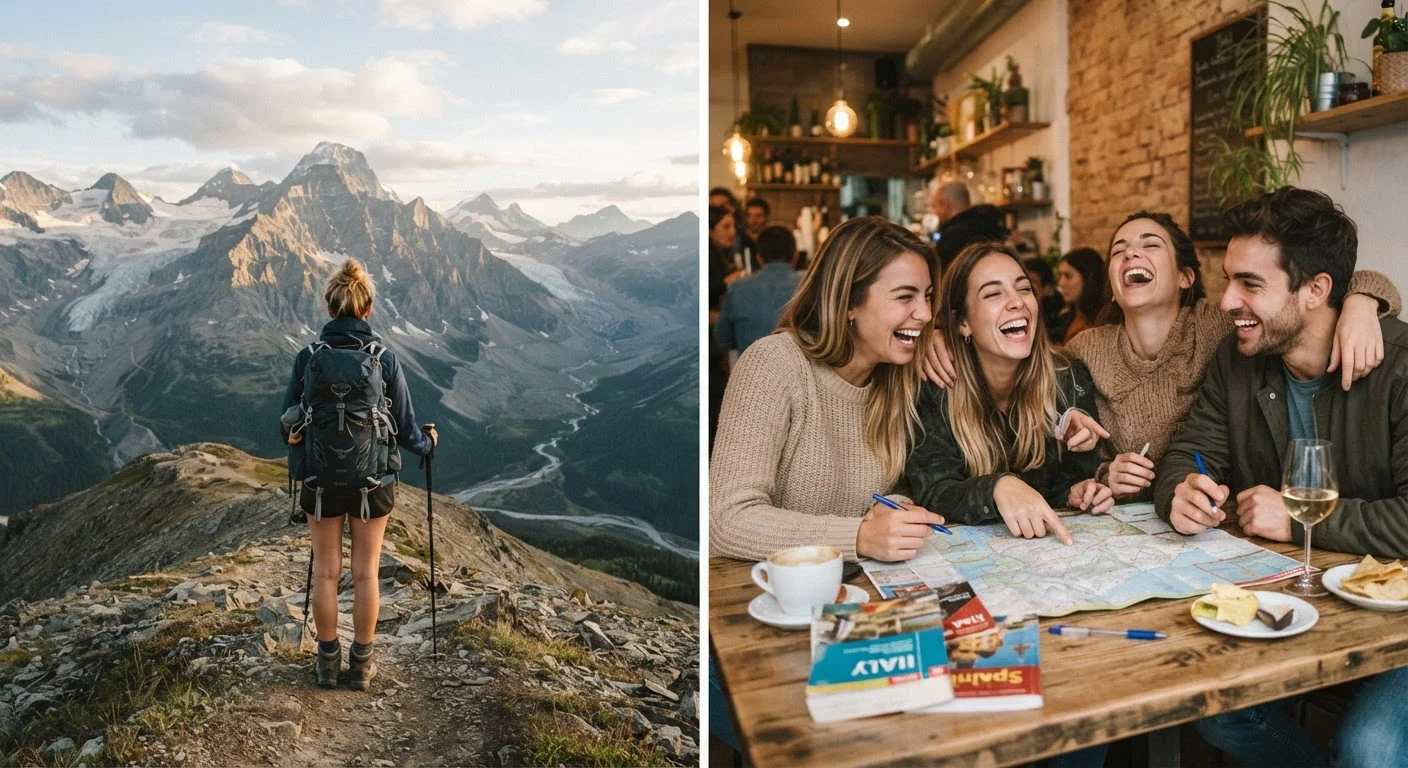
Key Takeaways
- Solo travel offers maximum flexibility but typically costs more per person for accommodations and tours.
- Group travel lowers per-person costs but requires compromise on itinerary, pace, and preferences.
- Neither arrangement is universally better - your trip goals determine which fits.
- Safety, decision fatigue, and social connection all weigh differently depending on travel style.
- Hybrid approaches - joining group tours for select legs - can capture benefits of both.
Complete control over itinerary and daily pace
Solo travelers can stay longer at places that captivate them, skip anything that doesn't, and change plans entirely without negotiating with anyone. This flexibility is difficult to replicate in a group setting.
Easier to connect with locals and other travelers
Traveling alone signals openness; locals and fellow travelers are generally more likely to strike up conversation with a solo traveler than with an established group. Many solo travelers report richer human connections as a direct result.
Builds genuine self-reliance and confidence
Navigating logistics, language barriers, and unexpected problems independently is challenging - and, for many people, deeply satisfying. These skills compound across trips.
No scheduling conflicts or compromise required
Your trip fits your calendar exactly. There's no coordination overhead, no waiting for group consensus, and no resentment when preferences diverge.
Higher per-person costs for rooms and tours
Single-occupancy pricing, solo-traveler surcharges on group tours, and the inability to split transportation costs mean solo travelers routinely spend more for the same experience.
Full cognitive and logistical load falls on you
Every navigation error, missed reservation, and unexpected problem is yours alone to solve. Over a long trip, this can accumulate into genuine exhaustion.
Social isolation on longer trips
Brief interactions with locals and other travelers don't fully substitute for sustained company. Extended solo trips can feel lonely, particularly during meals or evenings.
Reduced safety net in unfamiliar or remote areas
Without a companion to assist in a medical situation, a theft, or a missed connection, solo travelers have fewer immediate resources. This matters more in destinations with limited infrastructure.
Our Verdict
Solo travel rewards those who prioritize freedom, self-discovery, and the ability to pivot plans on a whim - but it comes at a real financial and logistical cost. Group travel spreads expenses and provides built-in companionship, though it demands patience and flexibility from everyone involved. Most travelers find their sweet spot somewhere in between, mixing independent days with shared experiences.
Solo travel suits self-directed, adaptable travelers comfortable making decisions independently; group travel is ideal for social travelers, families, or those managing tighter budgets who value shared logistics.
The Core Trade-Off: Freedom vs. Shared Resources
At its simplest, the solo-vs.-group question is a negotiation between control and efficiency. Solo travelers own every decision - where to eat, when to sleep, how long to linger at a museum. Group travelers pool resources and company, but pay with a portion of their autonomy.
Neither trade-off is inherently bad. The right framing is what do you actually want from this trip? A week of decompression and self-directed wandering calls for a different arrangement than a cost-conscious family reunion road trip. Before comparing logistics, it's worth being honest about your travel motivations. See our practical travel budgeting guide for help matching trip ambitions to a real budget before committing to either format.
Pros and Cons of Solo Travel
Solo travel has earned an almost mythic reputation - and for good reason. The experience of navigating an unfamiliar city entirely on your own terms is genuinely rewarding. But it comes with costs that glossy travel content tends to underplay.
Complete control over itinerary and daily pace
Solo travelers can stay longer at places that captivate them, skip anything that doesn't, and change plans entirely without negotiating with anyone. This flexibility is difficult to replicate in a group setting.
Easier to connect with locals and other travelers
Traveling alone signals openness; locals and fellow travelers are generally more likely to strike up conversation with a solo traveler than with an established group. Many solo travelers report richer human connections as a direct result.
Builds genuine self-reliance and confidence
Navigating logistics, language barriers, and unexpected problems independently is challenging - and, for many people, deeply satisfying. These skills compound across trips.
No scheduling conflicts or compromise required
Your trip fits your calendar exactly. There's no coordination overhead, no waiting for group consensus, and no resentment when preferences diverge.
The financial picture deserves particular attention. Single-occupancy hotel rates frequently run 20-30% higher than the per-person cost of a shared double room. Vacation rentals and group tour prices are almost always priced with pairs or larger parties in mind, meaning solo travelers often pay a "single supplement" that can meaningfully inflate a trip's total cost. Our breakdown of accommodation trade-offs shows how dramatically lodging costs shift depending on party size.
Higher per-person costs for rooms and tours
Single-occupancy pricing, solo-traveler surcharges on group tours, and the inability to split transportation costs mean solo travelers routinely spend more for the same experience.
Full cognitive and logistical load falls on you
Every navigation error, missed reservation, and unexpected problem is yours alone to solve. Over a long trip, this can accumulate into genuine exhaustion.
Social isolation on longer trips
Brief interactions with locals and other travelers don't fully substitute for sustained company. Extended solo trips can feel lonely, particularly during meals or evenings.
Reduced safety net in unfamiliar or remote areas
Without a companion to assist in a medical situation, a theft, or a missed connection, solo travelers have fewer immediate resources. This matters more in destinations with limited infrastructure.
Pros and Cons of Group Travel
Group travel - whether with friends, family, or a tour operator - introduces a social dimension that changes the experience fundamentally. For many people, sharing a destination is the whole point.
Complete control over itinerary and daily pace
Solo travelers can stay longer at places that captivate them, skip anything that doesn't, and change plans entirely without negotiating with anyone. This flexibility is difficult to replicate in a group setting.
Easier to connect with locals and other travelers
Traveling alone signals openness; locals and fellow travelers are generally more likely to strike up conversation with a solo traveler than with an established group. Many solo travelers report richer human connections as a direct result.
Builds genuine self-reliance and confidence
Navigating logistics, language barriers, and unexpected problems independently is challenging - and, for many people, deeply satisfying. These skills compound across trips.
No scheduling conflicts or compromise required
Your trip fits your calendar exactly. There's no coordination overhead, no waiting for group consensus, and no resentment when preferences diverge.
The friction points are real, though. Coordinating schedules across different work calendars, dietary needs, fitness levels, and spending tolerances is genuinely hard. Groups moving through airports and train stations take longer; group dinners require more reservation planning; a single participant's illness or flight delay can cascade into everyone's itinerary.
Higher per-person costs for rooms and tours
Single-occupancy pricing, solo-traveler surcharges on group tours, and the inability to split transportation costs mean solo travelers routinely spend more for the same experience.
Full cognitive and logistical load falls on you
Every navigation error, missed reservation, and unexpected problem is yours alone to solve. Over a long trip, this can accumulate into genuine exhaustion.
Social isolation on longer trips
Brief interactions with locals and other travelers don't fully substitute for sustained company. Extended solo trips can feel lonely, particularly during meals or evenings.
Reduced safety net in unfamiliar or remote areas
Without a companion to assist in a medical situation, a theft, or a missed connection, solo travelers have fewer immediate resources. This matters more in destinations with limited infrastructure.
For travelers weighing a structured group tour against independent travel, timing matters too. Shoulder season travel can make independent itineraries more manageable - thinner crowds reduce the coordination advantages group tours hold during peak periods.
Safety, Decision Fatigue, and the Middle Path
Safety considerations vary meaningfully by destination and traveler profile. Solo travelers - particularly in unfamiliar regions - carry the full cognitive load of staying aware, navigating, and making real-time decisions. That mental overhead is manageable for experienced travelers but can be exhausting on longer trips. Traveling with at least one companion distributes that vigilance and provides a safety net if something goes wrong.
The Hybrid Option Is Underused
Many travelers assume solo and group travel are binary choices, but a significant portion of trips blend both. Booking independent flights and accommodations while joining structured tours for specific activities - a cooking class, a multi-day trek, a guided city walk - lets you control your base itinerary while accessing the cost savings and social benefits of group formats for individual legs. Hostels with organized social events and group-friendly vacation rentals are increasingly designed with exactly this traveler in mind.
Decision fatigue is an underrated solo travel cost. Choosing every meal, every transport option, and every next move without input is energizing for some and draining for others. Know which camp you fall into before committing to two weeks alone in an unfamiliar country.
A practical middle path: travel independently for the bulk of a trip, then join a structured day tour or multi-day excursion for specific activities - a sailing trip, a guided hike, a culinary class - that benefit from group dynamics or logistics. This hybrid approach captures solo flexibility while offsetting some costs and providing social touchpoints. When planning a trip that crosses borders, the logistics shift further; domestic vs. international trip planning involves additional coordination that can tip the balance toward group arrangements for first-time international travelers.
~25%
Typical single-supplement surcharge on cruises and tours
Single supplements - extra fees charged to solo travelers - commonly range from 10% to 100% above the per-person double-occupancy rate, with 25% being a common baseline on many tour packages.
1 in 4
US leisure travelers who have taken a solo trip
Industry surveys consistently find that roughly a quarter of American leisure travelers have taken at least one trip entirely on their own, with numbers trending upward over the past decade.