

Key Takeaways
- Travel apps offer real-time updates and shared access but require internet connectivity.
- Spreadsheets give you full control over structure and work well for budget tracking.
- Paper lists are reliable offline backups and suit travelers who think better on paper.
- Most experienced travelers use a hybrid approach rather than a single tool.
- Matching your planning tool to your trip complexity and travel style reduces stress.
Our Verdict
No single planning tool wins outright - each has a distinct role depending on your trip complexity, tech comfort, and travel style. Apps shine for dynamic, real-time coordination; spreadsheets reward detail-oriented planners who want complete budget visibility; paper lists remain a surprisingly resilient backup and brainstorming tool.
| Best for | Recommended |
|---|---|
| Solo travelers or couples on complex multi-city trips | Travel Apps |
| Budget-focused planners who want itemized cost tracking | Spreadsheets |
| Travelers who prefer tactile organization or plan in low-connectivity situations | Paper Lists |
| Group trips or family travel with multiple itineraries to coordinate | Hybrid Approach |
Why Your Planning Tool Matters More Than You Think
Trip planning is fundamentally an information management problem. You're juggling confirmation numbers, activity windows, budget figures, packing needs, and contingency plans - often across weeks or months of preparation. The tool you choose shapes how reliably you capture and retrieve that information under pressure. A missed hotel confirmation at 11 p.m. abroad feels very different depending on whether it's searchable in an app, buried in a spreadsheet tab, or scrawled on a sticky note.
For travelers building a trip from scratch, it's worth understanding what each approach genuinely does well - and where it tends to break down - before defaulting to habit. See our framework for first-time planners if you're still deciding what kind of trip you're building.
Travel Apps: Powerful When Connected
Purpose-built travel apps - the kind that aggregate itineraries, store booking confirmations, and display maps offline - solve a real problem: they centralize information that would otherwise be scattered across a dozen email threads. Many can parse forwarded booking emails automatically, organize flights and hotels in chronological order, and share a live itinerary with travel companions.
The tradeoff is dependence. Apps require a charged device, and full functionality often requires an internet connection. In areas with unreliable mobile data - rural destinations, international SIM transitions, or long flights - app-based plans can become temporarily inaccessible. Security matters too: travel apps frequently store sensitive booking data, so account hygiene (strong passwords, two-factor authentication) is worth the setup time.
Apps tend to add the most value for travelers managing complex logistics: multiple cities, multiple travelers, or frequent schedule changes. For family travel with children, the shared-access feature alone can reduce a lot of back-and-forth.
| Travel Apps | Spreadsheets | Paper Lists | |
|---|---|---|---|
| Works offline | Partial (varies by app) | Yes (downloaded file) | Always |
| Budget tracking | Basic to moderate | Excellent, fully customizable | Manual, limited |
| Shareable with group | Yes, real-time sync | Yes, via cloud link | Requires physical copy |
| Real-time updates | Yes, automatic alerts | Manual updates required | Manual updates required |
| Ease of use on the go | High | Low | High |
| Setup time required | Low to moderate | Moderate to high | Very low |
| Reliability (no tech failure) | Depends on device/signal | Depends on device | Always reliable |
Spreadsheets: Structure You Control Completely
A well-built travel spreadsheet is hard to beat for budget tracking. Unlike apps, which display costs within a fixed interface, a spreadsheet lets you build exactly the columns, categories, and formulas that match how you think about money. Want to track per-person daily spending against a running total? You can build that. Want a tab for flight options with layover times listed side by side? Also doable.
Spreadsheets work particularly well in the planning phase, when you're comparing options and running scenarios. They're less fluid during the trip itself - updating a cell on a phone while navigating a foreign train station isn't practical. That's the core limitation: spreadsheets are a planning surface, not a travel companion.
For a practical framework on building your budget from the start, our travel budgeting guide walks through how to structure expenses before you book anything. Spreadsheets pair naturally with that kind of ground-up approach.
Paper Lists: Underrated and Surprisingly Resilient
Paper doesn't crash, run out of battery, or require a password reset. For many travelers, a handwritten list remains the most reliable single source of truth - especially for packing lists, day-of checklists, and quick reference notes that need to survive a long-haul flight without access to power.
Paper also has cognitive advantages for some planners. Research in learning and memory suggests that writing by hand can support better retention and more deliberate thinking than typing - relevant if you're working through a complicated itinerary and want it to actually stick in your memory. Our related piece on note-taking styles explores this dynamic in more depth for anyone curious about the underlying mechanics.
The obvious limitation is that paper doesn't update itself. If a flight time changes, every paper copy needs manual correction. Paper also doesn't share well across a travel group without photocopying or rewriting.
Building a Hybrid System That Actually Works
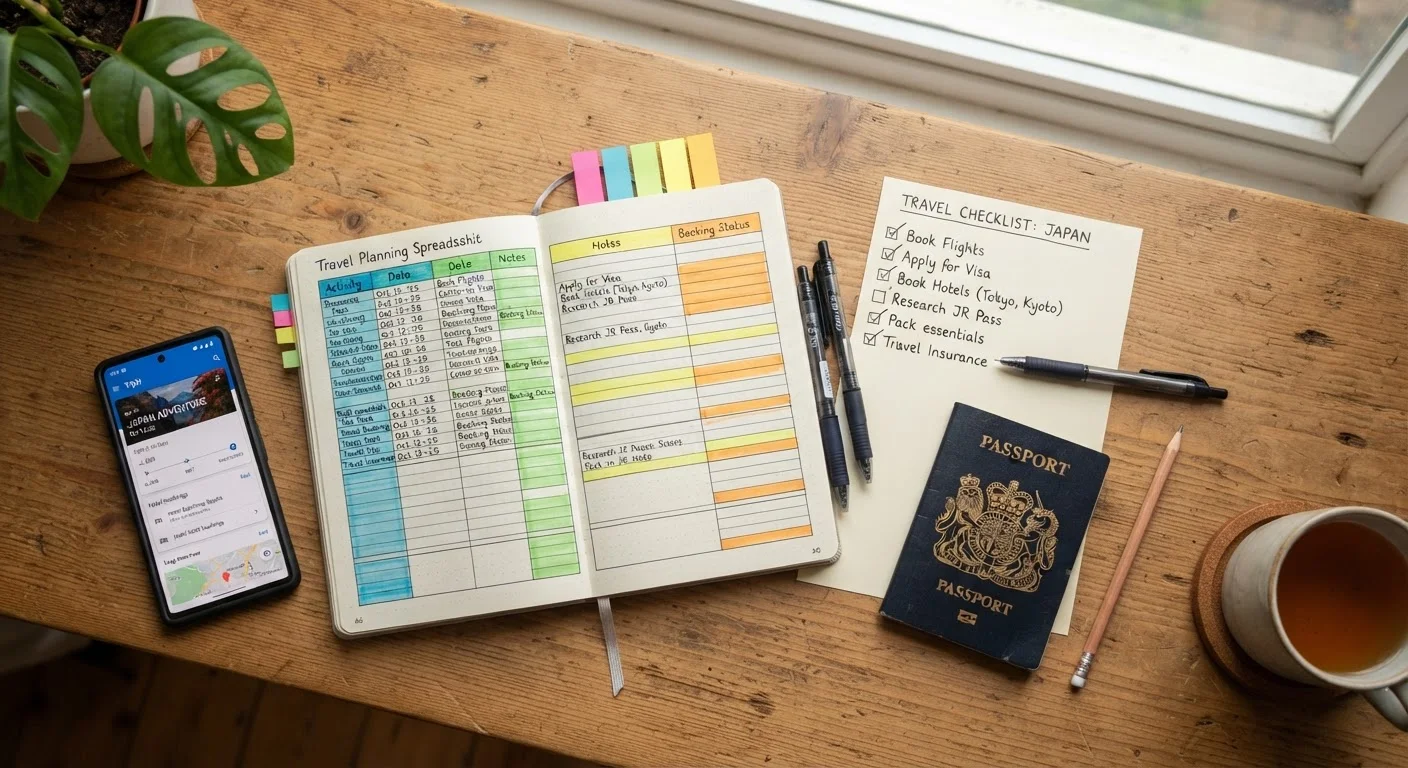
Most seasoned travelers don't pick one tool - they assign each tool to what it does best. A common pattern: use a spreadsheet during the planning phase for budget comparisons and option tracking, migrate confirmed bookings into a travel app before departure, and carry a printed one-page trip summary as a paper backup.
The key is deciding before the trip which tool is authoritative for which type of information. If your flight details live in the app but you've also written them on paper, and the app shows a gate change that the paper doesn't reflect, you need to know which one to trust. Assign roles intentionally.
However you organize your trip, leave room for the unplanned. Our piece on building an itinerary that leaves room to breathe makes a strong case for why the best-organized trips still hold open space for spontaneity.