

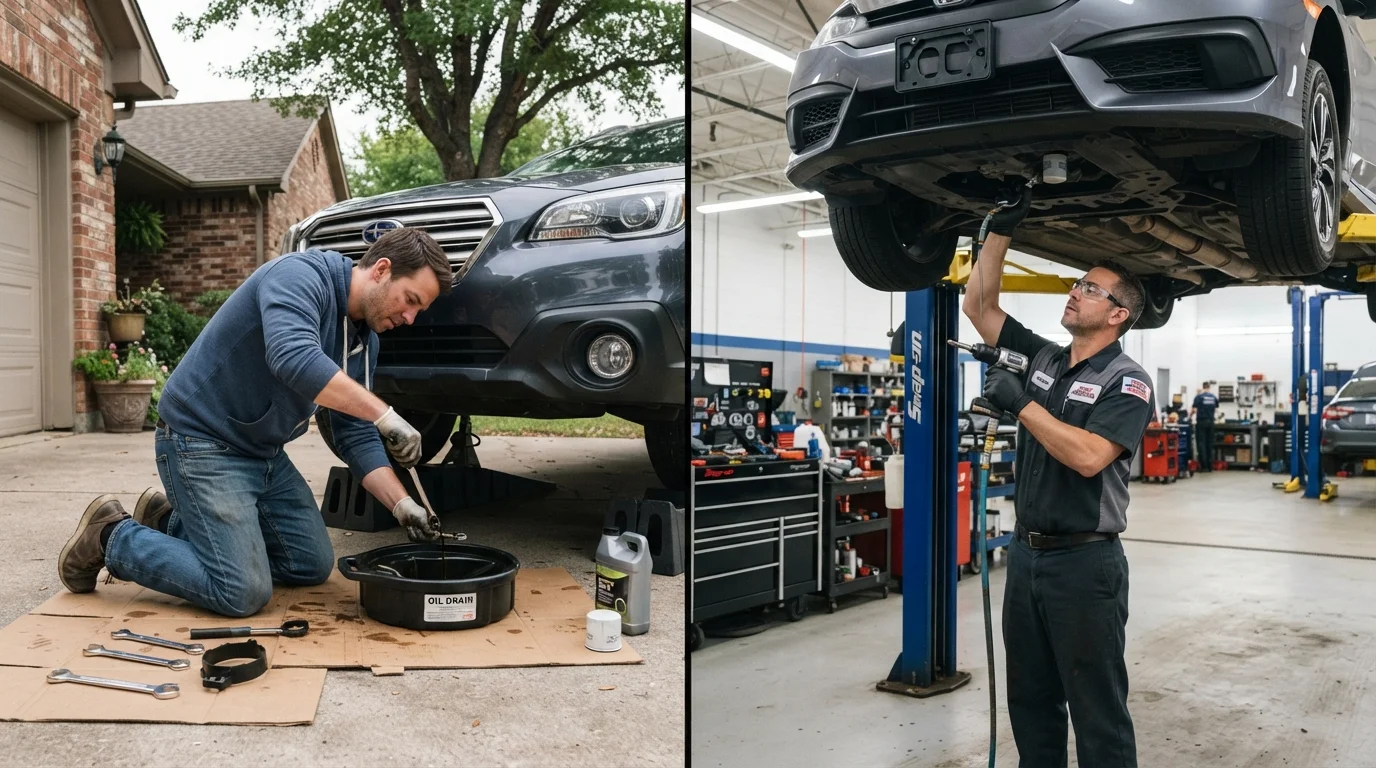
Key Takeaways
- Routine tasks like oil changes and air filter replacements are manageable for most home mechanics with basic tools.
- Complex jobs involving brakes, suspension, or electronics typically require professional diagnostic equipment and expertise.
- DIY maintenance can reduce labor costs but carries risk if performed incorrectly on safety-critical systems.
- Following your vehicle's maintenance schedule is essential whether you do the work yourself or use a shop.
- Misdiagnosed or improperly completed repairs can void warranties and increase long-term ownership costs.
Reduces labor costs on routine, low-complexity tasks
Labor charges often account for 50-70% of a shop invoice. Performing straightforward services yourself eliminates that cost on jobs where skill requirements are genuinely modest.
Builds mechanical familiarity with your own vehicle
Drivers who perform basic maintenance tend to notice early warning signs - unusual sounds, fluid leaks, worn components - before they escalate into expensive failures.
Flexible scheduling with no appointment wait
DIY work happens on your timeline, which can matter when a service is overdue and shop appointments are days out.
Full control over parts quality and fluid specifications
You can source parts that meet or exceed OEM specifications and verify that the exact fluids required by your owner's manual are being used, without relying on a shop's stock.
Errors on safety-critical systems carry serious consequences
Brake, steering, and suspension components are not forgiving of installation mistakes. An improperly seated brake pad or a loose tie rod end can create dangerous driving conditions.
Modern diagnostics require professional-grade equipment
Many fault conditions require live data analysis, bi-directional scan tools, and manufacturer-specific software that go well beyond the capability of consumer OBD-II readers.
Upfront tool investment reduces short-term savings
Jacks, jack stands, torque wrenches, and specialty sockets represent real costs that may take several service cycles to recoup, particularly for infrequent repairs.
May affect warranty coverage if not documented correctly
Some manufacturer or extended warranties require service records from licensed facilities. DIY work, even if performed correctly, may complicate warranty claims if documentation standards aren't met.
Risk of misdiagnosis without professional context
Replacing parts based on symptoms alone - rather than confirmed diagnosis - is a common and costly DIY mistake, particularly with electrical or sensor-related faults.
Our Verdict
DIY car maintenance offers genuine savings and self-sufficiency for straightforward, low-risk tasks - but it's not the right call for every job. Safety-critical systems, modern electronic diagnostics, and complex component replacements genuinely benefit from professional shop expertise and equipment. A hybrid approach, handling the easy stuff yourself while trusting a qualified technician with the complicated work, typically delivers the best outcomes for most drivers.
Drivers who are comfortable with basic tools, willing to research procedures carefully, and understand their own limits will get the most from a DIY-first strategy.
What DIY Maintenance Actually Looks Like
Doing your own car maintenance doesn't mean rebuilding an engine in your garage. For most everyday drivers, it means handling a defined set of routine services that require modest tools, a clean workspace, and careful attention to the vehicle's owner manual. Tasks such as replacing the engine air filter, swapping wiper blades, topping off fluids, and changing the oil and filter fall within reach for anyone willing to follow published procedures and use the correct parts.
These jobs share a common profile: they're low-risk if done incorrectly, well-documented, and don't typically require specialized equipment. Before attempting any maintenance, consult your vehicle's maintenance schedule to confirm what's due and what specifications apply - torque values, fluid grades, and filter part numbers vary significantly between makes and models.
If you're new to car ownership, a first-time owner's orientation can help you build confidence around core concepts before picking up a wrench.
Reduces labor costs on routine, low-complexity tasks
Labor charges often account for 50-70% of a shop invoice. Performing straightforward services yourself eliminates that cost on jobs where skill requirements are genuinely modest.
Builds mechanical familiarity with your own vehicle
Drivers who perform basic maintenance tend to notice early warning signs - unusual sounds, fluid leaks, worn components - before they escalate into expensive failures.
Flexible scheduling with no appointment wait
DIY work happens on your timeline, which can matter when a service is overdue and shop appointments are days out.
Full control over parts quality and fluid specifications
You can source parts that meet or exceed OEM specifications and verify that the exact fluids required by your owner's manual are being used, without relying on a shop's stock.
Where DIY Falls Short
Not every maintenance task belongs in the driveway. Modern vehicles are increasingly integrated systems - a brake job isn't just swapping pads; it often involves bleeding hydraulic lines, resetting electronic parking brake actuators, and verifying rotor thickness within manufacturer tolerances. Suspension work requires alignment afterward, a service that demands precision equipment found only in shops. Transmission service and timing components carry consequences severe enough that an error can mean engine replacement.
Beyond complexity, there's the matter of diagnostics. When a warning light illuminates, a professional-grade scan tool reads fault codes in context - not just a code number, but live data that reveals whether a sensor is genuinely failing or simply reporting a symptom of a deeper issue. Consumer-grade OBD-II readers provide limited visibility by comparison.
Errors on safety-critical systems carry serious consequences
Brake, steering, and suspension components are not forgiving of installation mistakes. An improperly seated brake pad or a loose tie rod end can create dangerous driving conditions.
Modern diagnostics require professional-grade equipment
Many fault conditions require live data analysis, bi-directional scan tools, and manufacturer-specific software that go well beyond the capability of consumer OBD-II readers.
Upfront tool investment reduces short-term savings
Jacks, jack stands, torque wrenches, and specialty sockets represent real costs that may take several service cycles to recoup, particularly for infrequent repairs.
May affect warranty coverage if not documented correctly
Some manufacturer or extended warranties require service records from licensed facilities. DIY work, even if performed correctly, may complicate warranty claims if documentation standards aren't met.
Risk of misdiagnosis without professional context
Replacing parts based on symptoms alone - rather than confirmed diagnosis - is a common and costly DIY mistake, particularly with electrical or sensor-related faults.
Even tire services involve more nuance than they appear to. Rotation, balancing, and alignment are distinct procedures with different equipment requirements, and skipping any one of them has real consequences for tire longevity and vehicle handling.
The Real Cost Comparison
Labor is typically the largest line item on a shop invoice, so DIY saves the most where labor hours are highest relative to parts cost. An oil change at a shop might run $60-$120 depending on oil type and location; performing it yourself might cost $30-$50 in materials. Over a year, that difference adds up - but it's offset if you factor in the cost of tools you don't yet own.
50-70%
Portion of repair bills attributed to labor
Industry estimates consistently show labor as the dominant cost component in most automotive repair invoices, making it the primary savings lever for capable DIYers.
~$30-$50
Typical DIY oil change material cost
Using conventional or synthetic oil appropriate to your vehicle's specification, a home oil change generally costs significantly less than a shop service of the same type.
The calculation shifts dramatically on complex repairs. An incorrectly installed component - a brake caliper, a wheel bearing, or a fuel injector - can damage surrounding parts and create safety hazards, turning a $200 DIY attempt into a $1,500 shop repair. Deferred or botched maintenance consistently costs more in the long run than paying for professional service the first time.
Understanding the full financial picture of vehicle ownership means weighing not just parts and labor, but risk - including warranty implications if dealer-required procedures aren't documented correctly.
Making the Right Call for Your Situation
A practical framework: if a task appears in a beginner maintenance guide, requires no special tooling, and carries no safety-critical consequences if done incorrectly, it's a reasonable DIY candidate. If it touches braking, steering, fuel delivery, or emissions systems - or if your vehicle is under a manufacturer or extended warranty - shop-level service is worth the cost.
Warranty and Documentation Considerations
If your vehicle is under a manufacturer's warranty or a third-party extended warranty, review the service documentation requirements before performing your own maintenance. The Magnuson-Moss Warranty Act generally prevents manufacturers from voiding warranties solely because an owner performs their own maintenance - but you may need to retain receipts for parts and fluids to demonstrate that correct specifications were followed. When in doubt, consult your warranty agreement or contact the issuer directly.
Modern vehicles have also grown more software-dependent. Procedures that once required only mechanical skill - such as replacing a battery or recalibrating advanced driver assistance systems (ADAS) after windshield replacement - now require dealer-level software tools to complete properly. What a modern tune-up actually includes illustrates how far today's service requirements have moved from the shade-tree era.
The smartest approach for most drivers is a division of labor: handle oil changes, filters, and fluid checks yourself, and budget for professional service on anything that touches safety systems or requires diagnostic equipment. That combination keeps ownership costs manageable without compromising reliability or safety.