

Key Takeaways
- Dealer financing is convenient but may carry higher interest rates than a bank or credit union loan.
- Getting pre-approved by your own bank gives you a rate benchmark before stepping into a dealership.
- Dealer-arranged loans can sometimes include manufacturer incentive rates not available elsewhere.
- The annual percentage rate (APR), not the monthly payment, is the most important number to compare.
- Reading the full loan contract carefully - including add-ons - protects you from inflated costs.
One-stop convenience at the dealership
Dealer financing combines vehicle selection and loan paperwork in a single visit, reducing the back-and-forth of arranging separate financing. For buyers with time constraints, this streamlined process has real practical value.
Access to manufacturer promotional rates
Automakers occasionally subsidize low or zero-percent APR offers through their captive finance companies. These rates are exclusively available through dealer financing and can represent significant savings on new vehicles.
Multiple lender bids submitted simultaneously
Dealerships work with a network of lenders, so they can often find approval options for buyers with varied credit histories, including those who might struggle to secure pre-approval independently.
Dealer markup can inflate your interest rate
Dealers may add a percentage to the lender's base rate as their compensation - a practice called dealer reserve. This markup is not always disclosed upfront and can meaningfully increase the total cost of the loan.
Add-on products inflate the financed amount
Finance offices routinely offer gap insurance, paint protection, and extended service contracts bundled into the loan. Rolling these into financing means you pay interest on them for the life of the loan, increasing total cost substantially.
Negotiating vehicle price and rate simultaneously is difficult
When the dealer controls both the sale price and the loan terms, it can be harder to isolate whether you're getting a fair deal on each. Focusing only on monthly payment can obscure an unfavorable total cost.
Our Verdict
Neither dealer financing nor bank lending is universally better - the right choice depends on your credit profile, the incentives available, and how thoroughly you've shopped rates. Dealer financing wins on convenience and occasionally on manufacturer-subsidized rates; a bank or credit union typically wins on transparency and rate competitiveness for well-qualified borrowers. Getting pre-approved before visiting a dealership costs nothing and gives you negotiating power either way.
Shoppers who pre-approve through their own bank and then compare that offer against dealer financing before signing are best positioned to minimize total interest paid.
How Each Financing Path Works
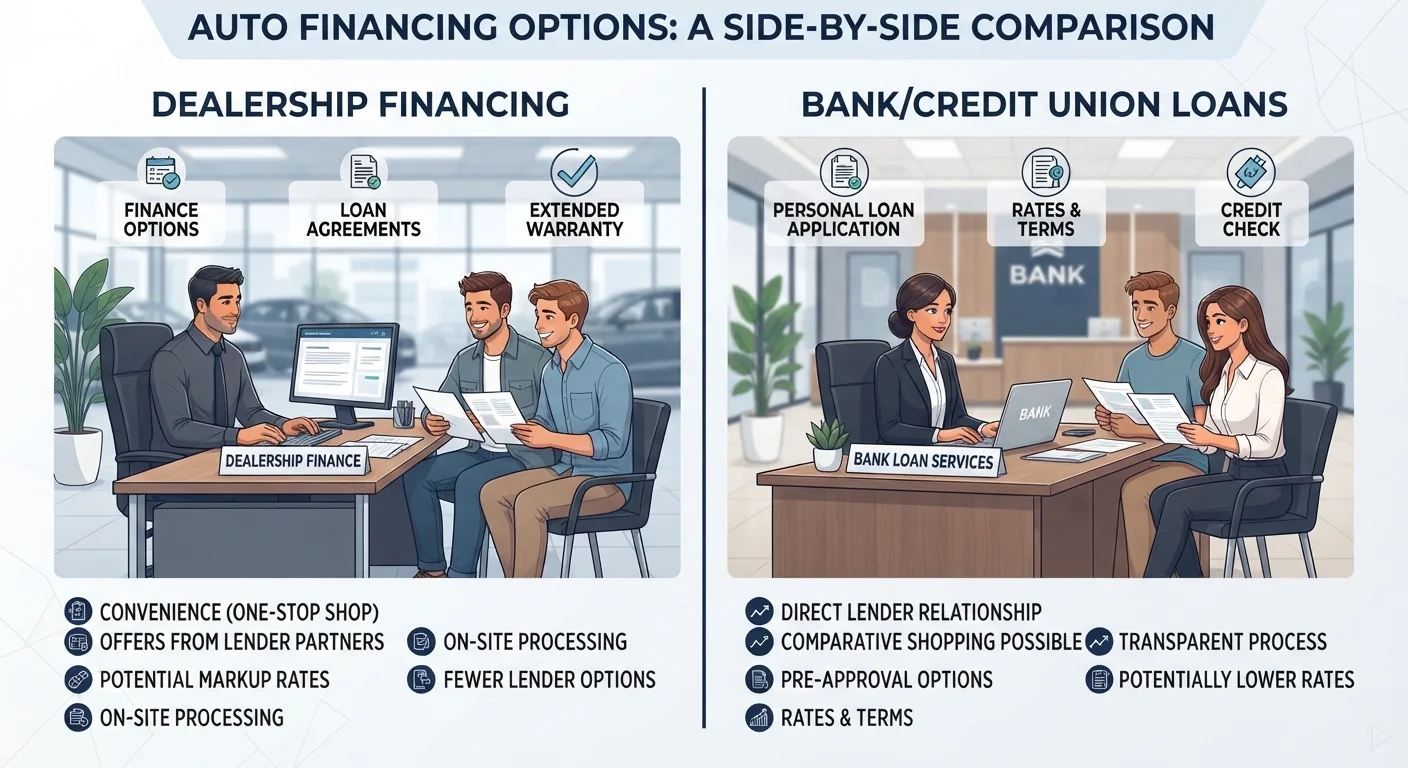
When you finance a car, you're borrowing money to pay the purchase price and repaying it - plus interest - over a set term. The two most common paths are direct lending (arranging a loan through your bank, credit union, or an online lender before you shop) and dealer-arranged financing (letting the dealership's finance and insurance office find a lender for you on the spot).
With direct lending, you secure a loan commitment - including a specific APR and term - before entering a dealership. That pre-approval letter functions like cash: you know your ceiling and your rate. With dealer financing, the dealership submits your application to multiple lenders simultaneously and presents you with a loan offer, often packaging it alongside the vehicle sale negotiation. For a plain-English breakdown of terms like APR and total cost of ownership, see the Car Ownership Cost Glossary.
Pros and Cons of Dealer Financing
Dealer financing appeals largely because of its speed and simplicity - you can drive off the lot the same day without arranging a separate loan. It also occasionally offers access to manufacturer-subsidized rates (sometimes called "promotional APR") that are only available through the automaker's captive finance arm and cannot be matched by outside lenders.
One-stop convenience at the dealership
Dealer financing combines vehicle selection and loan paperwork in a single visit, reducing the back-and-forth of arranging separate financing. For buyers with time constraints, this streamlined process has real practical value.
Access to manufacturer promotional rates
Automakers occasionally subsidize low or zero-percent APR offers through their captive finance companies. These rates are exclusively available through dealer financing and can represent significant savings on new vehicles.
Multiple lender bids submitted simultaneously
Dealerships work with a network of lenders, so they can often find approval options for buyers with varied credit histories, including those who might struggle to secure pre-approval independently.
On the downside, dealers earn a fee - often called a dealer reserve - when they mark up the interest rate a lender quotes them. This markup is legal and common, but it means the rate presented to you may not be the lowest rate you qualified for. Be equally cautious about add-on products (extended warranties, gap insurance, credit life coverage) bundled into the loan, which can substantially increase the total financed amount. The Hidden Vehicle Fees covers these charges in detail.
Dealer markup can inflate your interest rate
Dealers may add a percentage to the lender's base rate as their compensation - a practice called dealer reserve. This markup is not always disclosed upfront and can meaningfully increase the total cost of the loan.
Add-on products inflate the financed amount
Finance offices routinely offer gap insurance, paint protection, and extended service contracts bundled into the loan. Rolling these into financing means you pay interest on them for the life of the loan, increasing total cost substantially.
Negotiating vehicle price and rate simultaneously is difficult
When the dealer controls both the sale price and the loan terms, it can be harder to isolate whether you're getting a fair deal on each. Focusing only on monthly payment can obscure an unfavorable total cost.
Pros and Cons of Bank or Credit Union Financing
Arranging your own financing puts the APR negotiation in your hands before you ever discuss a monthly payment with a salesperson. Credit unions, in particular, are member-owned nonprofits that often post competitive rates on auto loans and have straightforward terms.
~0.5-1.5%
Typical dealer rate markup range
Industry analyses suggest dealers commonly mark up lender-quoted rates by roughly 0.5 to 1.5 percentage points, though this varies by lender agreement and state regulations.
72-84 months
Increasingly common auto loan terms
Experian's State of the Automotive Finance Market reports have tracked a steady rise in loans with 72- and 84-month terms, which reduce monthly payments but increase total interest paid.
The limitation is practical: pre-approval takes time, and your pre-approved rate may expire (typically within 30-45 days). If you're buying a brand-new vehicle and the manufacturer is running a 0% or low-APR promotional rate, your bank almost certainly cannot match it - so always ask the dealer what incentive financing is available before assuming your outside loan wins on rate alone.
For broader context on how loan repayment strategy affects long-term cost, the Debt Avalanche vs. Debt Snowball explains how to structure payoff for high-interest debt.
Making the Smarter Choice for Your Situation
The single most effective move available to any car buyer is to get pre-approved before visiting a dealership. This costs nothing, doesn't obligate you, and arms you with a concrete rate to compare against whatever the dealer presents. If the dealer can beat your pre-approved APR - even after you've accounted for any add-ons - dealer financing may be the better deal. If not, your outside loan wins.
Compare APR, Not Just Monthly Payment
Monthly payment comparisons are easy to manipulate by extending the loan term. Always ask for the APR and the total amount repaid over the full loan term before comparing offers. A lower monthly payment on a 72-month loan can cost more in total interest than a higher payment on a 48-month loan. Lenders are required by federal Truth in Lending Act regulations to disclose APR and total finance charges in writing before you sign.
When comparing offers, focus on the total amount repaid over the life of the loan, not just the monthly payment. A longer loan term lowers monthly payments but increases total interest paid and extends the period during which you may owe more than the car is worth - a position known as being "underwater" on the loan. If you're also weighing whether to buy at all, the Leasing vs. Buying breakdown offers a data-grounded comparison of both paths.
This article is for general informational purposes only and does not constitute personalized financial or legal advice. Consult a qualified financial professional regarding your individual circumstances.