

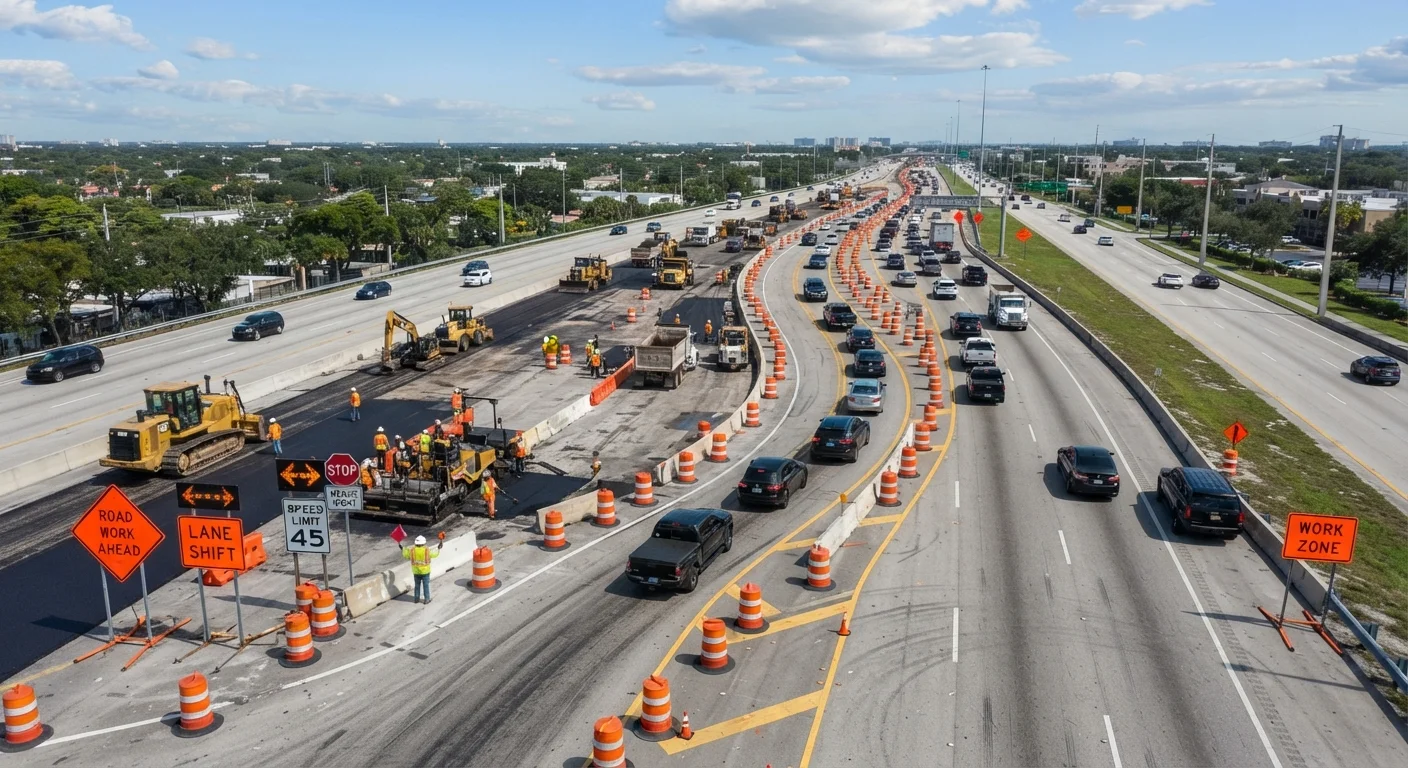
Key Takeaways
- Posted work zone speed limits are legally enforceable and fines are typically doubled in most U.S. states.
- Scanning ahead at least 12 seconds gives you time to react to lane shifts before they become sudden surprises.
- Following distance should increase to at least four seconds in active work zones where traffic stops unpredictably.
- Flaggers have the same legal authority as posted signs - treat their signals as you would a red traffic light.
- Merging early or using a coordinated zipper merge reduces rear-end crashes at lane closure points.
What you will need
Why Construction Zones Are Uniquely Hazardous
Work zones combine several risk factors that don't usually appear together on ordinary roads: reduced lane widths, shifting lane positions, abrupt speed changes, workers on foot within feet of moving traffic, and drivers who are uncertain about what comes next. According to the Federal Highway Administration, thousands of people are injured in work zone crashes in the United States each year, with rear-end collisions accounting for a disproportionate share.
The challenge is that construction zones are dynamic. A lane that was open yesterday may be closed today, and a detour that existed last week may have been removed. This unpredictability demands a different mindset than routine highway driving - one closer to the active scanning described in situational awareness techniques used by experienced drivers.
Work Zone Fines Are Not Negotiable
In the vast majority of U.S. states, fines for speeding and moving violations inside a designated work zone are doubled by law - and some states add mandatory license-point penalties as well. These elevated penalties apply even when no workers are physically present if the zone is posted. Always obey posted limits from the first advance warning sign, not just the moment you see cones.
Speed is the single biggest controllable variable. At lower speeds, reaction time translates to more stopping distance, and the severity of any impact is substantially reduced. Work zone speed limits are set based on worker proximity and sight-line constraints - they are not arbitrary.
What to Do Before You Enter the Zone
Preparation starts before the first warning sign appears. Check your state's DOT traveler information service or 511 line for scheduled lane closures on your route. If the project is long-running, construction patterns often change on a weekly basis as the work progresses.
Check Traffic Reports Before You Leave
State DOT websites and 511 traveler information lines publish scheduled lane closures for major projects. A 60-second check before a highway trip can help you choose an alternate route or adjust departure timing to avoid the heaviest construction delays.
Ensure your vehicle is in safe working order before any significant drive - reliable brakes, properly inflated tires, and functioning turn signals matter more in a compressed work zone than on an open road. Our car maintenance hub covers the key checks that keep your vehicle performing reliably in demanding conditions.
Don't Rely on GPS Alone
Navigation apps often lag days or weeks behind active construction changes. Lane closures, detours, and temporary signal patterns may not appear in real-time map data. Use posted signage as your primary guide and treat GPS routing as supplementary information only.
Once on the road, turn off any audio that competes with your attention. Podcasts and phone calls - even hands-free - measurably reduce the cognitive bandwidth available for hazard detection.
Step-by-Step: Navigating the Zone
Follow these steps in sequence each time you approach and move through a construction zone. The steps build on each other - reading signs early makes speed reduction gradual, which makes lane changes less abrupt, which makes the overall transit safer for everyone in the zone.
What you will need
Read Advance Warning Signs Early
Construction zones begin well before the first orange barrel. Advance warning signs - often placed 500 feet to half a mile ahead on highways - tell you what's coming: lane closures, reduced speed limits, flaggers, or detours. Begin reducing speed gradually as soon as you see the first sign rather than waiting until you reach the transition zone.
Reduce Speed and Match the Posted Limit
Work zone speed limits apply from the first posted sign, not just the narrow section where workers are present. Slow down smoothly and progressively rather than braking hard at the last moment. On multi-lane roads, check your mirrors before reducing speed so trailing drivers have time to react. This is especially relevant because, as discussed in research on reduced-limit zones, drivers routinely underestimate how fast they're traveling in familiar-looking corridors.
Increase Your Following Distance
The standard three-second following rule is insufficient in a work zone. Traffic can stop with little warning due to flaggers, equipment crossings, or abrupt lane merges. Increase your gap to at least four seconds - more if the surface is wet. This cushion gives you space to stop without rear-ending the vehicle ahead and reduces the pressure on drivers behind you. For a deeper look at how wet surfaces compound stopping distances, see driving in heavy rain.
Obey Flaggers Without Hesitation
Flaggers - workers in high-visibility vests directing traffic - carry the same legal authority as a traffic signal. When a flagger signals you to stop, stop completely. When they wave you through, proceed at the posted speed without accelerating aggressively. Make eye contact when possible to confirm the flagger's intent before moving. Never attempt to pass a flagging station without a clear signal to proceed.
Handle Lane Shifts and Merges Deliberately
When a lane narrows or closes, use the full available distance to merge - don't race to the closure point. Many state DOTs endorse the zipper merge: both lanes travel to the merge point, then vehicles alternate one by one. This reduces overall queue length and rear-end risk compared to early single-file merging. Signal your intentions clearly and match speed with adjacent traffic before moving over. The same spatial judgment used when merging onto a highway applies here.
Eliminate Distractions for the Duration
Work zones demand continuous visual scanning. Set your phone to Do Not Disturb, finish any food or drink before entering the zone, and brief any passengers that conversation may pause. Good situational awareness requires that your eyes scan the full zone - workers, barriers, equipment, signs, and surrounding vehicles - not just the car directly in front of you.
After clearing the zone, resume normal speed only after you pass the posted "End Road Work" or "Resume Speed" sign - accelerating inside the zone while workers are still present is a common mistake.