

Key Takeaways
- Hands-free calling is legal in most U.S. states, but laws vary significantly by jurisdiction.
- Removing the phone from your hand eliminates one physical risk, but cognitive distraction from conversation remains.
- Research suggests hands-free calls can impair reaction time similarly to handheld calls in some conditions.
- Situational complexity - heavy traffic, merging, poor weather - amplifies the cognitive cost of any phone conversation.
- No phone call, hands-free or otherwise, is entirely risk-free while driving.
Both hands remain on the steering wheel
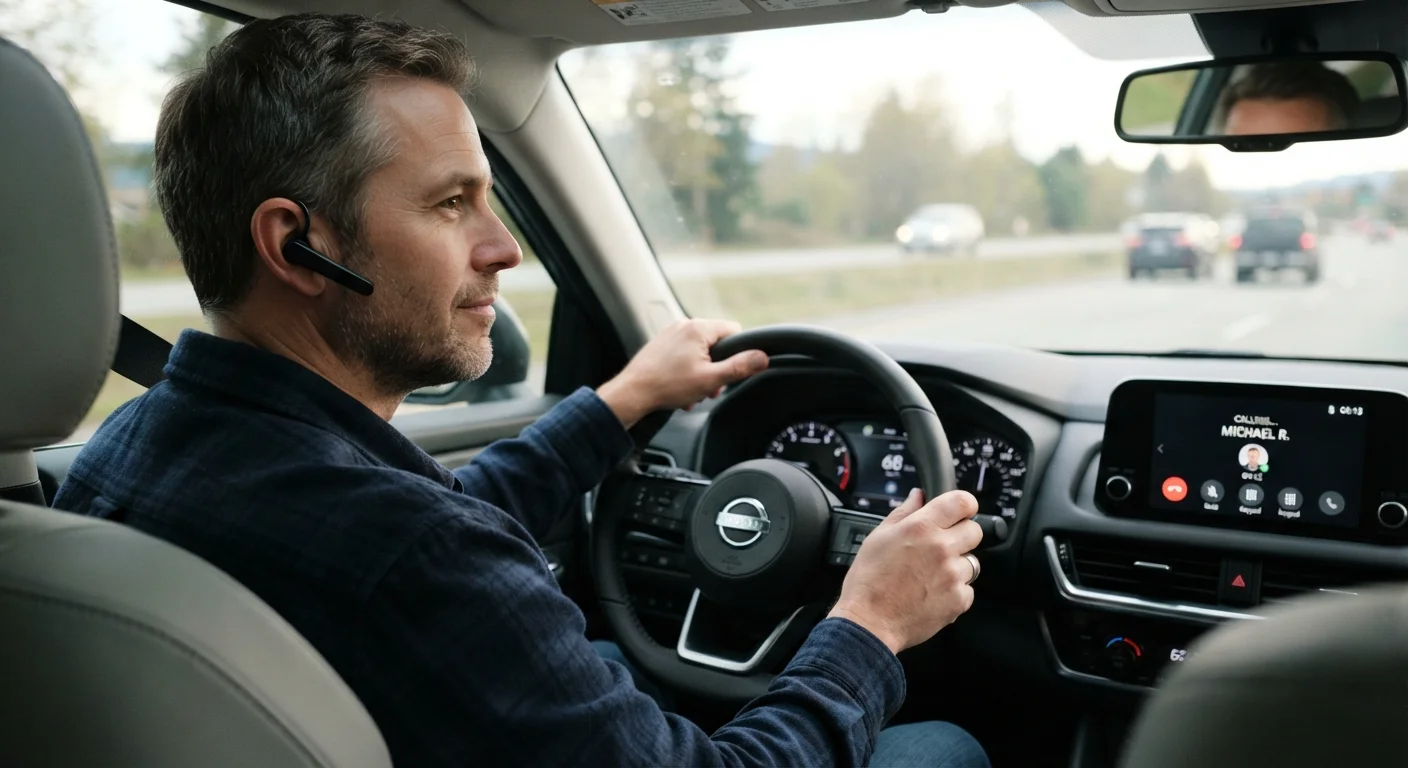
Maintaining a two-handed grip gives drivers full physical control of the vehicle, which is critical for emergency steering or sudden braking.
Legal compliance in most U.S. states
The majority of states prohibit handheld phone use while permitting hands-free calls, meaning hands-free systems keep drivers on the right side of the law and avoid fines.
Eyes stay on the road more consistently
Without a phone to glance at or hold, the visual distraction of checking a screen or looking at a device is largely eliminated.
Enables necessary communication for professional drivers
For people whose work requires them to be reachable - delivery drivers, field technicians, real estate agents - hands-free systems offer a practical way to stay accessible without removing hands from the wheel.
Integrated systems reduce interaction friction
Built-in vehicle systems with voice commands and steering-wheel controls minimize the physical steps needed to manage a call, reducing momentary manual distraction.
Cognitive distraction persists despite hands-free hardware
Carrying on a conversation occupies working memory and narrows the brain's attention to the driving environment, even when no physical interaction with a device occurs.
Reaction times can be measurably slower
Research has found that drivers engaged in phone conversations - hands-free or otherwise - may respond to hazards more slowly than undistracted drivers, with some studies measuring delays of several tenths of a second.
Remote callers do not adjust to driving conditions
Unlike a passenger who can see traffic and instinctively pause conversation, a caller on the phone is unaware of the driver's environment and may sustain demanding dialogue at the worst moment.
Risk rises sharply in complex driving situations
Merging, navigating intersections, driving in adverse weather, and operating in heavy traffic all impose high baseline cognitive loads - adding a phone call to these situations compounds the distraction risk significantly.
Emotional or complex calls are particularly hazardous
A stressful personal call or difficult work discussion can consume disproportionate mental bandwidth, leaving insufficient attention for the driving task regardless of the hands-free setup.
Driver confidence may exceed actual safety margin
Drivers using hands-free technology sometimes overestimate how safe they are, potentially taking on harder driving conditions or longer call durations than are advisable.
Our Verdict
Hands-free calling offers a meaningful safety improvement over holding a phone - it keeps both hands on the wheel and is broadly legal across the U.S. However, cognitive distraction from conversation is a real, documented risk that hands-free hardware does not eliminate. Drivers should treat any phone call while driving as an added workload, not a safe alternative.
Hands-free calling is most appropriate for low-complexity driving situations - highway stretches with light traffic - and for brief, simple conversations rather than emotionally demanding or complex discussions.
Why the Hands-Free Debate Matters
Nearly every American driver has taken or made a phone call behind the wheel. Hands-free devices - Bluetooth earpieces, integrated car systems, speakerphone - emerged as the assumed solution to the dangers of holding a phone while driving. Many states codified that assumption into law, banning handheld use while permitting hands-free calls.
But the science has grown more complicated. Researchers distinguish between manual distraction (taking hands off the wheel), visual distraction (taking eyes off the road), and cognitive distraction (taking mental attention off driving). Hands-free technology addresses the first two - but the third is harder to engineer away. Understanding all three dimensions helps drivers make informed decisions rather than simply legal ones.
Situational awareness - the ability to scan, predict, and respond to road conditions - is precisely the capacity that cognitive distraction erodes.
The Case For Hands-Free Calling
There are genuine, evidence-supported reasons why hands-free calling is considered an improvement over handheld phone use.
Both hands remain on the steering wheel
Maintaining a two-handed grip gives drivers full physical control of the vehicle, which is critical for emergency steering or sudden braking.
Legal compliance in most U.S. states
The majority of states prohibit handheld phone use while permitting hands-free calls, meaning hands-free systems keep drivers on the right side of the law and avoid fines.
Eyes stay on the road more consistently
Without a phone to glance at or hold, the visual distraction of checking a screen or looking at a device is largely eliminated.
Enables necessary communication for professional drivers
For people whose work requires them to be reachable - delivery drivers, field technicians, real estate agents - hands-free systems offer a practical way to stay accessible without removing hands from the wheel.
Integrated systems reduce interaction friction
Built-in vehicle systems with voice commands and steering-wheel controls minimize the physical steps needed to manage a call, reducing momentary manual distraction.
Beyond the hardware benefits, hands-free integration has improved significantly. Modern vehicles feature voice-activated dialing, steering-wheel call controls, and noise-canceling microphones that minimize the physical interaction needed to conduct a call. For professional drivers who must remain reachable, these systems represent a practical compromise between communication needs and road safety.
The Case Against Hands-Free Calling
The limitations of hands-free calling are well-documented, and they challenge the widespread assumption that it is substantially safer than any alternative.
Cognitive distraction persists despite hands-free hardware
Carrying on a conversation occupies working memory and narrows the brain's attention to the driving environment, even when no physical interaction with a device occurs.
Reaction times can be measurably slower
Research has found that drivers engaged in phone conversations - hands-free or otherwise - may respond to hazards more slowly than undistracted drivers, with some studies measuring delays of several tenths of a second.
Remote callers do not adjust to driving conditions
Unlike a passenger who can see traffic and instinctively pause conversation, a caller on the phone is unaware of the driver's environment and may sustain demanding dialogue at the worst moment.
Risk rises sharply in complex driving situations
Merging, navigating intersections, driving in adverse weather, and operating in heavy traffic all impose high baseline cognitive loads - adding a phone call to these situations compounds the distraction risk significantly.
Emotional or complex calls are particularly hazardous
A stressful personal call or difficult work discussion can consume disproportionate mental bandwidth, leaving insufficient attention for the driving task regardless of the hands-free setup.
Driver confidence may exceed actual safety margin
Drivers using hands-free technology sometimes overestimate how safe they are, potentially taking on harder driving conditions or longer call durations than are advisable.
The Passenger vs. Remote Caller Difference
Studies consistently show that talking to a passenger produces less cognitive impairment than talking on a phone - hands-free or handheld. Researchers attribute this partly to the shared situational awareness between driver and passenger: a passenger naturally quiets when traffic demands attention. A remote caller lacks any awareness of the driving environment and cannot self-regulate. This distinction is important when assessing the real-world risk of hands-free calls.
The cognitive load of a phone conversation is qualitatively different from talking to a passenger. A passenger shares the driving environment - they naturally pause when traffic gets heavy or a hazard appears. A remote caller has no such awareness and may sustain demanding conversation exactly when the driver needs full attention.
What the Research Actually Shows
Studies from the National Safety Council and academic institutions such as the University of Utah have found that hands-free calls can produce measurable impairment in driver response times and hazard detection, even when the driver's hands remain on the wheel. The human brain does not multitask so much as rapidly switch attention - and in that switching, critical information can be missed.
4x
Crash risk increase during phone calls
The National Safety Council has cited research estimating drivers using any phone - handheld or hands-free - are approximately four times more likely to be involved in a crash.
~37%
Reduction in brain activity devoted to driving
Carnegie Mellon University researchers found that listening to language on a phone reduced activity in the parietal lobe - the region associated with spatial processing - by approximately 37% compared to undistracted driving.
This does not mean all phone calls carry identical risk. A brief, low-stakes exchange - confirming a pickup time - differs meaningfully from a stressful business negotiation or emotionally charged personal call. Conversation complexity matters. So does driving complexity: the cognitive demand of navigating a busy urban intersection or merging onto a highway is already high without layering in a phone conversation. The interaction between those two demands is where accidents become more likely.
Drivers who want to understand how attention and focus degrade under competing demands may find parallels in research on concentration and distraction, which similarly shows that divided attention reduces performance quality even when individuals believe they are managing well.
Practical Guidance for Drivers
Given the trade-offs, a few principles can help drivers navigate hands-free use more safely:
- Use voice commands to initiate and end calls - avoid manually interacting with a device while moving.
- Defer complex or emotional conversations - if a call becomes demanding, it is appropriate to tell the caller you will ring back when parked.
- Increase following distance - a small buffer provides additional reaction time if attention momentarily lapses.
- Know your local laws - hands-free rules vary by state and sometimes by municipality; check official state DMV sources for current requirements.
- Recognize high-risk conditions - rain, heavy traffic, unfamiliar roads, and night driving all increase cognitive load. These are moments to let calls go to voicemail.
The safest call while driving remains no call at all. Hands-free technology narrows the risk gap meaningfully, but it does not close it.