

Why Road Markings Are More Than Paint
Road markings aren't decorative. Under the MUTCD - the federal standard governing signs, signals, and markings across all U.S. public roads - every line, arrow, and symbol has a defined legal meaning. Misreading them can result in moving violations, at-fault accidents, or worse. This guide decodes the most common markings American drivers encounter every day.
Yellow Lines: Separating Opposing Traffic
Yellow markings divide lanes carrying traffic in opposite directions. Their pattern - solid, dashed, or double - tells you exactly what passing is permitted.
- Single dashed yellow line: Passing is permitted from either side when safe. Common on rural two-lane roads with adequate sightlines.
- Single solid yellow line: Passing discouraged on your side; the driver on the dashed side may pass if safe.
- Double solid yellow lines: No passing in either direction. Crossing these lines - except to turn into a driveway or at an intersection - is illegal in every U.S. state.
- Double yellow with one dashed line: The driver adjacent to the dashed line may pass; the driver adjacent to the solid line may not. This asymmetric marking appears where sightlines differ by direction.
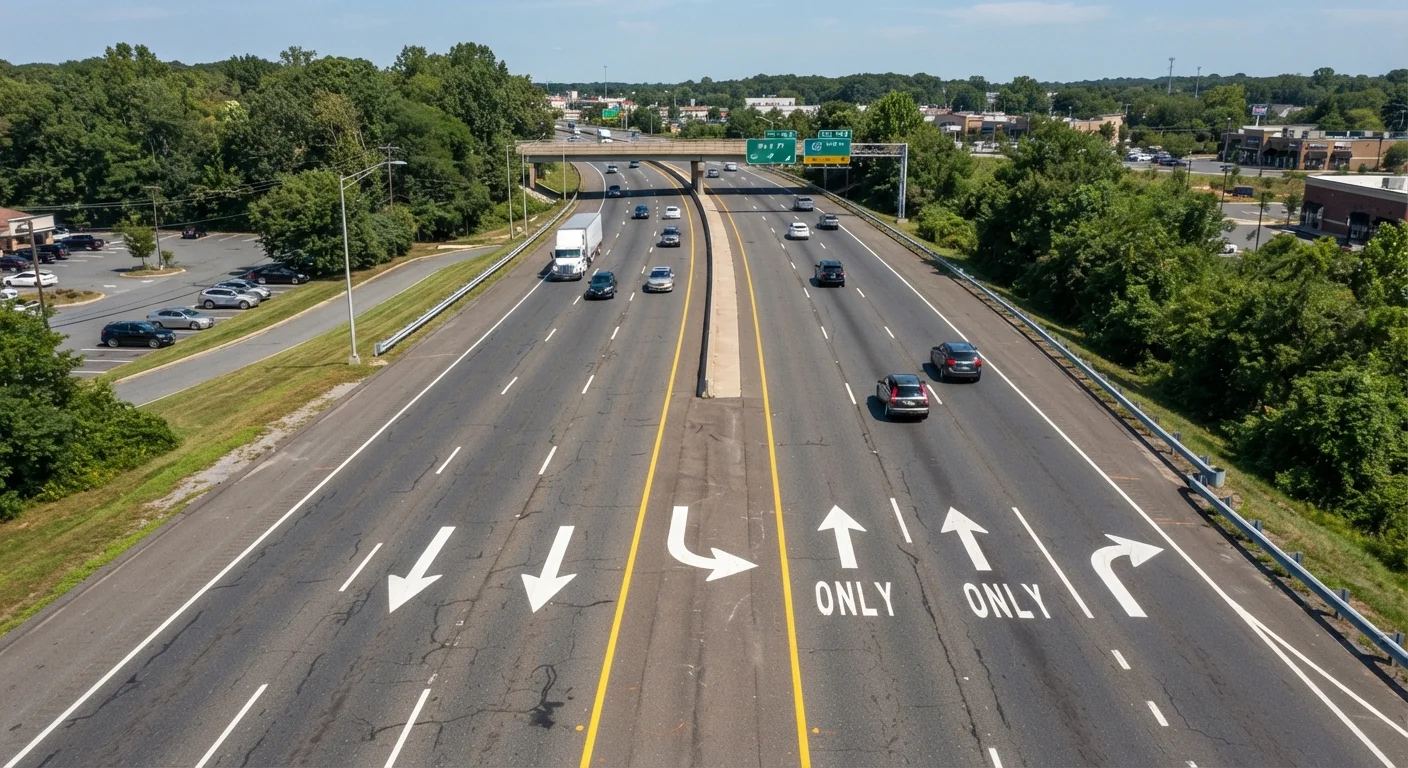
A wide yellow line flanking the edge of a divided highway marks the left boundary of a two-way roadway - drivers should never cross it into opposing lanes.
MUTCD
The Manual on Uniform Traffic Control Devices is the federal document that standardizes all traffic signs, signals, and pavement markings across U.S. public roads. It is published by the Federal Highway Administration.
Centerline
A yellow line or set of lines running along the middle of a roadway to separate opposing traffic flows. Its pattern (solid, dashed, or double) determines passing rules.
Edge Line
A solid white or yellow line at the edge of a travel lane indicating the pavement boundary. White marks the right edge; yellow marks the left edge on divided highways.
Gore Area
The triangular section of pavement between a through lane and an exit or entrance ramp. It is typically marked with diagonal white lines and is off-limits to through traffic.
HOV Lane
A High-Occupancy Vehicle lane reserved for vehicles carrying a minimum number of passengers, often separated by double solid white lines. Eligibility requirements vary by jurisdiction.
White Lines: Managing Same-Direction Traffic
White markings separate lanes or vehicles traveling in the same direction and define road edges.
- Dashed white lines: Lane boundaries you may cross when changing lanes safely.
- Solid white lines: Discourage lane changes - common near intersections, on-ramps, and bike lanes. Crossing them is not always illegal, but signals added risk.
- Double solid white lines: Do not cross. Used at high-occupancy vehicle (HOV) lane boundaries and some gore areas.
- White edge line: A solid white line at the road's right edge marks the pavement boundary. Crossing it means leaving the travel lane.
- Wide white stop line: A thick transverse line before an intersection indicating where vehicles must stop at a signal or sign.
Crosswalk lines, also white, mark pedestrian crossing zones. Drivers must yield to pedestrians within them in all 50 states. Understanding intersection rules - including who yields to whom - is covered in our guide to right-of-way at intersections.
Arrows, Words, and Symbols on the Pavement
Pavement markings extend well beyond lines. These are the most critical symbols drivers encounter:
3 million+
Miles of U.S. roads governed by MUTCD standards
The FHWA MUTCD applies to all public roads in the United States, spanning the nation's entire public road network.
~26%
Fatal crashes involving improper lane use or passing
According to NHTSA data, lane-departure and improper passing are consistently among the leading behavioral factors in fatal crashes.
- Turn arrows
- Solid arrows in a lane designate mandatory movement - a lane marked with a left-turn arrow only requires a left turn. A combination arrow permits multiple movements.
- "ONLY" and lane-use text
- Words painted on the pavement (e.g., BUS ONLY, BIKE ONLY) restrict lane use to specific vehicle types. Violations can result in fines.
- Railroad crossing markings
- An X with the letters RR - sometimes accompanied by a transverse stop line - warns of a crossing ahead. Commercial drivers are legally required to stop at many crossings regardless of signal status.
- Diagonal crosshatch (yellow)
- Yellow hatching between opposing turn lanes creates a buffer zone. Do not drive in it; in some states, occupying it constitutes a traffic violation.
- Bicycle lane markings
- A bicycle stencil with a white solid boundary defines a protected bike lane. Motor vehicles must not travel or park within it except to cross at designated points.
This article provides general educational information about road markings. Always consult your state's official driver manual and applicable traffic laws, as specific regulations may vary by jurisdiction.