

| U.S. intersection crash share | ~40% of all traffic crashes (Federal Highway Administration) |
| Roundabout entry rule | Yield to circulating traffic before entering |
| Four-way stop tiebreaker | Yield to the driver on your right (Uniform Vehicle Code, adopted by most U.S. states) |
| Yield sign legal requirement | Slow and stop if needed; gap must be safe before proceeding |
| Roundabout crash severity reduction | Up to 90% reduction in fatal crashes vs. traditional intersections (Insurance Institute for Highway Safety (IIHS)) |
| Most common four-way stop error | Rolling stop (not coming to a complete halt) |
Why Right-of-Way Confusion Is So Common
Right-of-way rules aren't instinctive - they're learned, and they vary by intersection type. Studies by the Federal Highway Administration have found that intersection-related crashes account for roughly 40% of all traffic collisions in the United States. Many of these involve drivers who simply weren't certain who was supposed to move first. This reference breaks down the legal priority order at the three most commonly misunderstood control types: roundabouts, four-way stops, and yield signs.
Understanding these rules isn't just about passing a driving test. It's the foundation of the situational awareness that separates confident, safe drivers from reactive ones. See how experienced drivers apply that awareness in our guide on reading traffic flow.
| U.S. intersection crash share | ~40% of all traffic crashes (Federal Highway Administration) |
| Roundabout entry rule | Yield to circulating traffic before entering |
| Four-way stop tiebreaker | Yield to the driver on your right (Uniform Vehicle Code, adopted by most U.S. states) |
| Yield sign legal requirement | Slow and stop if needed; gap must be safe before proceeding |
| Roundabout crash severity reduction | Up to 90% reduction in fatal crashes vs. traditional intersections (Insurance Institute for Highway Safety (IIHS)) |
| Most common four-way stop error | Rolling stop (not coming to a complete halt) |
Roundabouts: Yield Before You Enter, Not While You're Inside
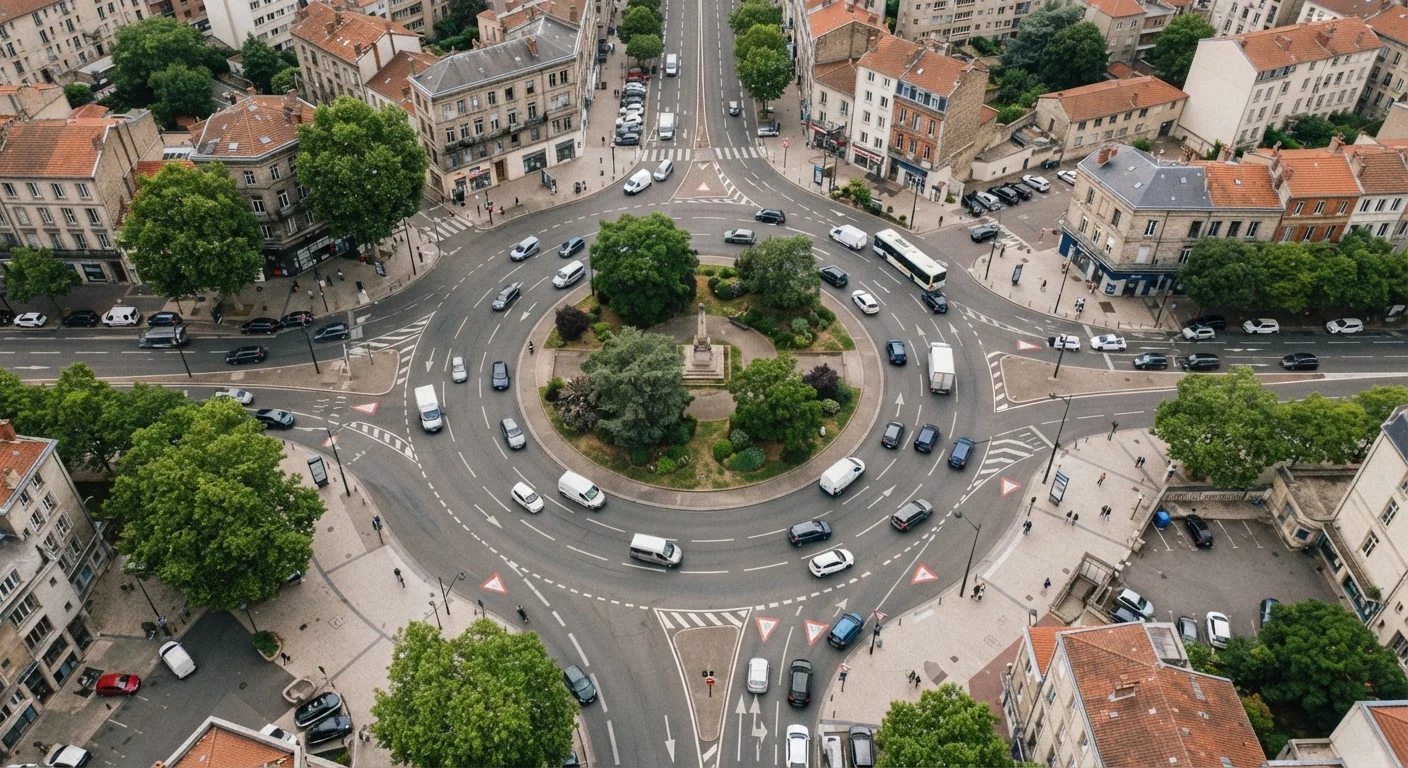
A roundabout is a one-way circular intersection where traffic flows counterclockwise around a central island. The governing rule is straightforward: vehicles already inside the circle have the right-of-way. Approaching drivers must yield at the dashed line before entering.
Key rules at a glance
- Yield at entry: Stop or slow at the yield line until there is a clear gap in circulating traffic.
- No stopping inside: Once you have entered, do not stop to yield to entering vehicles - you have priority.
- Lane discipline: In multi-lane roundabouts, choose your lane before entering. Right lanes are generally for right turns or straight-through movements; left lanes are for left turns or U-turns. Specific markings override general guidance.
- Pedestrians and cyclists: Yield to pedestrians in marked crosswalks both on approach and on exit. Cyclists may legally occupy a full lane.
Roundabouts are designed to eliminate T-bone and head-on collisions by removing conflicting left-turn movements. When everyone yields correctly on entry, they operate efficiently even at high traffic volumes.
Right-of-way
The legal priority one driver has to proceed through an intersection or roadway before another. Having the right-of-way doesn't eliminate the duty to drive safely - it establishes legal order of movement.
Circulating traffic
Vehicles already moving inside a roundabout. They hold the right-of-way over any vehicle attempting to enter the roundabout from an approach lane.
All-way stop
An intersection where every approach has a stop sign. All vehicles must come to a complete stop and proceed based on arrival order and the right-hand tiebreaker rule.
Yield
To legally give the right-of-way to other traffic or pedestrians. A yield obligation requires slowing and stopping if necessary until the path is safely clear.
Conflicting movement
Any traffic path that crosses or merges with another vehicle's intended path, creating potential for collision if both proceed simultaneously.
Four-Way Stops: Order, Ties, and the Right-Hand Rule
A four-way stop (also called an all-way stop) requires every vehicle to come to a complete stop before proceeding. Priority is determined by a clear hierarchy:
- First to stop, first to go. The vehicle that arrived and stopped first has priority. If you pulled up to the line before anyone else, you move first.
- Tie goes to the right. When two vehicles arrive simultaneously, the driver on the left yields to the driver on the right. This is the most frequently forgotten rule.
- Straight traffic over turning traffic. When arrival times are still unclear or vehicles face each other, vehicles going straight generally have priority over those turning left across traffic.
- Communicate before moving. Brief eye contact, a hand wave, or simply waiting an extra moment prevents the awkward simultaneous lurch that causes low-speed collisions.
One common error: treating a four-way stop like a yield sign and rolling through at low speed. Every approach requires a full stop - wheels must come to a complete rest - regardless of whether other vehicles appear to be present.
Yield Signs: Speed Management, Not a Full Stop
A yield sign means slow down, assess oncoming traffic, and give the right-of-way to vehicles already in or approaching the intersection or roadway. It does not automatically require stopping - but it does require stopping if a gap isn't available.
Where yield signs typically appear
- Roundabout entries (as covered above)
- Merge ramps where side-street traffic feeds into a main road
- T-intersections where the terminating road must yield to the through road
- Pedestrian crossings at mid-block locations
The legal obligation is clear: if yielding requires you to stop, you must stop. Failing to yield is one of the leading cited causes of angle and turning crashes at uncontrolled intersections.
Yield situations also arise in less obvious contexts - such as merging onto a highway, where the entering vehicle yields to highway traffic, and in construction zones where flaggers override all standard right-of-way rules.
Road markings reinforce yield obligations. Dashed lines at intersections signal yield points. For a full breakdown of what pavement markings legally require, see what road markings actually mean.