

Key Takeaways
- Match highway traffic speed before the acceleration lane ends - not after entering the travel lane.
- A safe merging gap is typically at least 4 seconds of following distance at highway speeds.
- Check your mirrors and blind spot before committing to a lane change - signal early.
- Braking on the on-ramp forces following traffic to brake too, increasing rear-end collision risk.
- Highway drivers are not legally required to yield to merging vehicles in most U.S. states, so gap selection is your responsibility.
What you will need
Why Merging Causes Problems Even for Experienced Drivers
Highway merging condenses several driving skills into a short window of time: speed management, gap judgment, mirror checks, signaling, and steering - all while tracking fast-moving traffic. Research from the Federal Highway Administration has consistently identified merging and weaving zones as disproportionate contributors to highway crashes, particularly rear-end and sideswipe collisions.
Part of the difficulty is legal: in most U.S. states, merging drivers are required to yield to highway traffic, not the other way around. Highway drivers are not obligated to create a gap for you, though many will when it is safe to do so. This places full responsibility for gap selection and speed matching on the person entering the highway.
Anxiety is also a genuine factor. Many drivers brake or hesitate on the ramp because the speed differential feels alarming. Counterintuitively, matching speed is the action that reduces danger - a car moving at highway speed is far easier for existing traffic to accommodate than one entering slowly.
What you will need
For drivers working on broader situational awareness skills, see our guide to reading traffic flow, which covers the scanning and prediction habits that underpin confident highway driving.
Step-by-Step: How to Merge Confidently
Read highway traffic before you reach the ramp
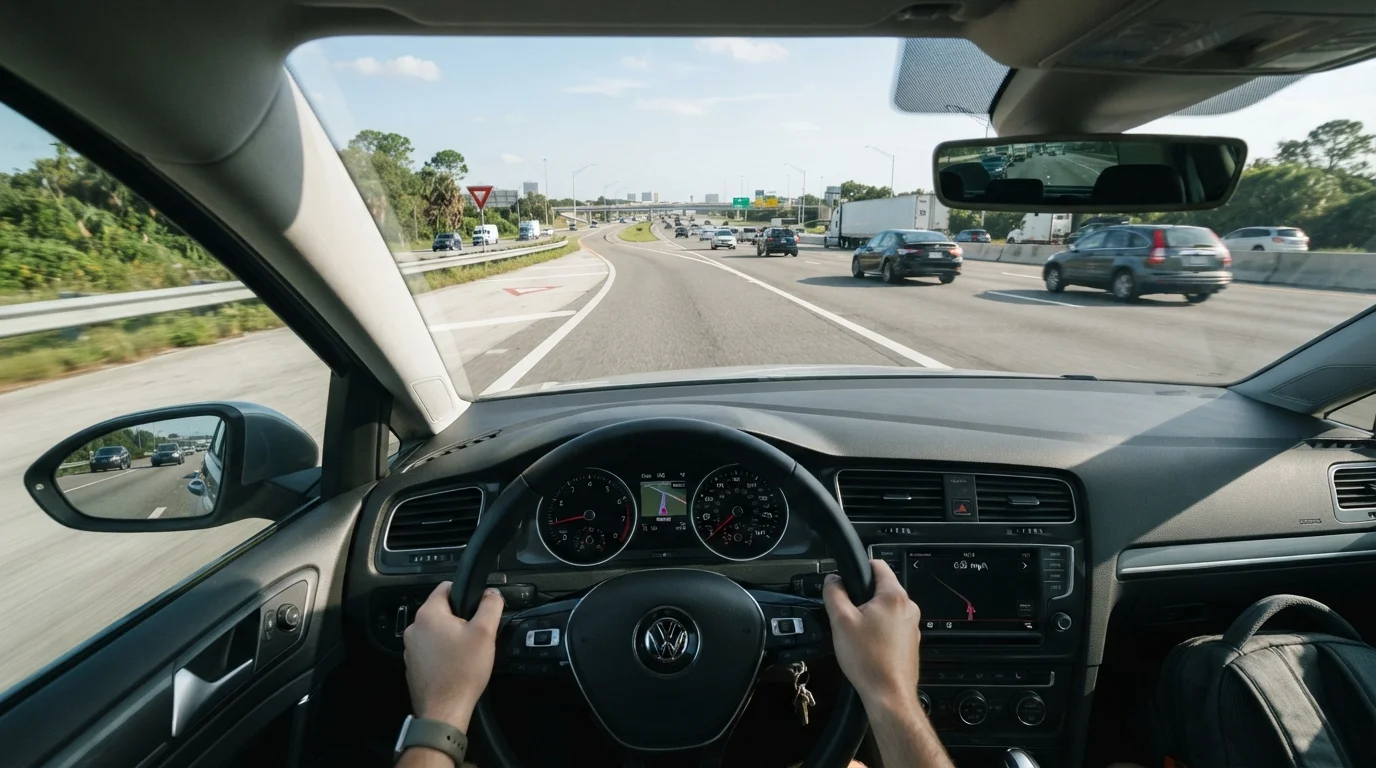
As you approach the on-ramp from surface streets, scan the visible section of highway for traffic density and speed. Look for natural gaps - stretches of road with more space between vehicles. Identifying a target gap early means you can time your acceleration to arrive at the merge point as that gap lines up with your position, rather than scrambling to find one at the last second.
Signal and begin accelerating immediately on the ramp
Activate your turn signal as soon as you enter the on-ramp. This signals your intent to highway traffic with maximum notice. Begin accelerating immediately - the on-ramp is an acceleration lane, not a waiting area. A typical highway travel lane runs at 55-75 mph depending on the posted limit; your goal is to reach that speed range before the lane ends.
Check mirrors and perform a blind spot head check
While continuing to accelerate, check your center mirror and the relevant side mirror to assess traffic in the target lane. Then perform a brief but deliberate head check - turn your head to glance over your shoulder into the blind spot zone your mirrors cannot cover. Electronic blind spot monitoring systems (if your vehicle has one) are a useful supplement, but they should not replace the physical check.
Select and commit to an adequate gap
A safe gap at highway speeds is generally at least 4 seconds of following distance - meaning roughly 4 seconds of clear space between you and the vehicle ahead of where you plan to slot in. To estimate this, pick a fixed point on the road and count how long after the vehicle ahead of your gap passes it before your front bumper would reach it. If it's less than 4 seconds, wait for the next gap rather than forcing the merge.
Once you identify an adequate gap, commit to it. Hesitation - alternately accelerating and lifting off the throttle - makes your movements unpredictable for highway drivers around you.
Merge smoothly and cancel your signal
Move into the travel lane with a smooth, controlled steering input - avoid jerky or sudden movements. Once your vehicle is fully within the lane and stable, cancel your turn signal. Immediately establish a safe following distance from the vehicle ahead, using the 3-4 second rule as a baseline. Resist the urge to stay in the right lane longer than necessary; if traffic allows, consider moving to the center lane to allow easier access for subsequent merging drivers.
You Must Match Speed, Not Wait to Merge
A common and dangerous error is slowing down or stopping at the end of an on-ramp to wait for a gap. This creates a rear-end hazard for drivers behind you and forces a nearly-stopped vehicle into 65 mph traffic. Use the full length of the acceleration lane to reach highway speed before merging.
Conditions that change this calculus include wet roads, reduced visibility, and construction zones. Wet pavement extends stopping distances significantly - a factor worth understanding before merging in rain. Our article on driving in heavy rain explains how reduced traction affects highway maneuvers. Similarly, if your merge point falls near or within a work zone, the guidance in our piece on moving through construction zones safely applies directly.
Short On-Ramps Require Earlier Decisions
Some older highway interchanges have very short acceleration lanes, leaving less room to reach speed. Identify this early and accelerate more aggressively from the start. If you misjudge and run out of lane, never stop on the shoulder unless it is a true emergency - reduce speed gradually and wait for a clear gap to re-enter.
Building Consistency: Making Good Merges a Habit
A single successful merge is skill. Consistent, calm merging in varied conditions - night, rain, heavy traffic, short ramps - is habit built through deliberate practice. Each on-ramp approach is an opportunity to run the same sequence: read traffic early, signal promptly, accelerate fully, check mirrors and blind spot, select a gap, commit.
If you're preparing for a long drive where multiple highway entries are expected, a pre-drive vehicle check is also worth completing. Properly inflated tires and functioning mirrors ensure your vehicle responds predictably when you need confident acceleration and visibility most.
Scan Ahead While Still on Surface Streets
Before you even reach the on-ramp, glance at highway traffic through any visible gaps. Spotting a dense cluster of vehicles or an open stretch early gives you several extra seconds to plan your speed and target gap. This habit is central to the situational awareness skills covered in our guide to reading traffic flow.
Right-of-way rules at other junction types - yield signs, four-way stops, roundabouts - follow their own logic. If those situations cause uncertainty, our breakdown of who goes first at common intersections is a practical companion reference.