

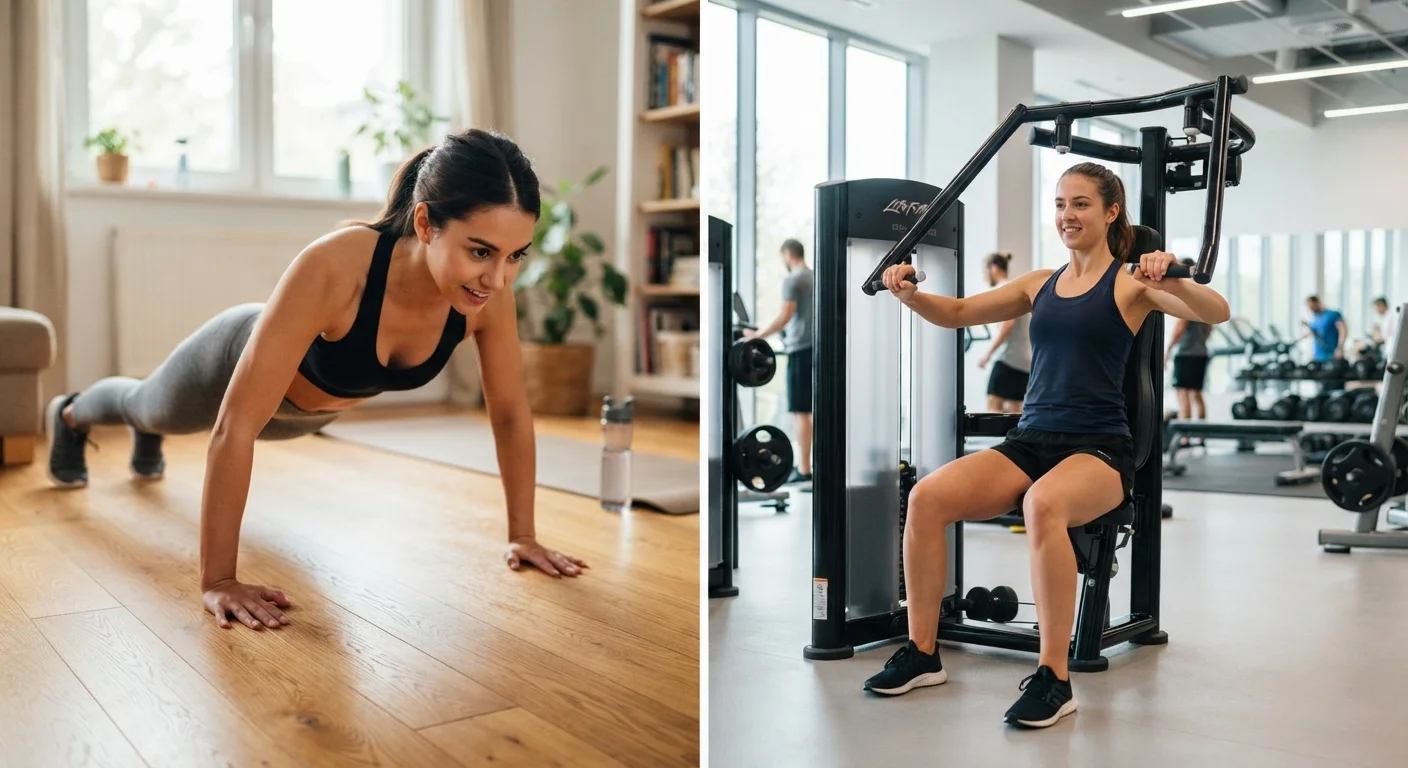
Key Takeaways
- Bodyweight training builds functional strength and requires no equipment or gym access.
- Weight machines guide your movement path, reducing technique errors and injury risk for beginners.
- Progressive overload - the key to strength gains - is achievable with both methods, though differently.
- Your schedule, budget, and physical goals should drive the choice between these two approaches.
- Many fitness professionals recommend combining both methods for a well-rounded routine.
Option A
Bodyweight Training
The flexible, equipment-free strength builder.
Best for: People who want to train anywhere, build functional movement, or avoid gym membership costs.
Option B
Weight Machines
The structured, guided approach for targeted muscle work.
Best for: Beginners learning movement patterns safely, those recovering from injury, and anyone wanting measurable, isolated muscle resistance.
If you have no gym access or are training on a tight budget
Bodyweight Training
Bodyweight exercises require no equipment and can be performed anywhere, making them the practical default for home or travel-based fitness.
If you are returning from an injury or managing joint concerns
Weight Machines
Machines control your range of motion and limit the stabilizer demands that can aggravate vulnerable joints - always consult a healthcare professional before resuming training after injury.
If you are new to strength training and worried about form
Weight Machines
Fixed movement paths reduce the learning curve significantly and help beginners build confidence before progressing to free movement.
If you want to improve everyday movement and athletic performance
Bodyweight Training
Exercises like squats, lunges, and push-ups recruit multiple muscle groups in patterns that transfer directly to real-life physical demands.
If you want the most complete long-term strength programme
Bodyweight Training
A hybrid approach blending bodyweight foundations with machine work delivers both functional adaptability and targeted overload - start with whichever fits your current situation and build from there.
What Each Approach Actually Involves
Bodyweight training uses your own body mass as resistance. Push-ups, squats, lunges, planks, dips, and pull-ups are foundational examples. Because no external load is fixed, these movements naturally recruit stabilising muscles alongside the primary movers - developing coordination and balance simultaneously with strength.
Weight machines, by contrast, isolate specific muscle groups along a predetermined movement arc. Leg press, chest press, lat pull-down, and cable row machines guide the body through a defined path, reducing the stability demand and allowing a lifter to focus entirely on the target muscle. Resistance is adjusted by moving a pin or changing a plate stack.
Both modalities qualify as resistance training. If you'd like a refresher on the vocabulary used to describe either method, the strength training glossary is a useful starting point.
| Criterion | Bodyweight Training | Weight Machines |
|---|---|---|
| Equipment needed | None (optional pull-up bar) | Gym or home machine required |
| Cost | Free to very low | Gym membership or machine purchase |
| Beginner ease | Moderate - technique matters | High - guided movement path |
| Functional carry-over | High - mirrors real movement | Moderate - more movement-specific |
| Progressive overload | Possible but less linear | Straightforward and measurable |
| Injury rehab suitability | Variable - consult a professional | Often preferred with clinical guidance |
| Location flexibility | Anywhere | Gym or fixed home setup only |
Progression, Adaptability, and the Overload Question
One of the most common misconceptions is that bodyweight training hits a ceiling. In practice, progression is built through leverage changes, tempo manipulation, and movement complexity - a standard push-up advances to an archer push-up, then to a single-arm variation. That said, adding load to machine-based exercises is often more straightforward: move the pin up one notch. For people whose primary goal is building maximum muscle mass, machines can make progressive overload (gradually increasing resistance over time) easier to track precisely.
Bodyweight training adapts well to limited space and unpredictable schedules. It also tends to reinforce movement quality that carries over to daily life - functional strength refers to the ability to perform everyday physical tasks, from lifting groceries to climbing stairs, without difficulty. Machine-based strength, while real, is more specific to the patterns those machines train.
~80%
Adults not meeting strength training guidelines
According to CDC physical activity data, roughly 80% of U.S. adults do not meet the recommended twice-weekly muscle-strengthening activity targets - regardless of method.
2x/week
Minimum recommended strength sessions
The U.S. Department of Health and Human Services Physical Activity Guidelines recommend muscle-strengthening activities on at least two days per week for adults.
For guidance on structuring either approach into your week, see building a weekly movement routine from scratch.
Accessibility, Safety, and Who Each Suits
Bodyweight training is inherently accessible - it requires no membership, no commute, and minimal space. This makes it particularly well-suited to people who prefer exercising at home. If that describes you, home workout habits worth keeping offers a practical look at what genuinely works in that environment.
Weight machines reduce the technical barrier to strength training. The guided range of motion means a beginner is less likely to compensate with incorrect muscle groups or load joints unsafely. For older adults, those managing chronic conditions, or anyone easing back into exercise, the controlled environment of a machine can feel significantly less intimidating. If joint stress is a concern, it's also worth reviewing low-impact exercise options before choosing a training format.
This article is for general informational purposes only and is not a substitute for personalised medical or fitness advice. If you have a health condition, injury, or are new to exercise, consult a qualified healthcare professional or certified fitness specialist before starting any new training programme.