

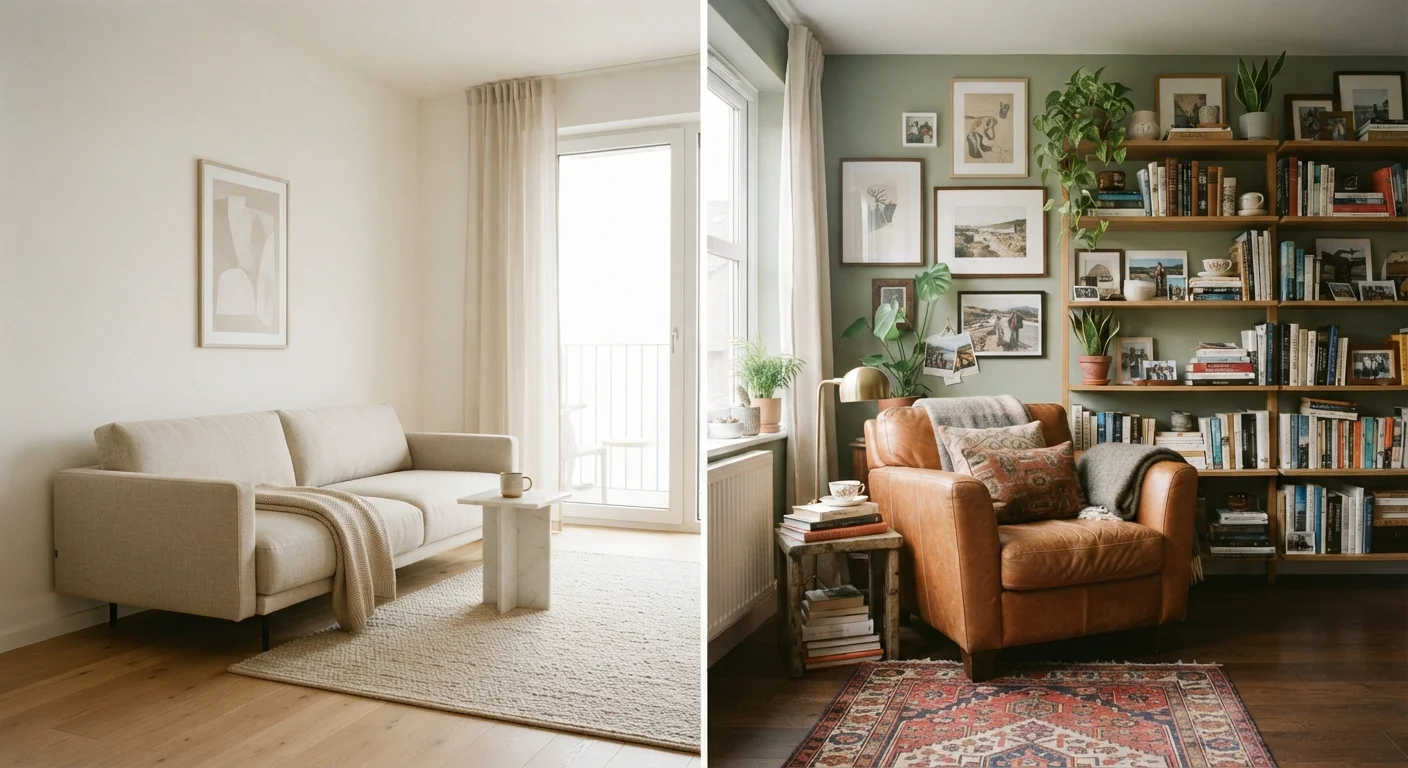
Key Takeaways
- Minimalism focuses on reducing possessions to only what is essential or intentional.
- Organized abundance embraces owning more while maintaining clear systems and storage.
- Neither approach is universally superior - household size, lifestyle, and personality all matter.
- A hybrid strategy is common and valid, applying each philosophy room by room.
- Consistency of maintenance matters more than which philosophy you choose.
Our Verdict
Both minimalism and organized abundance can produce genuinely tidy, functional homes. The difference lies in how much each household is comfortable owning and the systems required to manage it. Choosing the right philosophy means being honest about your lifestyle, the people sharing your space, and the maintenance effort you can realistically sustain.
| Best for | Recommended |
|---|---|
| Those who prefer low-maintenance upkeep and fewer decisions | Minimalism |
| Households with children, hobbies, or multi-use spaces | Organized Abundance |
| People who want flexibility without committing fully to either extreme | Hybrid Approach |
What Each Philosophy Actually Means
The word minimalism gets used broadly, but in a home organization context it means intentionally limiting what you own so that every item has a clear purpose or meaning. A minimalist home isn't necessarily stark or cold - it's simply one where possessions don't accumulate beyond what the household actively uses or values. The payoff is a lower maintenance burden: fewer objects means fewer things to clean, store, and sort.
Organized abundance, by contrast, accepts - and even celebrates - owning a lot. The philosophy holds that possessions enrich daily life, and the goal isn't to pare down but to build systems robust enough to keep everything findable and manageable. A well-organized abundant home might have full pantry shelves, a stocked craft room, and a library of books - all of it accessible and in order.
Neither label means clutter is acceptable. Both approaches aim for a tidy, functional space; they simply disagree on the quantity of objects required to live well. Understanding which resonates with your household is the first step toward a system that actually holds. If you're still working out your starting point, our introduction to home organization offers a structured way to begin.
How the Two Approaches Compare
Looking at these philosophies side by side across practical household criteria makes the trade-offs clearer.
| Criterion | Minimalism | Organized Abundance | |
|---|---|---|---|
| Volume of possessions | Intentionally limited | Plentiful but structured | |
| Storage infrastructure needed | Minimal - fewer items require less | Significant - bins, shelves, labels essential | |
| Day-to-day maintenance effort | Lower once established | Higher - systems require upkeep | |
| Upfront effort to set up | High - decluttering decisions are intensive | High - categorizing and storing takes time | |
| Suitability for families with children | Challenging - kids generate volume | Generally better fit | |
| Flexibility for hobbies and collections | Low - conflicts with accumulation | High - space for tools and supplies | |
| Visual calm | High - fewer objects on surfaces | Depends on system discipline |
One pattern that emerges: minimalism tends to reduce the ongoing effort required to maintain order, while organized abundance front-loads effort into building and labeling storage systems. Both demand discipline - just in different forms.
Who Thrives with Minimalism
Minimalism suits households that find decision-making around objects genuinely exhausting, or those whose living spaces are physically small. When square footage is limited, owning less isn't an aesthetic choice - it's a practical one. Singles, couples without children, and people who move frequently often report that a minimalist framework reduces daily friction and makes resets faster after a busy week.
The approach also works well for people who experience visual noise as stressful. Research in environmental psychology suggests that cluttered visual fields can increase cognitive load, though individual responses vary considerably. For households sensitive to this, fewer objects on surfaces may translate to a calmer environment.
The challenge with minimalism is that it requires ongoing gatekeeping. Every new item brought into the home is a decision point. Clutter management principles like one-in, one-out are frequently paired with minimalist households to prevent gradual accumulation from undoing the system.
Start with One Room, Not the Whole House
Committing to a philosophy works better when tested in a single contained space first - a bathroom cabinet or a bedroom closet is a manageable experiment. Living with the results for a few weeks will tell you more than any organizing book about whether reduced volume or improved systems feel like the right fit for your household.
Who Thrives with Organized Abundance
Organized abundance tends to suit larger households, especially those with children. Kids generate gear - and telling a family of five to own less is often unrealistic advice. The emphasis instead falls on assigning every category of object a clear home, using labeled containers, dedicated zones, and storage that scales. Our article on organizing with kids at home explores systems that hold up even in high-traffic, high-mess environments.
This approach also fits people with active hobbies - sewing, woodworking, cooking from scratch, gardening - where the tools of the practice are numerous and meaningful. Paring down a well-used tool collection or a cookbook library may feel like self-denial rather than simplicity, and for many people that feeling is accurate rather than sentimental.
The maintenance burden in an abundant household is real, however. Systems need periodic review - seasonal decluttering rotations help prevent storage from quietly filling past capacity. The investment in quality storage infrastructure - shelving, bins, drawer dividers - also tends to be higher upfront.
The Case for a Hybrid Approach
Most well-organized homes, if examined closely, are neither purely minimalist nor purely abundant. A household might apply minimalist thinking in the bedroom - keeping surfaces clear and wardrobes edited - while maintaining an abundant, fully stocked kitchen and a sprawling home office. Matching the philosophy to the room's function and the occupants' relationship to it is a practical middle path.
A room-by-room organization audit is a useful tool for identifying where each philosophy makes sense in your own home. Some rooms will reveal themselves as candidates for reduction; others will show that the problem isn't volume but the absence of good systems.
What consistently matters more than philosophy is maintenance. The habits that quietly undermine tidy spaces are usually the same regardless of how much or how little a household owns - things tend to drift when there's no routine reset built into the week. Choosing the framework that fits your life honestly is the surest way to build one you'll actually maintain.