

Key Takeaways
- Age-appropriate systems are the foundation - children can only maintain what they can physically and cognitively manage.
- Fewer categories and larger containers reduce daily friction and help kids return items independently.
- Involving children in the setup process dramatically increases their willingness to participate in upkeep.
- Systems must be re-evaluated as kids grow, since what works at age four rarely works at age eight.
- Consistent routines - not perfect tidiness - are the realistic goal in households with children.
Why Most Organizing Systems Fail in Family Homes
Many organizing approaches are designed for adults living adult lives. They rely on fine motor sorting, consistent categorization, and motivation that most children simply don't have - not because they're difficult, but because they're kids. When a system demands more than a child can reliably deliver, the burden falls entirely on parents to maintain it, and it quietly collapses.
The organizing methods that hold up over time in family homes share a common design principle: they're built around how the household actually behaves, not how it ideally should. That means accounting for dropped backpacks, dumped puzzle pieces, and the reality that a six-year-old cannot reliably distinguish between 12 different toy subcategories.
If you're feeling overwhelmed about where to even begin, this structured starting point can help you establish realistic first steps before layering in family-specific strategies.
Design storage around the child's physical reach and cognitive stage, not adult convenience.
Children can only return items to places they can physically access and mentally categorize. Systems built for adult reach or adult logic create dependency rather than independence, meaning parents end up doing all the maintenance.
Use broad categories with large containers rather than granular sorting systems.
Fine-grained sorting requires sustained attention and motivation that most children don't consistently have. Broad categories with forgiving containers lower the effort threshold enough that kids will actually use them.
Involve children in setting up and naming the system from the beginning.
Children maintain systems they had a hand in creating. When they choose which bin goes where or draw the label icons themselves, they develop a sense of ownership that translates into more consistent follow-through.
Establish a daily reset routine rather than expecting ongoing tidiness.
Expecting a household with children to stay tidy throughout the day is unrealistic and leads to constant correction. A defined reset - such as a ten-minute tidy before dinner - creates a predictable rhythm without requiring perfection all day.
Eliminate excess inventory regularly so storage capacity is never overwhelmed.
Even the best organizing system breaks down when there's simply too much stuff. In households with children, toy and clothing volume tends to grow faster than storage does, making periodic culling essential.
Building Systems Kids Can Actually Maintain
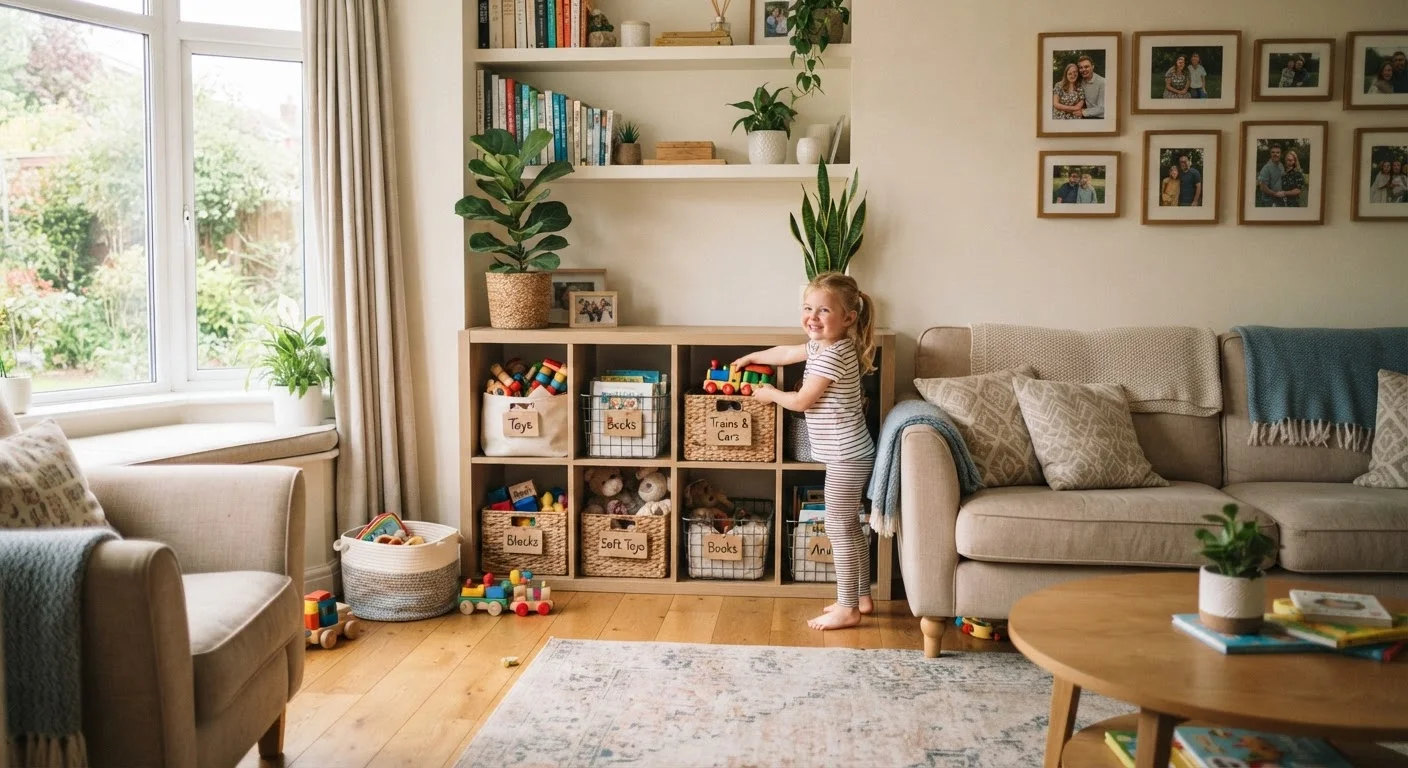
The most durable family organizing systems share a few structural traits: they use fewer, broader categories; they store items at the child's physical level; and they make the correct choice the easiest choice. When a bin is labeled "Blocks" rather than "Small wooden rectangular blocks," a child can succeed. When books live on a low shelf within arm's reach, they get returned.
Picture Labels Work Better Than You Think
For children who aren't yet reading reliably, photograph the actual contents of each bin and tape the printed image to the front. This removes guesswork entirely and makes returning items a matching exercise rather than a reading task. Laminating the photos adds durability - a worthwhile step in high-traffic spaces.
Labeling deserves particular attention. For pre-readers, picture labels on bins and drawers - either printed images or hand-drawn icons - remove the literacy barrier entirely. As children grow into reading, text labels reinforce the system rather than replace it. The zones, bins, and labels approach is especially effective in shared spaces like playrooms, mudrooms, and bedrooms.
It's also worth walking through your home periodically with fresh eyes. A room-by-room organization audit can reveal where current systems are failing before the clutter becomes overwhelming.
Adapting Systems as Children Grow
One of the most overlooked aspects of family organization is that children change - fast. A system designed for a toddler will be outgrown by a kindergartner, and a setup that worked beautifully at age seven may feel babyish and ignored by age ten. Building in a regular review rhythm is not a sign that your system failed; it's a sign you're paying attention.
Plan to reassess storage and organizational systems at least once a year, ideally aligned with a natural transition like the start of school, a birthday, or a seasonal clean-out. Seasonal decluttering cycles offer a natural checkpoint to rotate what's stored, donate outgrown items, and adjust systems to match a child's current capabilities and interests.
As children grow older - generally around age eight or nine - they can take on more ownership of their own spaces. This is the right time to shift from parent-designed systems to collaborative ones, where the child has meaningful input into how their room or belongings are organized. Ownership drives maintenance.
Disorganization rarely stays contained, and its effects ripple beyond just physical clutter. Understanding the full costs of household disorganization - on time, stress, and daily friction - can be a useful motivator for the whole family to participate.
~15 min
Average daily time parents spend searching for misplaced items
Research on household time use suggests families lose significant time each day to locating objects - time that better-organized systems can recover.
80%
Of clutter stems from disorganization, not lack of space
Professional organizers widely cite this estimate to illustrate that acquiring more storage rarely solves the underlying problem in family homes.