
Self-Paced vs. Scheduled Online Courses: What the Difference Actually Means for Your Learning

Key Takeaways
- Self-paced courses let you start anytime and move through material at your own speed, with no fixed deadlines.
- Scheduled courses follow a shared calendar, typically with weekly assignments, live sessions, and peer cohorts.
- Completion rates tend to be higher in structured courses due to external accountability and social motivation.
- Self-paced formats work best for disciplined learners; scheduled formats suit those who benefit from routine.
- The right choice depends on your schedule flexibility, accountability needs, and the subject complexity.
- Neither format is universally superior - matching format to your learning style matters more than format prestige.
Option A
Self-Paced Online Courses
The flexible, go-at-your-own-speed format.
Best for: Learners with unpredictable schedules, strong self-motivation, or prior familiarity with the subject area.
Option B
Scheduled (Cohort-Based) Online Courses
The structured, deadline-driven format with built-in community.
Best for: Learners who thrive on accountability, peer interaction, and a clear, sequential learning progression.
If your work or family schedule changes week to week
Self-Paced Online Courses
You can log in whenever a window opens without falling behind a shared calendar or missing live sessions.
If you have struggled to finish online courses before
Scheduled (Cohort-Based) Online Courses
Fixed deadlines and a peer group create the external accountability that significantly improves completion rates.
If you want to explore a new subject at an introductory level
Self-Paced Online Courses
Low-stakes, open-access self-paced courses are ideal for sampling a topic before committing to a structured program.
If the subject requires feedback, discussion, or collaborative practice
Scheduled (Cohort-Based) Online Courses
Writing, leadership, coding bootcamps, and similar disciplines benefit from instructor feedback and peer critique on a shared timeline.
If you are pursuing a certificate or credential with employer recognition
Scheduled (Cohort-Based) Online Courses
Many employer-recognized certificates are tied to cohort-based programs that verify engagement through proctored assessments and graded milestones.
What Each Format Actually Looks Like
The labels self-paced and scheduled (sometimes called cohort-based or instructor-led) describe how a course organizes time - not how much content it covers or how rigorous it is.
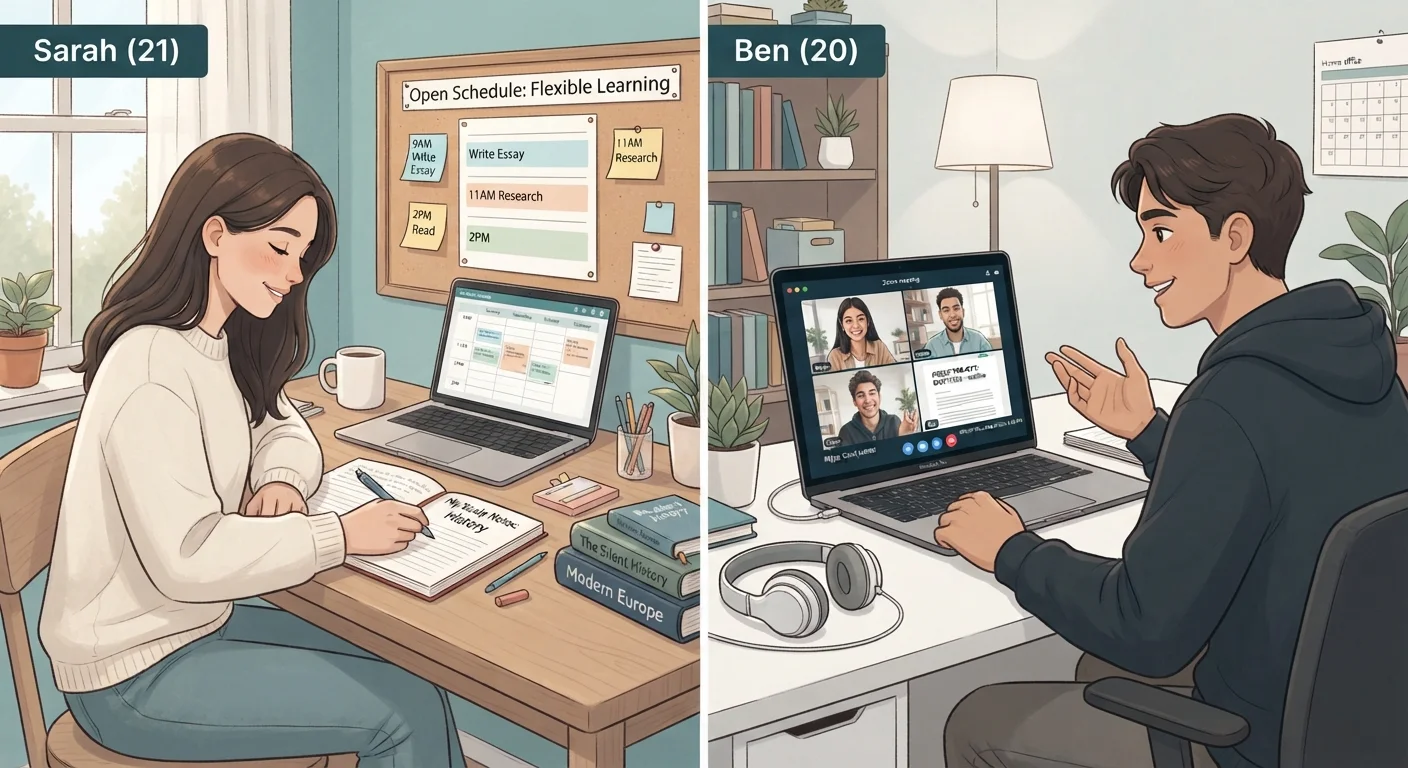
In a self-paced course, all materials - video lectures, readings, quizzes - are available from day one. You choose when to study, how long each session lasts, and how quickly you progress. There are no live meetings and typically no fixed due dates, though some platforms set an overall enrollment window (commonly 90 to 180 days) before access expires.
In a scheduled course, the class moves through material together. A new module or week opens on a set date, assignments have real deadlines, and there are often live or synchronous elements - video office hours, discussion boards with required participation, or peer-graded projects. You are learning alongside a cohort of fellow students on the same timeline.
For a broader orientation to course formats and terminology, see the Online Learning Complete Reference Guide.
| Criterion | Self-Paced | Scheduled / Cohort-Based |
|---|---|---|
| Start date | Anytime (rolling enrollment) | Fixed term start date |
| Deadlines | None or enrollment window only | Weekly or milestone-based |
| Live sessions | Rarely included | Often included (office hours, webinars) |
| Peer interaction | Limited or asynchronous forums | Active cohort, peer review common |
| Instructor feedback | Automated or minimal | Instructor or TA graded |
| Typical completion time | Varies widely by learner | Fixed (e.g., 6-12 weeks) |
| Accountability | Self-driven only | External (deadlines, peers) |
| Best for credentials | Skills certificates, badges | Verified certificates, degree credit |
The Completion Rate Problem - and Why Format Matters
Research on massive open online courses (MOOCs) has consistently found that self-paced courses carry low completion rates - often cited in the range of 5 to 15 percent across major platforms. This does not mean self-paced learning is ineffective; it reflects that many enrollees are browsing, auditing, or have shifting priorities. But it does highlight a genuine risk: without deadlines, it is easy to let coursework slide indefinitely.
Scheduled courses tend to produce higher completion because they introduce social accountability - you are aware that peers and an instructor are progressing alongside you. Missed participation becomes visible, and many programs factor engagement into grades or certificates.
~5-15%
Average MOOC completion rate
Multiple studies on large-scale open online course platforms have consistently found completion rates in this range for self-paced enrollments.
~2x
Completion rate lift with deadlines
Research published in educational psychology journals suggests that externally imposed deadlines can roughly double the likelihood of a learner finishing an online course.
If you have started and abandoned online courses before, the format itself may deserve part of the blame. Choosing a structured cohort-based program could be a more honest match for your motivational style. Conversely, if you have a strong internal drive and limited free hours, a self-paced course removes the anxiety of missed live sessions. Learn about habits that help regardless of format in Getting the Most Out of Any Online Course.
When Self-Paced Is the Smarter Fit
Self-paced courses are genuinely well-suited to certain learners and goals:
- Irregular schedules: Shift workers, caregivers, and frequent travelers benefit from being able to study at 11 p.m. or between appointments without penalty.
- Refreshing existing knowledge: If you already understand the basics of a topic and want to fill specific gaps, you can skim familiar sections and spend more time where you need it.
- Lower-stakes exploration: Self-paced free or low-cost courses let you test interest in a subject before investing in a longer program. See Free vs. Paid Online Courses for a breakdown of what each type typically offers.
- Faster completion: A motivated learner can finish a self-paced course in days rather than the weeks a cohort schedule dictates.
Access Windows in Self-Paced Courses
Many self-paced courses are not available indefinitely. Platforms commonly grant access for 90 to 180 days from enrollment, after which materials may become unavailable even if you have not finished. Before enrolling, confirm the exact access period and whether extensions are available - ideally in writing from the course provider.
Making the Choice - and Verifying What You Are Signing Up For
Before enrolling, ask specifically how the course is structured. Some programs market themselves as flexible but include weekly live sessions that are effectively mandatory. Others describe a cohort but allow fully asynchronous participation. The label does not always match the reality.
Key questions to clarify before committing:
- Are there live sessions, and are they required or recorded?
- Do assignments have hard deadlines, or are they suggestions?
- Is there a discussion community, and is participation graded?
- What happens if you need to pause - can you defer, or do you lose access?
The pre-enrollment checklist covers these points alongside accreditation, refund policies, and instructor credentials. For a wider lens on the trade-offs of studying entirely online, The Upsides and Limits of Learning Entirely Online offers a balanced assessment worth reading before you commit.
Ultimately, the most important variable is not which format is objectively better - it is which format is honest about how you actually learn and what your life currently allows.