

Key Takeaways
- Spaced repetition fights the forgetting curve by reviewing material just before you're likely to forget it.
- Reviews scheduled at increasing intervals are more efficient than massed practice or cramming.
- The technique works for virtually any subject, from vocabulary to anatomy to legal statutes.
- Flashcard systems - digital or paper - are the most practical tools for implementing spaced repetition.
- Combining spaced repetition with active recall produces stronger, longer-lasting memory than either method alone.
Spaced Repetition
Spaced repetition is a study method in which you review material at carefully timed intervals that grow progressively longer as you become more confident with the information. Instead of cramming everything the night before a test, you spread reviews across days, weeks, or months. This approach works with the brain's natural memory processes to make forgetting harder and recalling easier.
The method is grounded in the 'spacing effect,' a phenomenon documented by psychologist Hermann Ebbinghaus in the 1880s and repeatedly confirmed in cognitive science research. Modern implementations often use algorithms - such as the SM-2 algorithm - to calculate optimal review timing based on individual performance.
Why Your Brain Forgets - and What That Has to Do With Timing
Hermann Ebbinghaus, a 19th-century German psychologist, was among the first to study memory systematically. His work revealed what researchers now call the forgetting curve: without any review, people lose a significant portion of newly learned information within hours or days. The curve is steep at first, then gradually flattens as time passes.
The practical implication is striking. A single study session plants information, but without reinforcement, that information fades. The solution isn't to study harder in one sitting - it's to revisit material at the right moments. Spaced repetition targets what researchers call the optimal forgetting point: the moment just before information slips away entirely. Reviewing at that moment strengthens the memory trace more efficiently than reviewing when the material still feels fresh.
To understand why this works at a deeper level, see our guide to how memory actually works, which explains the stages of encoding, storage, and retrieval that underpin every effective study strategy.
~50%
Information forgotten within one hour without review
Ebbinghaus's foundational memory research showed that roughly half of newly learned material is lost within the first hour absent any reinforcement.
200%+
Improvement in long-term retention with spaced practice
A meta-analysis of distributed practice studies, summarized in Cepeda et al. (2006) in Psychological Bulletin, found spacing consistently outperformed massed practice across a wide range of learning tasks.
1885
Year the spacing effect was first documented
Hermann Ebbinghaus published his self-experiment findings on memory and forgetting in 1885, making spaced repetition one of the longest-studied techniques in educational psychology.
How the Spacing Schedule Actually Works
In a spaced repetition system, every piece of material you study is assigned a review interval. After your first review, you might see a card again the next day. If you recall it correctly, the interval doubles - perhaps four days, then a week, then two weeks. If you struggle to remember it, the interval resets shorter, giving you more practice on weaker material.
This self-adjusting quality is what separates spaced repetition from simple flashcard drills. The system sends you back to difficult items more frequently while gradually reducing reviews for well-known material. The result: your study time concentrates where it's needed most.
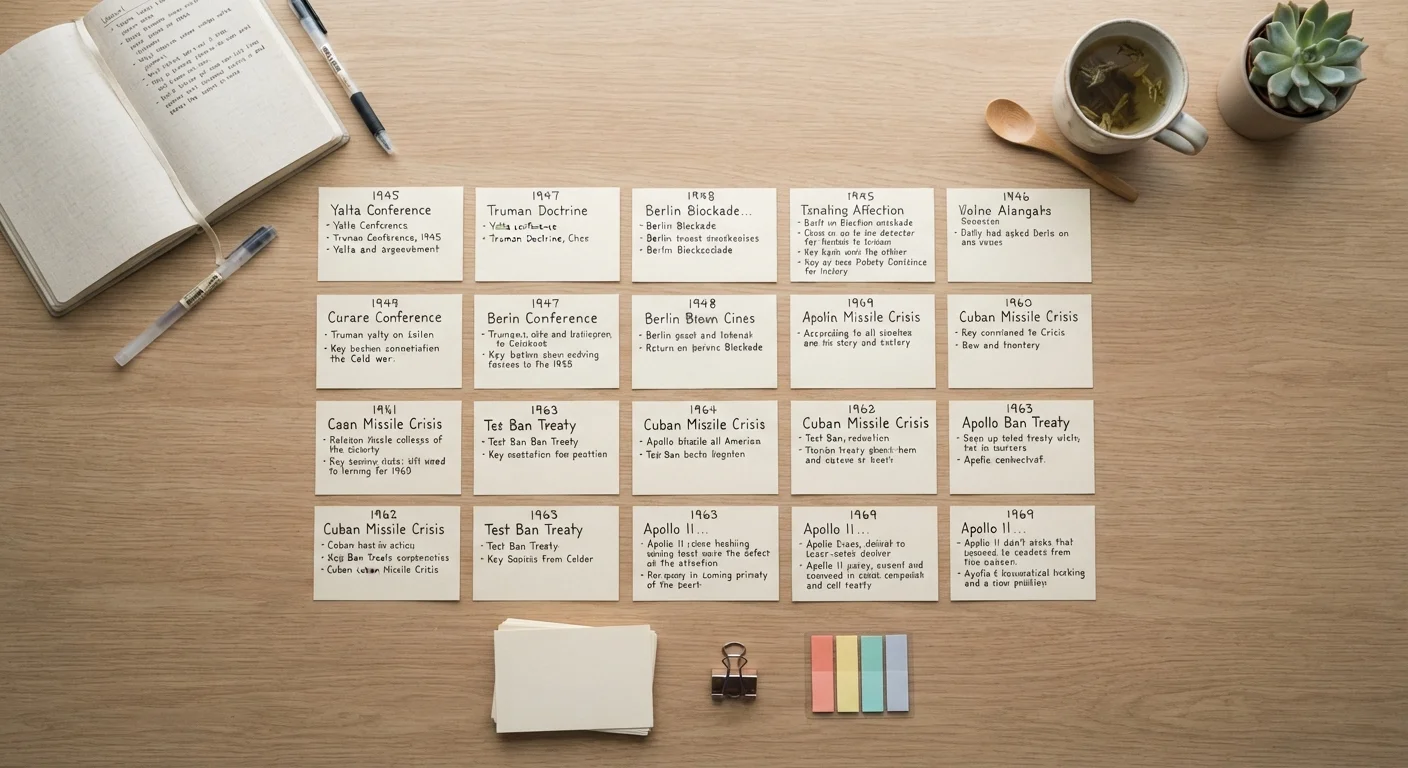
Paper-based versions use a simple box or folder system - cards move forward through labeled sections (Day 1, Day 3, Week 1, Month 1) when answered correctly, and move back when missed. Digital tools automate this entirely, logging your response and scheduling the next review without any manual sorting.
Start Small to Build the Habit
One of the most common mistakes with spaced repetition is adding too many new cards too quickly. A sustainable approach means limiting new items per session - even just five to ten - until the daily review habit feels routine. Consistency across weeks matters far more than volume in any single sitting.
Spaced Repetition Paired With Active Recall
Spaced repetition is a scheduling strategy - it tells you when to review. Active recall is a retrieval strategy - it determines how you review. The two work best together.
When you cover the answer on a flashcard and force yourself to retrieve the information before flipping it over, you're practicing active recall. That effort of retrieval - even when it feels difficult - is precisely what deepens memory encoding. Passively re-reading notes, by contrast, creates a sense of familiarity without the same strengthening effect.
Research in cognitive psychology consistently shows that the combination of spaced review intervals and effortful retrieval practice produces stronger long-term retention than either approach used alone. For a detailed look at why retrieval practice outperforms passive review, see Active Recall vs. Passive Review.
Applying Spaced Repetition to Any Subject
The mechanics of spaced repetition are subject-neutral. What varies is how you break your material into reviewable units.
A few practical guidelines apply across subjects. Keep each card or review item focused on a single concept or fact - mixing multiple ideas into one item makes it harder to isolate what you do and don't know. Write items in your own words whenever possible, since that process itself deepens encoding. And review consistently: short daily sessions outperform infrequent marathon reviews.
If you're new to structured studying and want a broader framework for building effective habits, Getting Started with Effective Study Habits provides a solid foundation alongside which spaced repetition fits naturally. For a comparison of where spaced repetition sits among other evidence-based methods, Every Major Study Technique, Explained is a useful companion reference.