

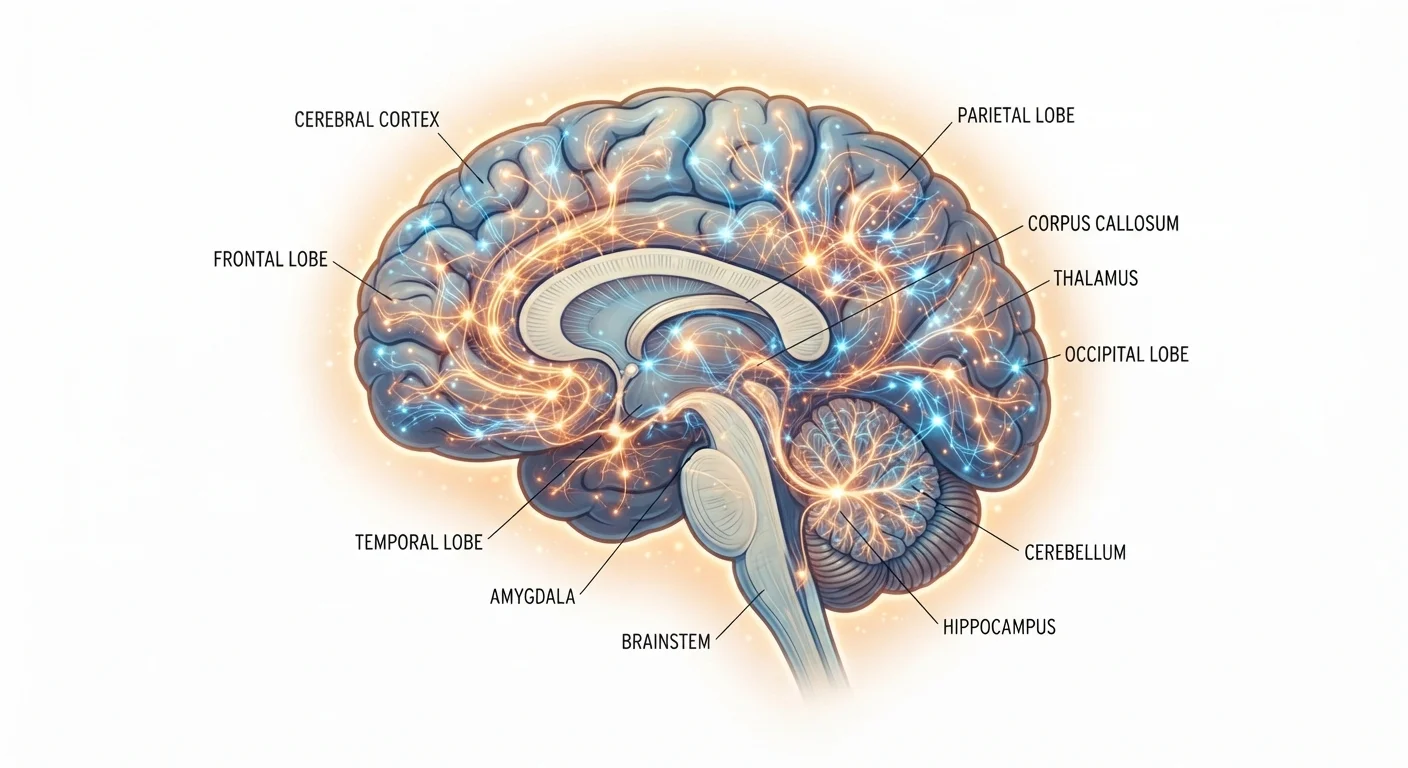
Key Takeaways
- Memory has three core stages: encoding, storage, and retrieval - each can be strengthened with the right strategies.
- Information first enters working memory, which has limited capacity and duration.
- Long-term memory is built through repeated, meaningful engagement with material.
- Retrieval practice - actively recalling information - strengthens memory more than re-reading alone.
- Sleep plays a critical biological role in consolidating memories from short-term to long-term storage.
- Understanding how memory works is the first step toward choosing study techniques that actually stick.
Human Memory
Memory is the brain's ability to encode, store, and retrieve information over time. It is not a single system but a collection of interconnected processes that determine what you learn, how well you retain it, and how easily you can recall it later. Understanding these processes gives students a meaningful advantage when designing their study habits.
Neuroscientists distinguish between declarative memory (facts and events) and non-declarative memory (skills and conditioned responses), each supported by different brain structures such as the hippocampus and cerebellum respectively.
The Three Stages Every Learner Should Understand
Memory is not a single on/off switch - it is a sequential process with three distinct stages. Knowing where each stage can break down tells you exactly where to focus your effort.
Encoding is the entry point. When you encounter new information, your brain begins translating it into a format it can work with. Encoding is stronger when information is connected to something you already know, processed deeply (thinking about meaning, not just surface features), and encountered in a focused state of attention. Distracted studying produces shallow encoding.
Storage is what most people mean when they say "memory." Information initially lives in working memory - a temporary workspace with a limited capacity and a short lifespan of seconds to minutes. For information to persist, it must move into long-term memory, a process called consolidation. This transfer is aided by repetition, emotional significance, and - critically - sleep.
Retrieval is the stage students most often overlook in study planning. The act of pulling information back out of long-term memory is not passive - it is itself a learning event. Each successful retrieval strengthens the memory trace, making future recall faster and more reliable. This is the principle behind active recall and practice testing. See our overview of major study techniques for a full breakdown of how retrieval-based methods compare.
~50%
Information forgotten within one hour
Memory research has consistently shown that without review, roughly half of newly learned material becomes inaccessible within an hour of study.
~80%
Forgotten within 24 hours without review
Studies on memory decay suggest that without any reinforcement, the majority of new information is lost within a day of the initial learning session.
2×
Retrieval practice retention advantage
Research published in cognitive psychology literature indicates that students who use practice testing retain roughly twice as much material as those who re-read the same content.
Why the Brain Forgets - and How to Work With It
Forgetting is not a flaw; it is the brain's default behavior. Without active reinforcement, memories decay - a pattern described by the forgetting curve, a concept associated with early memory research showing that retention drops sharply in the hours and days after learning, then levels off.
What counteracts the forgetting curve? Spaced review. Rather than cramming all study into one session, distributing practice across multiple sessions causes the brain to re-encode information each time, strengthening the memory trace. Our article on spaced repetition explains the research in depth and shows how to apply it to any subject.
Another factor is interference - when similar information competes and disrupts retrieval. Studying very similar topics back-to-back can increase interference. Alternating between subjects (a technique called interleaving) can reduce this effect and build more flexible, durable knowledge. For definitions of these and related terms, the study terms glossary is a useful quick reference.
Test Yourself Before You Feel Ready
Most students wait until they feel confident before attempting practice tests or self-quizzing. Research on retrieval practice suggests the opposite approach works better - testing yourself before you feel ready creates productive difficulty that strengthens encoding. The struggle to retrieve information, even when partially unsuccessful, improves long-term retention more than additional re-reading does.
Applying Memory Science to Everyday Studying
Understanding these mechanisms is only useful if it changes what you do at your desk. Here are the most evidence-informed adjustments students can make:
- Prioritize retrieval over review. After reading a section, close the book and write down what you remember. This active effort encodes the material far more durably than re-reading.
- Space your sessions. Returning to material after a gap - even a short one - forces re-encoding and dramatically slows forgetting.
- Protect your sleep. Memory consolidation is biologically dependent on sleep. Treating sleep as optional study time is counterproductive.
- Reduce working memory load. Break complex topics into smaller components and learn them sequentially. Don't try to master everything in a single pass.
- Connect new to known. Relating new concepts to things you already understand strengthens encoding by creating more retrieval pathways.
These principles hold across subjects and age groups. Whether you are preparing for a licensing exam, a college course, or a professional certification, the biology of memory works the same way. For a broader framework, principles of effective studying and getting started with effective study habits are natural next steps.
“Memory is not a filing cabinet. It is a living system that is rebuilt each time we recall something - and that reconstruction is shaped by what we know, what we feel, and how we have studied.”
— Henry Roediger III, Cognitive psychologist and memory researcher, Washington University in St. Louis