

Key Takeaways
- Envelope budgeting uses physical cash to create hard spending limits per category, eliminating overspending by design.
- Digital trackers automate transaction logging but require consistent review to translate data into behavioral change.
- Envelope budgeting is less practical for online purchases, subscriptions, and bill payments.
- Digital trackers carry a learning curve and depend on the user actively responding to spending alerts.
- Both methods work best when paired with a regular monthly budget review routine.
- Your payment habits - cash versus card - are often the deciding factor between the two systems.
Option A
Envelope Budgeting
The tactile, zero-temptation cash system.
Best for: People who overspend on discretionary categories and benefit from a physical spending limit they can see and feel.
Option B
Digital Spending Trackers
The automated, data-rich modern approach.
Best for: People who primarily pay by card and want real-time visibility across multiple accounts without handling cash.
If you consistently overspend on dining, entertainment, or shopping
Envelope Budgeting
Physical cash creates an undeniable hard stop - when the envelope is empty, spending stops. No notification or willpower required.
If most of your spending happens online or through card transactions
Digital Spending Trackers
Trackers sync automatically with bank and card accounts, making them the only practical option for a mostly cashless lifestyle.
If you're new to budgeting and want the simplest possible starting point
Envelope Budgeting
No apps, no setup, no syncing required - just labeled envelopes and your weekly cash allocation.
If you manage multiple income streams or complex household finances
Digital Spending Trackers
Digital tools can aggregate data across accounts and generate category-level reports that would be impractical to replicate manually.
If you want to combine behavioral accountability with modern convenience
Digital Spending Trackers
Many tracker apps offer virtual envelope-style category budgets, blending the discipline of the envelope method with the ease of card payments.
How Each Method Works
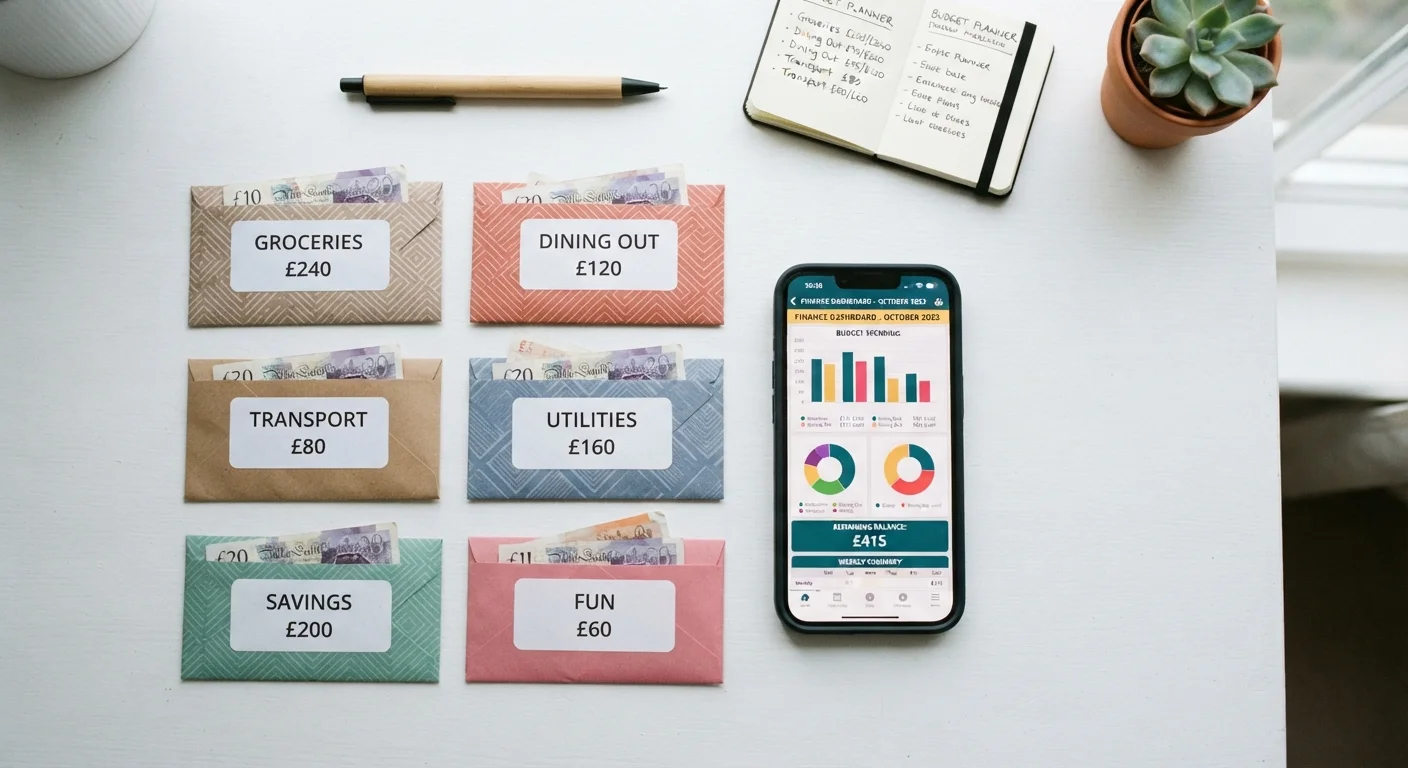
Envelope budgeting is a cash-based system rooted in a simple principle: divide your take-home pay into spending categories, place the allotted cash in a labeled envelope for each, and stop spending in that category when the envelope is empty. Common envelopes include groceries, dining out, gas, and personal spending. The method has been in use for generations and requires no technology whatsoever.
Digital spending trackers are software tools - typically mobile apps or browser-based platforms - that connect to your bank accounts and credit or debit cards to automatically log and categorize every transaction. You set budget targets per category, and the app tracks your progress throughout the month, often sending alerts when you approach a limit. For context on how this fits into broader budgeting approaches, see percentage-based vs. amount-based budgeting.
| Criterion | Envelope Budgeting | Digital Spending Trackers |
|---|---|---|
| Setup effort | Low - envelopes and cash only | Moderate - account linking and configuration |
| Works with card payments | No - cash only | Yes - syncs automatically |
| Spending visibility | Category-level only | Full transaction history |
| Behavioral enforcement | Hard stop when cash runs out | Alerts only; willpower required |
| Cost | Free | Free to paid tiers available |
| Online purchase compatibility | None | Full |
| Trend reporting | Manual tracking required | Automated charts and summaries |
| Learning curve | Very low | Low to moderate |
Where Each Method Has the Edge
Envelope budgeting excels at behavioral friction. Research in behavioral economics consistently shows that paying with cash reduces spending relative to card payments - a phenomenon sometimes called the "pain of paying." The physical act of handing over bills makes spending feel more real. If discretionary overspending is your core problem, the envelope method addresses the root cause directly rather than just reporting on it afterward.
However, envelopes become awkward fast in a digital economy. Recurring subscriptions, online purchases, and automatic bill payments are incompatible with a cash-only system. Many users end up running hybrid systems - cash envelopes for variable spending and a separate mental (or written) ledger for fixed costs - which adds complexity and defeats some of the method's simplicity.
Digital trackers win on completeness and convenience. Because they pull data directly from your accounts, they capture everything: card swipes, online purchases, bill payments, and ATM withdrawals. This gives you an accurate, whole-picture view of spending that would take hours to replicate manually. They also make it easy to review trends across months. Pair a tracker with the monthly budget review checklist to turn raw data into real adjustments.
The downside: data doesn't change behavior on its own. A tracker tells you that you overspent on dining by $140 - it doesn't stop you from doing it again next month. Consistent follow-through on the insights is entirely on the user.
~$227
Average monthly overspend in discretionary categories
A widely cited Lending Club and PYMNTS survey found that a significant share of American consumers consistently spend more than planned on non-essential categories.
12-18%
Estimated reduction in discretionary spend using cash
Multiple behavioral economics studies, including work associated with MIT and Carnegie Mellon researchers, suggest cash payers tend to spend meaningfully less than card payers in equivalent situations.
60%+
Adults who say they don't follow a formal budget
Gallup polling has consistently found that fewer than half of American adults maintain a detailed household budget, highlighting the challenge of any budgeting system requiring sustained effort.
Which One Fits Your Life?
The right choice usually comes down to two questions: How do you primarily pay for things, and what's your biggest budgeting failure mode?
If you pay mostly in cash or are willing to shift toward cash spending for discretionary categories, the envelope method is a low-friction, zero-cost system that forces discipline automatically. It works especially well for variable categories where overspending tends to creep in - groceries, clothing, and entertainment. The cash vs. card research offers useful context on how payment method affects behavior.
If your financial life is mostly digital - direct deposit, auto-pay, card transactions - a tracker is the only realistic fit. The key is treating it as an active tool, not a passive dashboard. Set a weekly check-in on your spending, not just a monthly look-back. You can explore how spending journals reveal patterns to get more from your tracking routine.
Some people run both in limited form: digital trackers for fixed and online expenses, cash envelopes for the two or three categories where they most often go over budget. That hybrid approach captures the psychological power of cash where it matters most, without sacrificing the convenience of digital tracking for everything else.
This article is for general informational purposes only and does not constitute personalized financial advice. Consult a qualified financial professional for guidance tailored to your individual circumstances.