

Key Takeaways
- Spending journals reveal behavioral patterns that bank statements and budgeting apps often miss.
- Manual journaling creates friction that slows impulsive purchases, while digital tools offer speed and automation.
- Most people discover two to four recurring spending leaks within their first two weeks of daily tracking.
- Consistency matters more than format - even a simple notes app works if used daily.
- Spending data is most useful when reviewed weekly alongside a broader monthly budget.
What a Spending Journal Actually Does
A spending journal is a deliberate record of every dollar you spend - not just the big purchases, but the $4 coffee, the impulse convenience-store stop, and the streaming service you forgot about. Its core function is to replace financial guesswork with observable data.
Bank statements show what was charged and when. A spending journal adds the layer that statements can't: why you spent, how you felt, and what context surrounded the purchase. That context is where behavioral patterns live. For anyone working to close the gap between income and savings, those patterns are where real change happens.
Tracking is also associated with greater awareness of spending triggers - boredom, stress, social pressure - that automated tools tend to categorize away rather than surface. For related insights on small charges that quietly compound, see how to find your spending leaks.
Manual vs. Digital: Choosing What You'll Actually Use
Both approaches work. The right one is whichever format you'll sustain past day five.
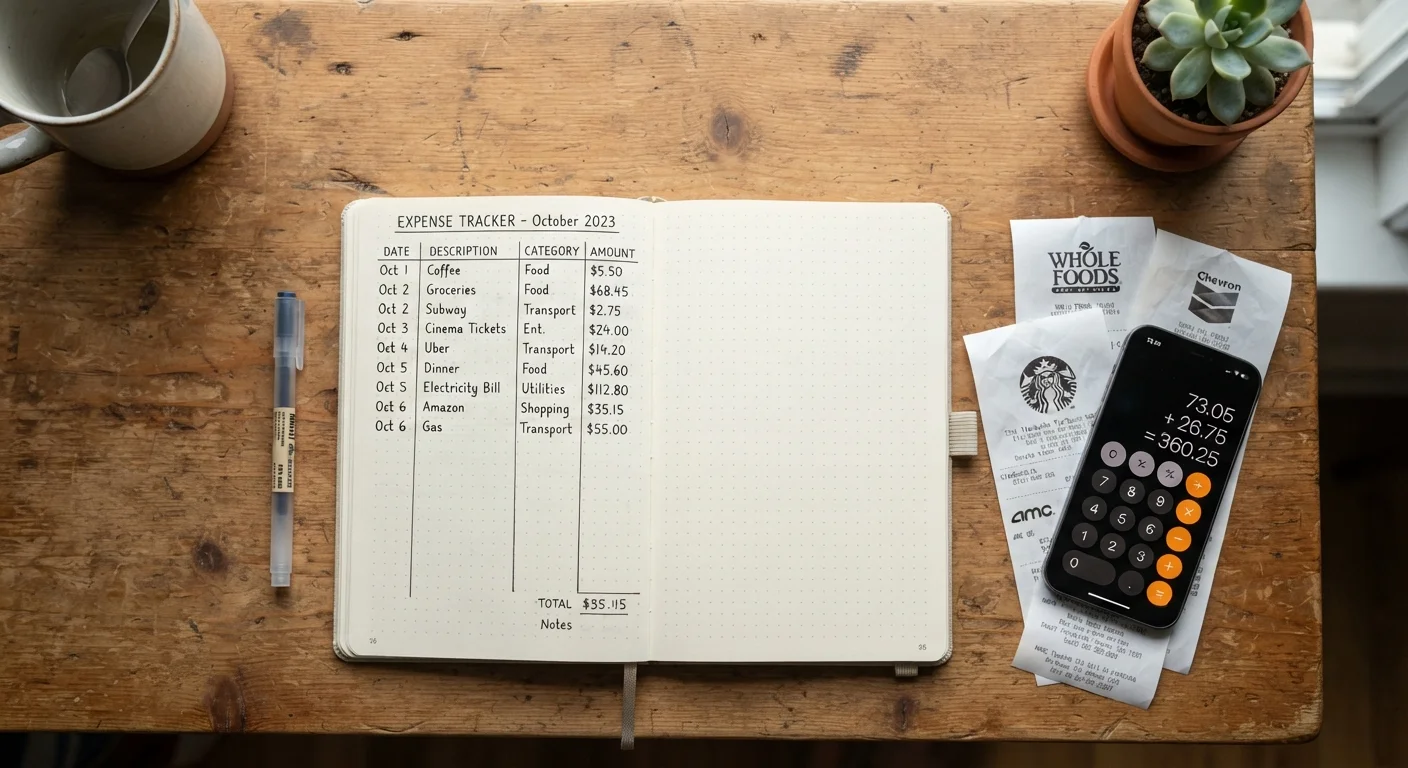
Manual (paper) journals create deliberate friction. Writing by hand slows you down, which means you're less likely to record a purchase without registering it emotionally. Research in cognitive psychology consistently finds that handwriting strengthens memory encoding - so you're more likely to remember what you spent and reconsider before you spend again.
Digital journals - whether a spreadsheet, a notes app, or a dedicated budgeting app - excel at speed and organization. You can log a purchase in seconds, sort by category, and run totals without arithmetic. The tradeoff is that speed can reduce mindfulness; it's easy to tap-log and move on without reflection.
A hybrid approach suits many people: quick digital entry for every transaction during the day, with a brief weekly manual review where you write three observations about what you noticed. For a side-by-side comparison of format philosophies, see how envelope budgeting compares to digital trackers.
What Patterns Typically Emerge
Most people who journal their spending for two to four weeks report a version of the same surprise: their mental estimate of what they spend in a category is significantly lower than what the journal reveals. This gap - call it the perception-reality gap - is the journal's most valuable output.
Common patterns that surface include:
- Cluster spending: purchases concentrated on certain days (typically Friday evenings and Sunday afternoons) that don't align with planned budget periods.
- Emotional triggers: spikes in discretionary spending tied to stressful work weeks or low-energy days.
- Subscription drift: recurring charges for services actively used months ago but forgotten since.
- Convenience premium: regularly paying more for proximity or speed - delivery fees, airport food, last-minute purchases - that accumulate into a significant monthly line item.
Identifying these patterns is the precursor to addressing them. Once you know a pattern exists, you can decide - deliberately - whether it aligns with your priorities. Use your journal data alongside a monthly budget review checklist to catch and adjust overspending before it compounds.
Building a Sustainable Tracking Habit
Tracking fails when it becomes a chore tied to guilt rather than a tool tied to curiosity. A few structural choices make the difference between a habit that lasts and one that dies by week three.
Setting a consistent logging time - right after each purchase, or during a designated five-minute evening review - removes the decision fatigue of remembering to track. Pairing it with an existing routine (morning coffee, lunch break) helps it stick. Keep your format simple enough that a bad day doesn't create a backlog that feels impossible to catch up on.
If you're deciding how frequently to review your data, consider your income and payment schedule. Weekly reviews tend to surface problems early enough to course-correct, while monthly reviews are better suited to identifying larger structural patterns. For a fuller discussion of review cadences, see weekly vs. monthly budgeting trade-offs.
This article provides general financial information for educational purposes only and does not constitute personalized financial advice. For guidance specific to your situation, consult a qualified financial professional.