

Key Takeaways
- Every dollar of income is assigned a job before you spend it, leaving a balance of zero.
- Zero-based budgeting differs from traditional budgeting by requiring active monthly rebuilding rather than rolling over prior allocations.
- Savings and debt payments count as budget categories, not afterthoughts.
- The method works best for people with relatively stable, predictable income.
- It requires more upfront effort than percentage-based methods but offers greater spending clarity.
Zero-Based Budgeting
Zero-based budgeting (ZBB) is a method where you allocate every dollar of your income to a specific category-expenses, savings, or debt repayment-so your income minus your total allocations equals exactly zero. It doesn't mean spending everything you earn; it means every dollar has a deliberate assignment before the month starts. This approach forces intentional decision-making with each paycheck rather than spending by default.
ZBB originated in corporate finance in the 1970s as a way to justify every budget line from scratch each period, rather than building on prior-year figures. The personal finance adaptation follows the same logic at the household level.
How Zero-Based Budgeting Actually Works
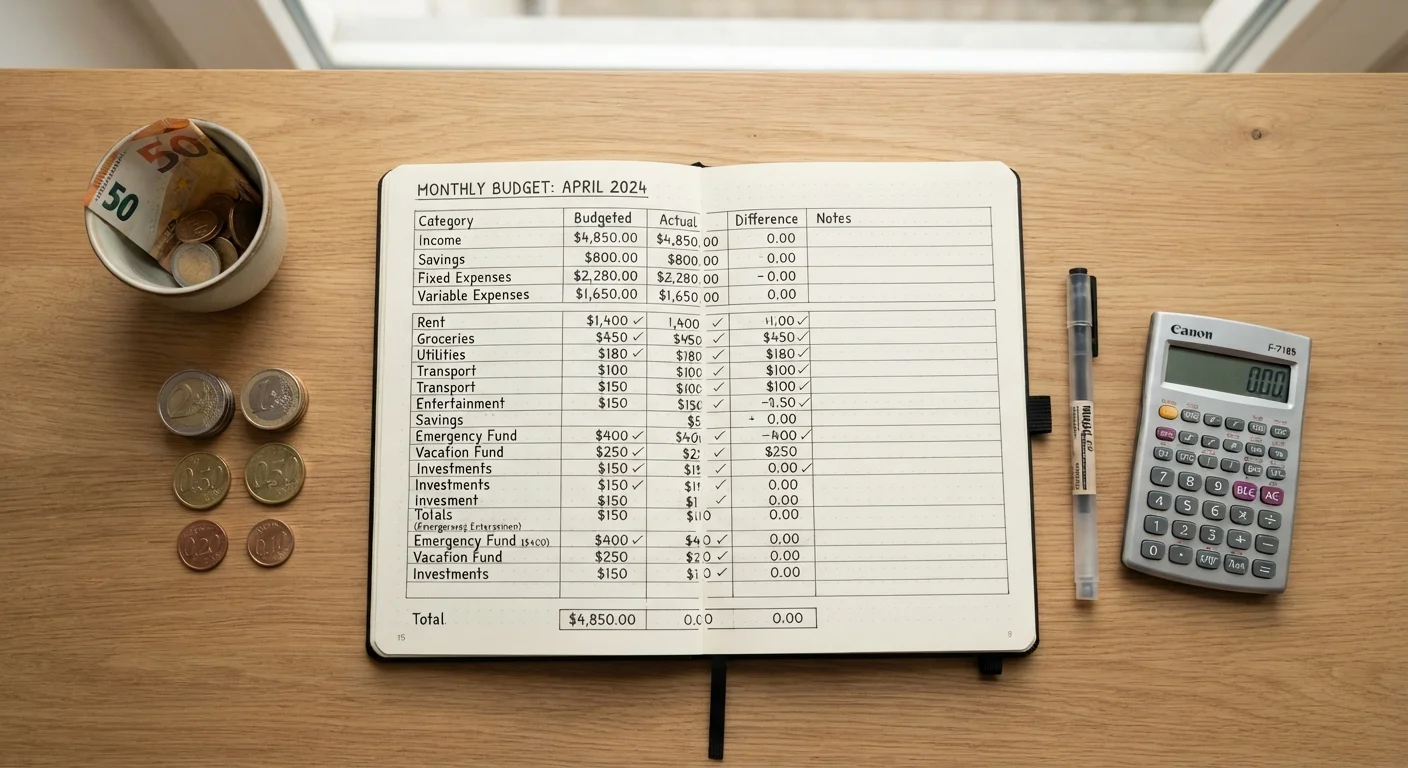
The mechanics of ZBB are straightforward: start with your total monthly take-home income, then build a list of budget categories and assign dollar amounts until the remaining balance reaches zero. Every category-rent, groceries, utilities, car insurance, streaming subscriptions, savings, credit card payments-gets a line item.
The key distinction from traditional budgeting is that you rebuild the budget from zero each month rather than copying last month's numbers forward. That reset forces you to consciously decide whether last month's categories and amounts still make sense given your current priorities and expenses.
For example, if you earned $3,800 in take-home pay, your budget might look like this: $1,200 for rent, $400 for groceries, $180 for utilities, $300 for transportation, $250 for debt repayment, $400 for savings, and the remainder distributed across personal spending, subscriptions, and a small miscellaneous buffer-totaling exactly $3,800. Nothing is left unassigned.
ZBB Applies Beyond Monthly Expenses
Zero-based budgeting principles extend naturally to saving for a specific trip or large purchase. The same logic-assigning every dollar before spending it-works well for travel budgeting, where a defined savings target keeps your plans grounded in real numbers.
For a broader overview of budgeting frameworks and how ZBB fits into your overall financial picture, see the complete budgeting starting point guide.
Why It Differs from Traditional Budgeting
Most conventional budgets start with fixed recurring expenses and loosely track discretionary spending against whatever is left over. The problem: that leftover money tends to disappear without a clear record of where it went. Zero-based budgeting eliminates that gray zone by requiring every dollar to have a named destination before it's spent.
Traditional budgets also often carry over unchanged from month to month, which means outdated spending assumptions quietly persist. ZBB's monthly rebuild surfaces those assumptions-like that gym membership you stopped using or a subscription price that quietly increased.
“A budget is telling your money where to go instead of wondering where it went.”
— John C. Maxwell, Author and speaker on leadership and personal development
Compare this approach with other methods by exploring envelope budgeting versus digital spending trackers to see which format suits your daily habits.
Who Benefits Most-and Where It Gets Challenging
Zero-based budgeting tends to deliver the clearest results for people who:
- Receive a predictable monthly paycheck and can estimate income reliably
- Feel their money is disappearing without knowing where it goes
- Are working toward a specific financial goal, such as paying off debt or building an emergency fund
- Are willing to spend 20-30 minutes per month maintaining the budget
The method is more demanding for households with irregular income-freelancers, gig workers, or commission-based earners-because the foundation of ZBB is knowing what you have before you allocate it. A practical workaround is to budget from a conservative income floor and allocate any additional earnings when they arrive.
ZBB also requires honest categorization. Underestimating grocery or fuel costs will leave you scrambling to reallocate mid-month. The first two or three months typically involve the most adjustment as you calibrate your spending patterns against your allocations.
If you're building a household budget for the first time, the six-step household budget guide provides a solid foundation before layering on the ZBB framework.
This article is for general informational and educational purposes only and does not constitute personalized financial advice. Consult a qualified financial professional for guidance specific to your situation.