

| Governing body for pet food standards (U.S.) | Association of American Feed Control Officials (AAFCO) |
| Required panels on every pet food label | Product name, net weight, ingredient list, guaranteed analysis, nutritional adequacy statement, feeding directions, manufacturer info (AAFCO Model Regulations) |
| Ingredient list order | Descending by pre-processing weight |
| Life stages recognized by AAFCO | Growth, Reproduction, Adult Maintenance, All Life Stages |
| Moisture max in dry kibble | Typically ≤ 12% |
| Moisture max in canned/wet food | Up to 78% |
The Seven Required Label Sections
Every commercially sold pet food in the United States must display seven core pieces of information, as outlined in AAFCO model regulations. Knowing what each one is supposed to communicate is the first step to reading any label with confidence.
| Governing body for pet food standards (U.S.) | Association of American Feed Control Officials (AAFCO) |
| Required panels on every pet food label | Product name, net weight, ingredient list, guaranteed analysis, nutritional adequacy statement, feeding directions, manufacturer info (AAFCO Model Regulations) |
| Ingredient list order | Descending by pre-processing weight |
| Life stages recognized by AAFCO | Growth, Reproduction, Adult Maintenance, All Life Stages |
| Moisture max in dry kibble | Typically ≤ 12% |
| Moisture max in canned/wet food | Up to 78% |
The product name itself carries regulatory meaning. If a single ingredient (such as "chicken") makes up the product name with no qualifier, that ingredient must constitute at least 95% of the total formula by weight (excluding water). Add the word "dinner," "entrée," or "formula" and that threshold drops to 25%. A label reading "with chicken" only requires 3%. These thresholds apply to both dog and cat food under AAFCO guidelines.
This article is part of a broader look at responsible pet ownership, where nutrition is just one of many daily considerations.
Ingredient List: What the Order Actually Means
Ingredients are listed by pre-cooking weight in descending order. That means the first ingredient is heaviest before any water is removed during processing. This is important context: a whole meat listed first (like "chicken") may weigh more than a meal ingredient (like "chicken meal") before cooking, but chicken meal is already dehydrated and typically contains more concentrated protein per pound.
"Ingredient splitting" is a practice where a manufacturer lists variations of the same ingredient separately-for example, "ground corn," "corn gluten meal," and "corn flour"-which pushes each item lower on the list than a combined corn entry would appear. While not inherently deceptive, it's worth recognizing when scanning a label.
Labels Reflect Quantity, Not Always Quality
The guaranteed analysis tells you how much crude protein or fat is present, but not how digestible or bioavailable those nutrients are. A food with a high crude protein percentage may still deliver fewer usable amino acids than one with a slightly lower figure if it relies on less digestible sources. For deeper context on protein quality, see protein sources and digestibility.
By-products and organ meats are not automatically inferior. Liver, kidney, and heart are nutrient-dense foods in their own right. What matters more is the named source: "chicken by-products" is more informative than "poultry by-products," since the latter leaves the species unspecified.
Guaranteed Analysis and the AAFCO Nutritional Adequacy Statement
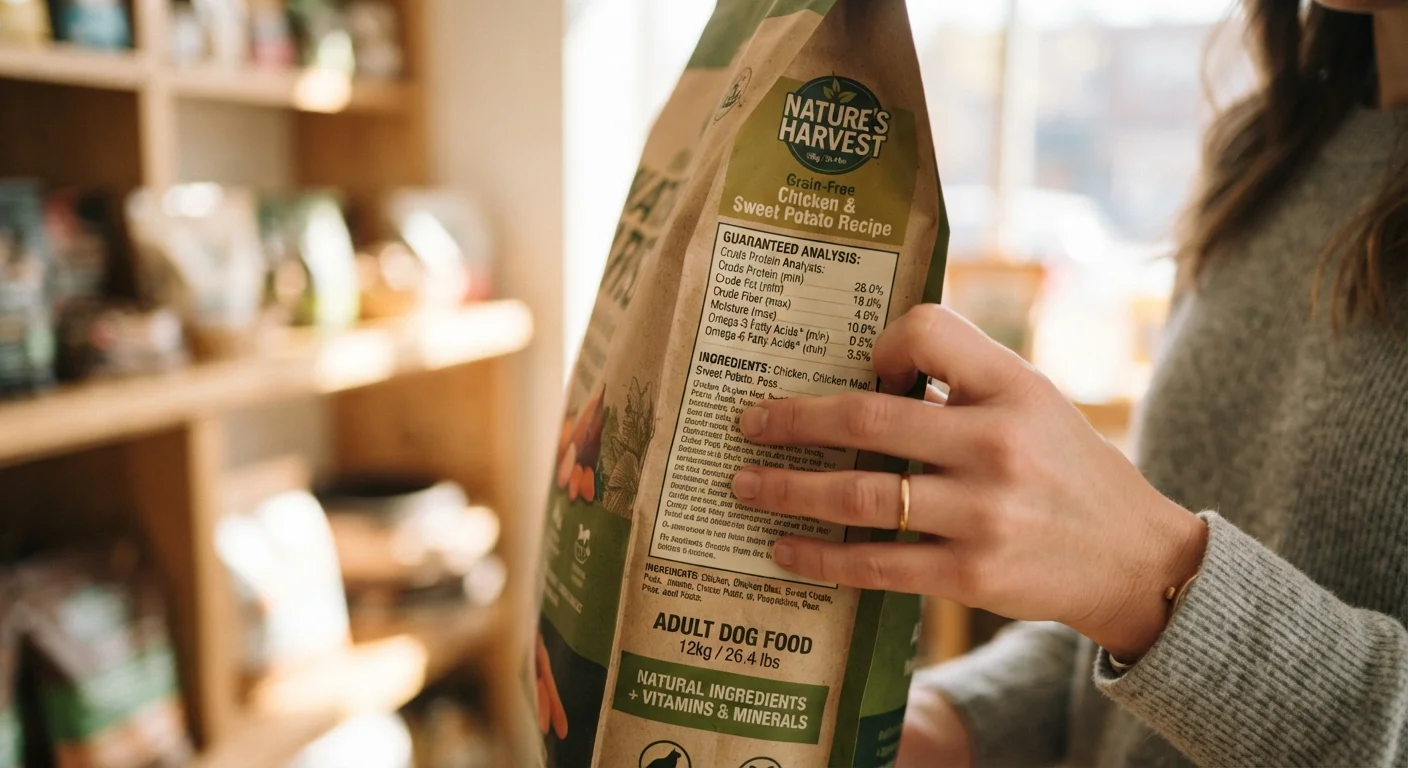
The guaranteed analysis panel lists four values at minimum: crude protein (minimum %), crude fat (minimum %), crude fiber (maximum %), and moisture (maximum %). Some labels voluntarily add others such as taurine, omega fatty acids, or calcium.
Guaranteed Analysis
A mandatory label panel that lists minimum percentages of crude protein and crude fat, and maximum percentages of crude fiber and moisture. These are regulatory minimums and maximums, not precise nutrient measurements.
AAFCO Statement
A declaration on pet food labels indicating whether the product meets nutritional standards set by the Association of American Feed Control Officials. It specifies which life stage the food is formulated for.
As-Fed Basis
Nutrient values reported as they appear in the food at its current moisture level, before any drying or adjusting. Comparing wet and dry foods requires converting to dry matter basis.
Dry Matter Basis
Nutrient values calculated after removing all moisture, allowing meaningful comparison between wet, dry, and raw pet foods with very different water content.
Crude Protein
An estimate of total protein content calculated by measuring nitrogen in the food. It reflects quantity, not digestibility or amino acid quality.
By-Products
Secondary parts of an animal after the primary cuts are removed, such as organs, lungs, or blood. Nutritional value varies; organ meats like liver can be nutrient-dense.
Because wet and dry foods contain very different moisture levels, direct comparisons using as-fed numbers are misleading. To compare accurately, calculate nutrients on a dry matter basis: subtract the moisture percentage from 100 to get the dry matter percentage, then divide the nutrient percentage by that figure and multiply by 100.
The AAFCO nutritional adequacy statement is arguably the most important line on the label. It tells you two things: whether the food is complete and balanced (meaning it's intended as a sole diet, not a supplement or treat), and which life stage it supports. A food labeled for "All Life Stages" must meet the more demanding standards for growth and reproduction. If you're managing your pet's weight alongside their diet, body condition scoring offers a practical complement to label reading.
The adequacy statement also discloses the method used: formulated to meet indicates laboratory analysis, while animal feeding tests indicates the food was tested on live animals using AAFCO protocols. Neither method is inherently superior, but feeding trials provide real-world palatability and tolerance data.
This article is intended for general informational purposes only and does not constitute veterinary or medical advice. Always consult a licensed veterinarian for guidance specific to your pet's health and nutritional needs.