

Why Body Language Fluency Matters Before You Train
Effective dog training isn't just about cues and rewards - it's a two-way conversation. Before you ask your dog to perform any behavior, knowing how to read what your dog is already communicating lets you adjust timing, pacing, and environment to set them up for success. Dogs signal discomfort, confusion, and readiness through posture, facial expression, and movement long before they act out or shut down.
Misreading these signals is one of the most common reasons training stalls. A dog that appears "stubborn" is often overwhelmed; one that seems "distracted" may be scanning for an exit. Understanding what your dog is actually communicating - tail position, ear angle, weight distribution - gives you the foundation to train humanely and effectively.
This reference covers the signals most relevant during training sessions: what relaxed engagement looks like, how stress shows up early, and what escalation signs mean you need to pause immediately.
Signs Your Dog Is Ready and Engaged
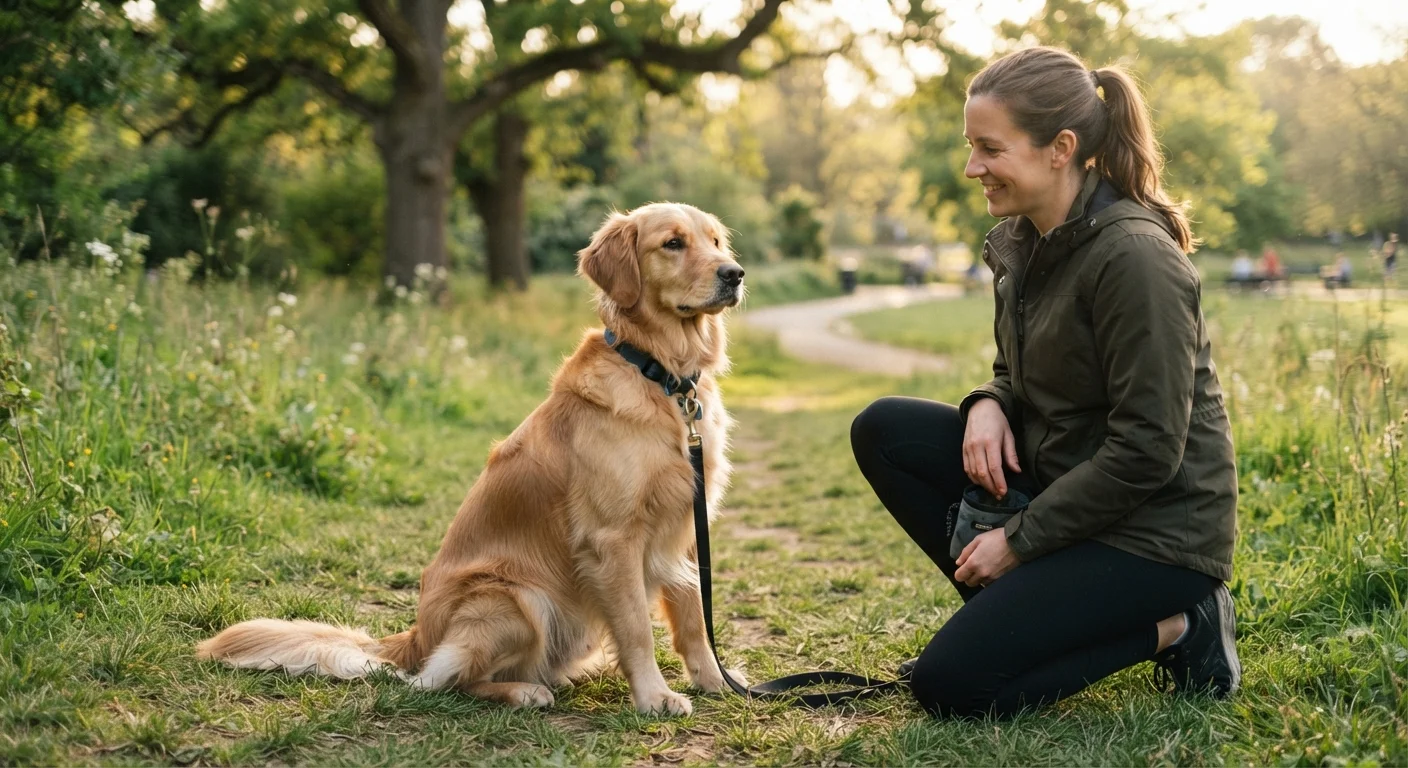
A dog in a receptive training state shows a cluster of relaxed, attentive signals. Learning to recognize this baseline helps you confirm when to introduce new behaviors or increase difficulty.
Calming signals
A set of visual behaviors dogs use to communicate stress, de-escalate tension, or signal a desire to avoid conflict. First catalogued by Norwegian trainer Turid Rugaas, they include yawning, lip-licking, and turning away.
Displacement behavior
An out-of-context action - such as sudden sniffing or scratching - that occurs when a dog is conflicted or anxious. It serves as a behavioral pressure valve during stressful situations.
Whale eye
The visible exposure of the whites (sclera) of a dog's eye, typically when the head is turned away but the gaze stays fixed. It is a recognized warning signal indicating tension or discomfort.
Piloerection (hackles)
Involuntary raising of the fur along a dog's spine, caused by the same nervous system response as goosebumps in humans. It signals heightened arousal - which may be excitement, fear, or aggression depending on context.
Operant conditioning
A learning process in which behavior is shaped by its consequences. In dog training, this typically involves reinforcing desired behaviors with rewards to increase their frequency.
Threshold
The point at which a dog's arousal or stress level crosses from manageable into reactive or overwhelmed. Keeping dogs "under threshold" during training sessions is a key principle of force-free methods.
- Soft eyes: Relaxed, slightly squinting appearance - not hard, wide, or fixed.
- Loose mouth: Jaw slightly open, tongue may loll; no tension in the lips or muzzle.
- Ears forward or slightly to the side: Oriented toward you, not pinned back or rigid.
- Smooth, mid-height tail wag: Broad, circular or side-to-side movement; tail held at or below back level.
- Weight distributed evenly: Four paws on the ground, no exaggerated lean forward or back.
- Orientation toward handler: Dog naturally checks in with eye contact or turns body toward you.
When you observe this combination, your dog is telling you the session conditions work for them. Build on that window rather than pushing through when it closes.
Early Stress Signals to Catch Immediately
Stress signals - sometimes called calming signals in behavioral literature - appear well before a dog becomes reactive or shuts down. Catching them early is the key to humane, productive training. The following behaviors, especially in clusters, indicate your dog needs a break, a simpler task, or a change of environment.
- Yawning outside of sleepiness: A slow, exaggerated yawn during training is a self-soothing behavior.
- Lip licking or nose licking: A quick flick of the tongue to the nose, unrelated to food, signals low-grade anxiety.
- Turning head or body away: Avoidance of direct eye contact or physically orienting away from you.
- Blinking slowly or looking away: Used to de-escalate perceived pressure.
- Sniffing the ground suddenly: When not tracking a scent trail, sudden ground-sniffing during a cue is often displacement behavior.
- Shaking off: A full-body shake, like after a bath, can reset tension between interactions.
- Slow movement or freezing: Slowing down in response to a cue or going still signals the dog is conflicted.
If you notice two or more of these signals in sequence, reduce criteria, shorten the session, or end on an easy success. Pushing through early stress signals is associated with faster escalation and long-term aversion to training. For a deeper look at how aversive experiences affect behavior, see how punishment-based training affects dogs behaviorally and emotionally.
Escalation Signs That Mean Stop Now
Some body language signals indicate a dog is moving past manageable stress into a state where continued training is counterproductive - or unsafe. Recognize these as clear stop signals, not challenges to overcome.
- Whale eye: The white of the eye (sclera) becomes visible as the dog turns its head but keeps its gaze fixed - a high-tension warning.
- Hard stare: Unblinking, direct, fixed gaze toward a person, dog, or object.
- Stiff, rigid posture: All muscles appear tense; weight may shift forward onto front legs.
- Tail held high and still, or tucked tightly: Either extreme - rigidly elevated or clamped under the body - signals significant arousal or fear.
- Raised hackles: Piloerection along the spine from neck to tail base indicates high arousal; not always aggressive, but always meaningful.
- Lip curling or teeth exposure: A visible warning that should never be ignored or punished away.
- Growling: Vocalized warning - the dog is communicating discomfort clearly. Suppressing growling removes a critical safety signal.
When any of these appear, end the session calmly without punishment. Consult a certified professional dog trainer or veterinary behaviorist if escalation signals occur regularly. Once you have a reliable read on your dog's emotional state, building core commands becomes far more effective and sustainable.
This article provides general educational information about dog behavior and is not a substitute for professional behavioral assessment. If your dog shows frequent stress or warning signals, consult a qualified veterinary behaviorist or certified professional dog trainer.