

Key Takeaways
- Scratching is a normal feline behavior driven by instinct, not spite or defiance.
- Post placement, texture, and height are critical factors in whether a cat will accept a scratching post.
- Positive reinforcement - treats, play, and praise - is far more effective than punishment.
- Consistency and patience over one to three weeks typically yields lasting behavior change.
- Never declaw; it is a surgical amputation with documented long-term physical and behavioral consequences.
What you will need
Why Cats Scratch - and Why It Matters for Training
Scratching is among the most misunderstood feline behaviors in domestic households. It is not an act of retaliation or stubbornness. Cats scratch for three biologically grounded reasons: claw maintenance, physical stretching, and scent communication. The glands between a cat's toes release pheromones during scratching, leaving invisible chemical signals that mark territory and provide reassurance in familiar spaces.
Because the behavior is instinct-driven, any successful training approach must work with the instinct rather than against it. Punishment suppresses the visible behavior temporarily but does nothing to address the underlying need - and can introduce stress that actually escalates marking behaviors. The goal of this guide is to make the scratching post so consistently rewarding that your cat chooses it over your furniture without coercion.
It is also worth noting that if your cat is scratching their own body excessively rather than surfaces, that is an entirely different concern. See our guide to skin conditions in pets for information on what repetitive self-scratching may signal medically.
Declawing Is Not a Solution
Declawing (onychectomy) removes the last bone of each toe and is considered a major surgical procedure by veterinary organizations including the American Veterinary Medical Association. It is associated with chronic pain, altered gait, and increased biting behavior. Many states and municipalities have banned the practice. Redirect scratching through training instead.
Setting Up for Success: Tools and Placement
The single biggest reason scratching posts fail is poor selection or placement. A post that wobbles, sits in an unused corner, or offers an unappealing texture will be ignored entirely. Review the tools listed below before beginning, and prioritize stability and location above all else.
Sisal Scratching Post (vertical)
Provides a stable, rough-textured surface that mimics tree bark and satisfies cats' instinct to scratch and stretch vertically.
Corrugated Cardboard Scratcher (horizontal)
Offers an alternative texture and orientation for cats that prefer scratching low, flat surfaces like carpet or rugs.
High-Value Cat Treats
Used immediately after desired scratching behavior to reinforce positive associations with the post.
Catnip or Catnip Spray
Applied to the post to attract the cat's attention and encourage initial investigation.
Double-Sided Furniture Tape
Applied to furniture surfaces to make them temporarily unappealing without harming the cat.
Interactive Wand Toy
Used to guide play sessions near the scratching post, building a positive association with the area.
Match the Post to Your Cat's Preference
Watch where and how your cat currently scratches. Cats that favor carpet tend to prefer horizontal surfaces; those targeting vertical couch arms often prefer tall, upright posts. Offering both types when starting out helps you identify which your individual cat prefers, improving the odds of quick adoption.
For indoor cats especially, providing enriching scratch outlets is part of meeting their full behavioral needs. Our overview of indoor versus outdoor cat considerations explores how environment shapes feline behavior more broadly.
Step-by-Step: Redirecting the Behavior
Follow the steps below in order. Most cats show measurable improvement - consistently choosing the post over furniture - within one to three weeks when the process is applied consistently. Individual cats vary; seniors or cats with established long-term habits may take longer.
Understand Why Cats Scratch
Before training can succeed, it helps to understand the function scratching serves. Cats scratch to shed the dead outer sheath of their claws, to stretch the muscles of their back and shoulders, and to deposit scent from glands in their paws - marking territory in a way that feels instinctively necessary. Scratching is not destructive behavior in the feline world; it is maintenance and communication. Recognizing this reframes your goal: you are not eliminating a behavior, you are redirecting it to an appropriate outlet.
Choose the Right Scratching Post
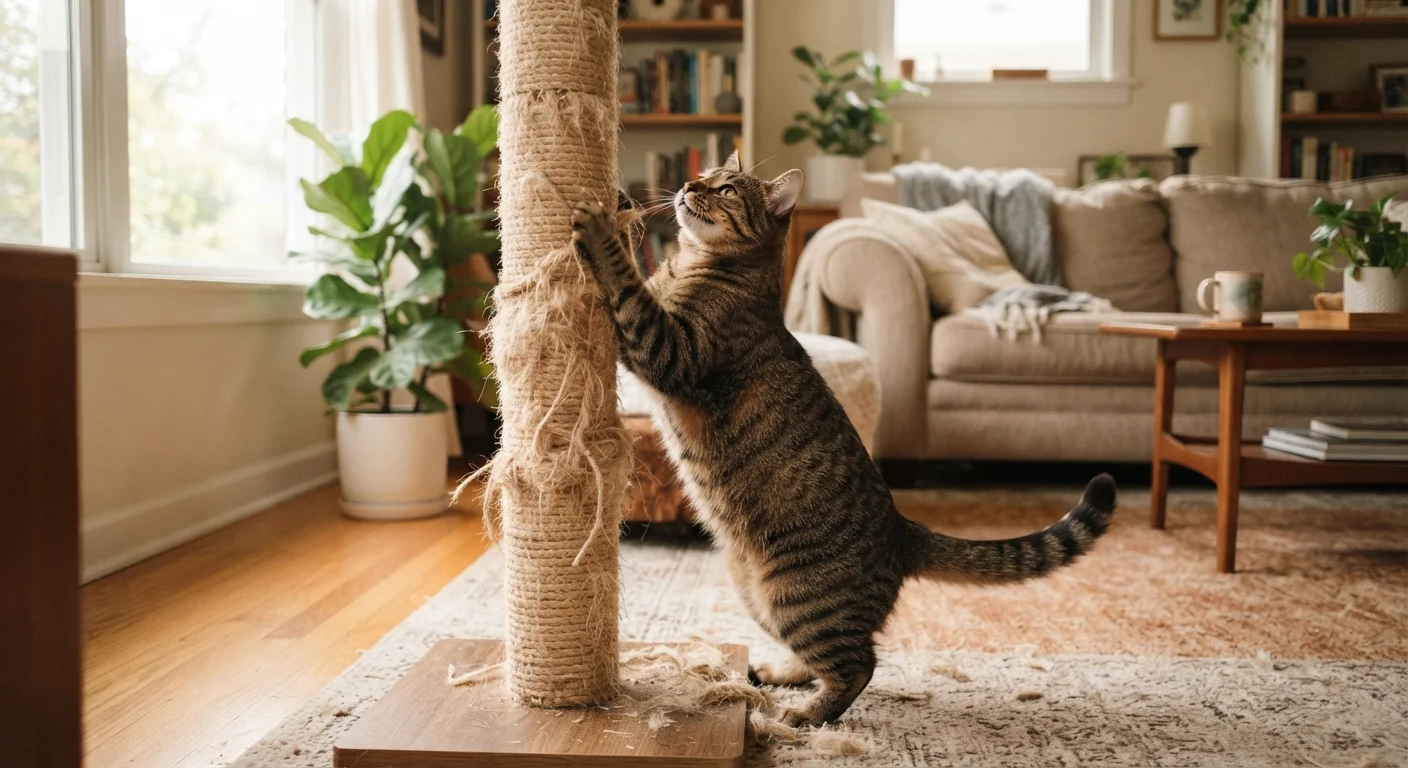
Select a post that is tall enough for your cat to fully extend their body - generally at least 28 to 32 inches for an average adult cat. The post must be stable; any wobble will cause most cats to abandon it immediately. Sisal rope and woven sisal fabric are the most widely accepted textures because they provide satisfying resistance. Avoid posts covered only in looped carpet, which can snag claws uncomfortably. If budget allows, start with both a vertical post and a horizontal cardboard scratcher to determine your individual cat's preference.
Position the Post Strategically
Place the post in the locations where your cat already scratches - near the sofa arm they favor, beside the doorway they mark, or adjacent to their sleeping area. Cats scratch in socially significant spots, so placing a post in a back room your cat rarely visits will not work. If you have multiple problem areas, use multiple posts. Once your cat reliably uses a post, you can gradually move it - a few inches per day - toward a location that suits your home better.
Introduce the Post with Positive Reinforcement
Sprinkle a small amount of dried catnip on the base and lower portion of the post, or use a catnip spray if your cat responds to it (note: roughly one-third of cats are not strongly affected by catnip due to genetics). Use a wand toy to initiate play near the post, letting the toy brush against the surface so your cat's paws naturally contact it. The moment your cat places their paws on the post - even briefly - reward with a small, high-value treat and calm verbal praise. Never physically move your cat's paws onto the post, as this can cause stress and negative associations.
Make Furniture Less Appealing Temporarily
While you build the post habit, reduce the reward of scratching furniture by applying double-sided tape (sold specifically for this purpose) to the surfaces your cat targets. Cats dislike the sticky sensation on their paws and will typically disengage quickly. Loosely draped aluminum foil can serve a similar purpose. These deterrents are temporary tools - use them only while the cat is building a consistent relationship with the post, then remove them gradually over two to three weeks.
Maintain the Post and Reinforce Long-Term
As your cat uses the post, the surface will accumulate their scent - which actually makes it more attractive over time. Resist the urge to replace or heavily clean a well-used post too soon, as you would be removing exactly what makes it appealing. Trim your cat's nails every two to three weeks using a proper pet nail trimmer to reduce the impact of any scratching that does occur on furniture. Continue to reward post use with occasional treats and play even after the habit is established, to keep the behavior durable.
Understanding your cat's overall communication style can help you read when they are stressed, engaged, or receptive to training. Our guide to reading your pet's body language covers feline signals that are directly relevant to training sessions.
Troubleshooting Common Setbacks
If your cat continues to ignore the post after two weeks of consistent effort, reassess three variables: texture, height, and location. Try a different material - some cats strongly prefer cardboard over sisal. Ensure the post is tall enough for a full vertical stretch. Move it directly in front of the furniture being scratched, even if that placement feels inconvenient for now.
Households with multiple cats may need one post per cat plus at least one additional post, as competition for resources can prevent any single cat from developing a reliable post habit. Scratching is also a territorial signal - in multi-cat homes, each cat benefits from having their own dedicated surfaces to mark.
If litter box problems are co-occurring alongside scratching issues, it may be worth evaluating whether stress or an underlying medical issue is a broader factor. Our guide to litter box problems in cats can help distinguish training gaps from medical concerns that warrant a veterinary visit.