
Living Out of One Carry-On: What Works, What Doesn't, and What Gets Left Behind

Key Takeaways
- Carry-on-only travel eliminates checked bag fees and baggage claim wait times.
- The biggest challenges are laundry logistics, variable weather, and special gear needs.
- Trip length, destination climate, and activity type all affect whether one bag is realistic.
- Strategic packing choices - not just fewer items - determine success with a single bag.
- Some trips genuinely require more luggage; knowing the difference saves real frustration.
No checked bag fees on most domestic routes
Domestic carriers typically charge $35-$45 per checked bag each way, meaning a round trip can save $70-$90 per person - more on budget carriers with stricter fee structures.
Faster airport experience from curb to gate
Skipping check-in lines and baggage drop can save 20-40 minutes at busy airports, and arriving at the destination without a baggage claim stop adds another 20-30 minutes back to your day.
No risk of lost or delayed luggage
Airlines mishandled approximately 6 bags per 1,000 passengers on US domestic routes in recent reporting periods; keeping everything with you eliminates that risk entirely.
Greater mobility between destinations
Navigating public transit, cobblestone streets, or overnight trains is significantly easier with one bag you can carry, rather than a wheeled suitcase requiring flat, smooth surfaces.
Forces intentional, lighter packing habits
The physical constraint of a carry-on encourages travelers to think critically about what they actually use, often resulting in trips that feel less burdened and more spontaneous.
Laundry becomes a regular trip task
Carry-on-only travel on trips longer than four or five days typically requires doing laundry en route, which adds logistical planning and occasional cost - not every destination makes this easy.
Multi-climate itineraries are genuinely difficult
Packing for both cold-weather and hot-weather segments in one bag requires careful layering strategies and often means compromising comfort in one climate or the other.
Specialized gear rarely fits
Activities like skiing, hiking with full equipment, golf, or formal events requiring suits and dress shoes are difficult to accommodate in a standard carry-on without renting gear at the destination.
Liquid and TSA rules limit toiletry options
The TSA 3-1-1 rule restricts liquids to 3.4-oz containers, which creates challenges for travelers with specific skincare, haircare, or medical liquid needs that can't be sourced locally.
Size limits vary by airline and aircraft
Carry-on size allowances differ between carriers and can be smaller on regional jets or international budget airlines, meaning a bag that qualifies on one flight may not on another.
Our Verdict
Carry-on-only travel delivers genuine advantages in speed, savings, and simplicity - but it asks real trade-offs of certain trip types. It works remarkably well for city-focused, warm-weather, or shorter trips where laundry access is available. For outdoor adventures, multi-climate itineraries, or trips requiring formal attire, the constraints become harder to work around without careful planning.
Travelers taking week-or-shorter trips to urban destinations who prioritize mobility and are comfortable with a small laundry routine on the road.
Why Travelers Go Carry-On Only
The appeal is straightforward: skip the check-in line, skip baggage claim, and skip the nerve-wracking wait to find out whether your bag made the connection. For many travelers, the switch to a single carry-on starts as an experiment and becomes a permanent habit.
Beyond convenience, there's a real financial angle. Checked bag fees on domestic US carriers typically run $35-$45 per bag each way, and those costs stack up fast on multi-leg itineraries or family trips. Travelers planning around a real budget - something the Travel Budgeting From the Ground Up walks through in detail - often identify baggage fees as one of the more predictable costs to reduce.
There's also a mindset shift that many carry-on converts describe: packing less forces clearer thinking about what you actually need. That intentionality tends to make trips feel less cluttered - physically and mentally.
No checked bag fees on most domestic routes
Domestic carriers typically charge $35-$45 per checked bag each way, meaning a round trip can save $70-$90 per person - more on budget carriers with stricter fee structures.
Faster airport experience from curb to gate
Skipping check-in lines and baggage drop can save 20-40 minutes at busy airports, and arriving at the destination without a baggage claim stop adds another 20-30 minutes back to your day.
No risk of lost or delayed luggage
Airlines mishandled approximately 6 bags per 1,000 passengers on US domestic routes in recent reporting periods; keeping everything with you eliminates that risk entirely.
Greater mobility between destinations
Navigating public transit, cobblestone streets, or overnight trains is significantly easier with one bag you can carry, rather than a wheeled suitcase requiring flat, smooth surfaces.
Forces intentional, lighter packing habits
The physical constraint of a carry-on encourages travelers to think critically about what they actually use, often resulting in trips that feel less burdened and more spontaneous.
Where Carry-On Travel Gets Complicated
The limitations show up quickly on certain trip types. A week in a single warm city? One bag is manageable. Two weeks across three countries with different climates, a wedding, a hiking segment, and February temperatures? The math gets hard fast.
Laundry is the central variable. Carry-on travel essentially requires doing laundry every three to five days - either at a laundromat, via hotel services, or by hand-washing in a sink. That's workable in cities with easy laundry access, but it adds planning friction that not every traveler wants. It's also worth factoring into the kind of flexible itinerary structure that leaves room for the unexpected.
Specialized gear is another genuine barrier. Ski equipment, golf clubs, hiking boots, formal wear, CPAP machines, and musical instruments all resist compression into a 22-inch bag. Renting gear at the destination is one workaround, but it's not always available or cost-effective.
Laundry becomes a regular trip task
Carry-on-only travel on trips longer than four or five days typically requires doing laundry en route, which adds logistical planning and occasional cost - not every destination makes this easy.
Multi-climate itineraries are genuinely difficult
Packing for both cold-weather and hot-weather segments in one bag requires careful layering strategies and often means compromising comfort in one climate or the other.
Specialized gear rarely fits
Activities like skiing, hiking with full equipment, golf, or formal events requiring suits and dress shoes are difficult to accommodate in a standard carry-on without renting gear at the destination.
Liquid and TSA rules limit toiletry options
The TSA 3-1-1 rule restricts liquids to 3.4-oz containers, which creates challenges for travelers with specific skincare, haircare, or medical liquid needs that can't be sourced locally.
Size limits vary by airline and aircraft
Carry-on size allowances differ between carriers and can be smaller on regional jets or international budget airlines, meaning a bag that qualifies on one flight may not on another.
What Experienced Packers Leave Behind (and What They Don't)
Seasoned carry-on travelers tend to converge on a few hard-won rules. "Just in case" items are the first casualties - that extra pair of shoes, the backup outfit, the full-size hairdryer that "might not be at the hotel." Hotels almost universally provide hairdryers; most destinations have pharmacies for forgotten toiletries.
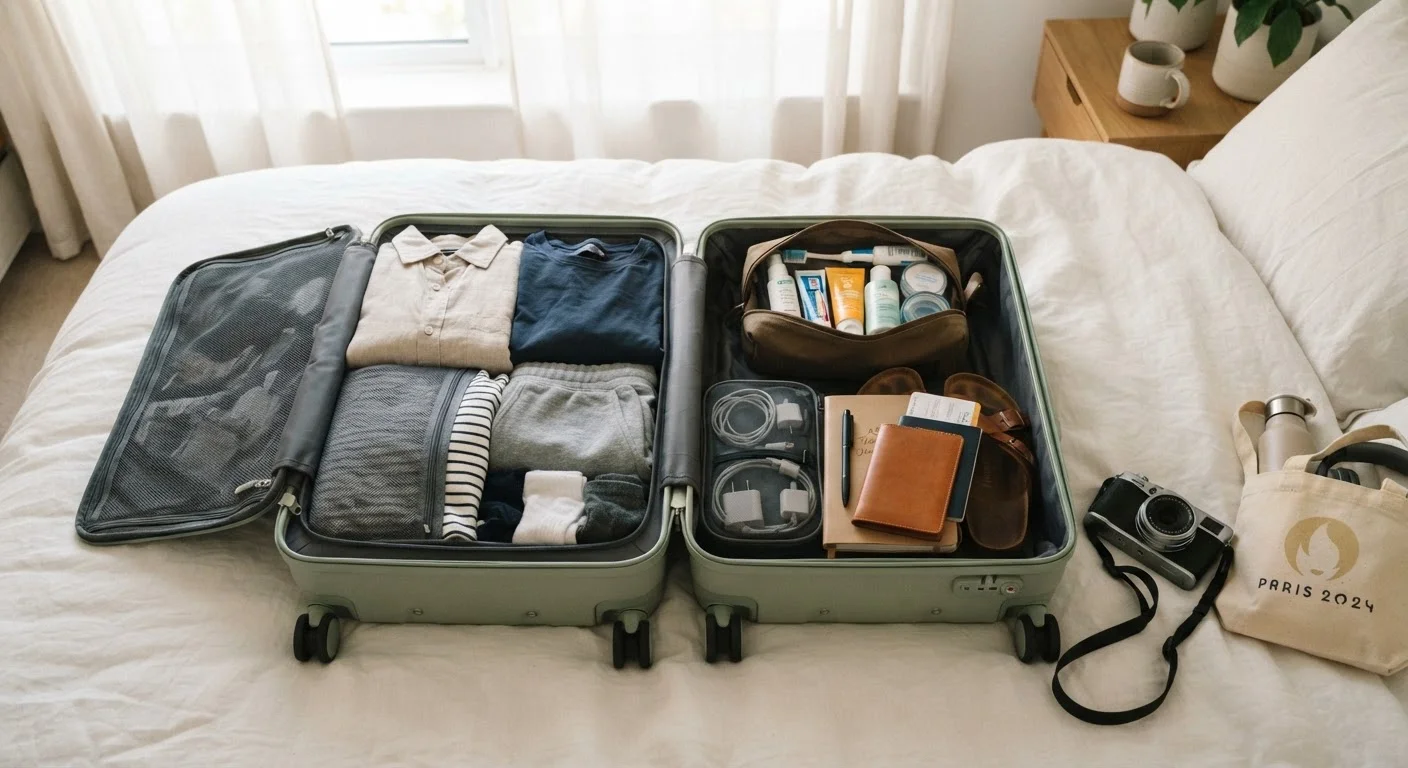
What stays in the bag: one pair of versatile shoes that works for walking and dinner, a neutral-color clothing palette that mixes easily, quick-dry fabrics that hand-wash and dry overnight, and a well-edited toiletry kit using travel-size or solid formats. A lightweight packable layer covers most temperature surprises without taking much space.
Know Your Airline's Carry-On Policy
Carry-on size limits are not universal. Standard US carrier allowances are typically around 22 x 14 x 9 inches, but regional jets and international budget airlines often have stricter limits. Some carriers also have weight caps on carry-ons, which is less common domestically but standard on many international routes. Always verify the specific policy for every carrier on your itinerary before packing.
Electronics deserve special attention. Cords, adapters, and chargers accumulate fast and weigh more than expected. A single multi-port USB-C charger and a universal adapter typically replace four to six separate items. For longer trips, this is one of the highest-return packing decisions available.
For travelers planning complex itineraries, the right trip organization tools can help audit a packing list before you zip up - cross-referencing activities, weather, and laundry access across each destination.
When One Bag Is the Wrong Choice
Carry-on-only travel has real fans, but it genuinely doesn't suit every trip. Long-haul journeys with multiple climate zones, trips that include formal events, or any itinerary built around equipment-heavy activities are situations where checking a bag is simply the practical call. For context on what long-haul trips actually require logistically, the long-haul planning guide outlines the full scope.
6 per 1,000
Bags mishandled per 1,000 passengers (US domestic)
US Department of Transportation Air Travel Consumer Reports track mishandled baggage rates across major US carriers annually.
$70-$90
Typical round-trip checked bag savings per person
Based on standard domestic carrier fees of $35-$45 per bag each way, which vary by airline and fare class.
The goal isn't to pack as little as possible for its own sake - it's to travel in a way that serves the trip. Sometimes that means a checked bag. Knowing which situation you're actually in before you start packing saves more frustration than any compression cube ever will.