

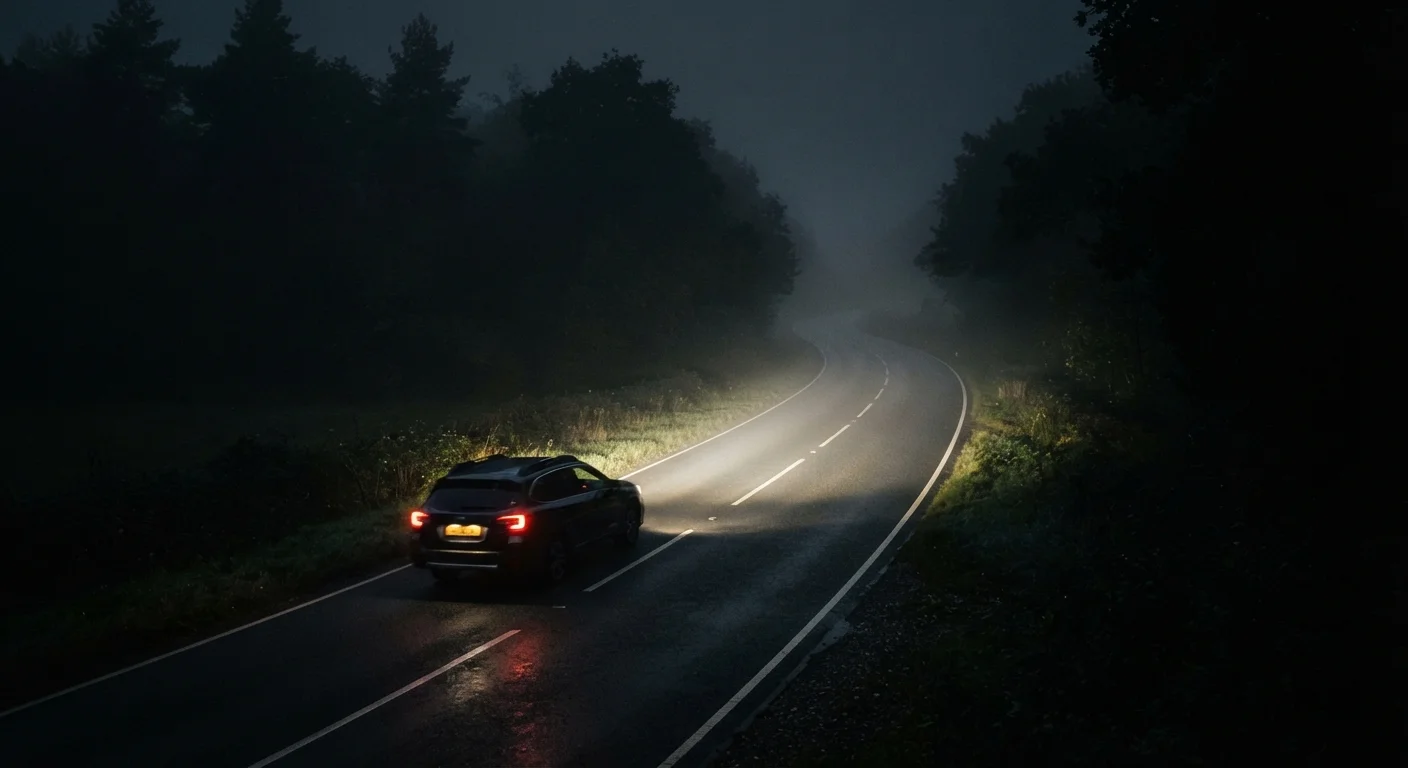
Key Takeaways
- Fatal crash rates per mile driven are roughly three times higher at night than during the day.
- Human vision degrades significantly in low light, reducing hazard detection range and depth perception.
- Fatigue and impaired driving are disproportionately concentrated in nighttime hours.
- Headlight aim, windshield clarity, and following distance all require adjustment after dark.
- Daytime driving carries its own risks, including sun glare and higher overall traffic volume.
- Targeted habits - slower speeds, cleaner headlights, adequate rest - meaningfully reduce night driving risk.
Option A
Night Driving
The higher-risk, lower-visibility environment most drivers underestimate.
Best for: Unavoidable travel when shorter windows, cooler temperatures, or schedules demand driving after dark.
Option B
Daytime Driving
The statistically safer baseline - but not without its own hazards.
Best for: General travel where planning flexibility exists, offering maximum visibility and lower crash rates per mile.
If you have flexibility in when you travel
Daytime Driving
Lower crash rates per mile and full natural visibility make daytime travel the safer default when scheduling allows.
If night driving is unavoidable on unfamiliar roads
Night Driving (with preparation)
Reduce speed, increase following distance, verify headlight alignment, and ensure you're well-rested before setting out.
If fatigue is a factor
Daytime Driving
Drowsiness compounds night driving risk dramatically - delaying a trip until daylight and rest are both available is the safer choice.
If you're driving on high-traffic urban roads
Daytime Driving
More pedestrians and cyclists are visible in daylight, and road markings, signage, and lane changes are easier to process.
If you're navigating long highway stretches with sparse traffic
Night Driving (with precautions)
Lower congestion can reduce some collision scenarios, but wildlife crossing risk and fatigue demand extra vigilance and planned rest stops.
The Numbers Behind the Risk Gap
Driving after dark feels routine for most Americans, yet the statistical picture is striking. According to the National Highway Traffic Safety Administration (NHTSA), roughly half of all traffic fatalities occur at night despite nighttime accounting for a much smaller share of total vehicle miles traveled. Expressed per mile driven, the fatal crash rate at night is approximately three times higher than during daylight hours.
That disparity doesn't stem from one cause - it reflects a convergence of visibility limitations, driver fatigue, and a higher concentration of impaired drivers on the road after dark. Understanding each factor separately helps drivers make smarter decisions about when and how they travel.
~3x
Higher fatal crash rate at night vs. day
NHTSA data show nighttime fatal crash rates per vehicle mile traveled are roughly three times those recorded during daylight hours.
~50%
Of traffic fatalities occur at night
Despite representing a smaller share of total miles driven, nighttime accounts for approximately half of all U.S. traffic fatalities annually.
Up to 80%
Headlight output lost to lens clouding
Studies from the American Automobile Association (AAA) have found that severely yellowed or oxidized headlight lenses can reduce usable light output by up to 80%.
How Darkness Physically Changes What You Can See
The human eye is not well engineered for low-light driving. Standard headlights illuminate roughly 160 to 250 feet ahead, yet at 60 mph a vehicle travels about 88 feet per second - meaning a driver has just two to three seconds to detect, react, and brake for anything at the edge of headlight range. Stopping distance at that speed typically exceeds 300 feet, creating what safety researchers call an overdriving your headlights situation even under normal conditions.
Peripheral vision - critical for detecting pedestrians and cyclists stepping into the roadway - narrows in darkness. Depth perception and color recognition also degrade, making it harder to judge the speed and distance of approaching vehicles accurately. Older drivers are disproportionately affected because the aging eye requires more light to achieve the same clarity a younger driver experiences automatically.
Contrast this with daytime conditions: natural light provides uniform illumination across the entire visual field, road markings stay crisp, and hazards such as debris, potholes, or merging vehicles register far earlier. That said, daytime is not risk-free - low-angle morning and evening sun can temporarily blind drivers more severely than darkness itself. See our guide to weather-related driving hazards for how environmental conditions compound visibility challenges.
| Criterion | Night Driving | Daytime Driving |
|---|---|---|
| Fatal crash rate per mile | ~3x higher | Baseline (lower) |
| Effective visibility range | 160-250 ft (headlights) | Full natural field of view |
| Peripheral vision quality | Significantly reduced | Full peripheral awareness |
| Fatigue risk | High (circadian low points) | Lower (natural alertness cues) |
| Impaired driver prevalence | Substantially higher | Lower |
| Glare hazards | Oncoming headlights | Low-angle sun glare |
| Wildlife hazard | Higher (dawn/dusk peaks) | Lower midday |
| Traffic volume | Generally lower | Higher (peak hours) |
Fatigue and Impairment: Night's Hidden Multipliers
Reduced visibility alone doesn't fully explain the night crash premium. Two behavioral factors magnify the problem substantially: fatigue and alcohol or drug impairment.
The body's circadian rhythm dips sharply between midnight and 6 a.m., producing drowsiness regardless of how rested a driver feels when they get behind the wheel. Reaction time slows, lane-keeping degrades, and - critically - fatigued drivers often fail to recognize how impaired they are. Drowsy driving warning signs such as drifting, missing exits, or heavy blinking frequently go unnoticed until a near-miss occurs.
NHTSA data consistently show that drunk driving fatalities are heavily concentrated in nighttime hours, particularly on weekends. The combination of impaired reaction time, degraded vision, and lower road illumination creates a risk profile that is qualitatively different from any single factor operating alone.
Practical Adjustments for Night Driving
Because some night driving is unavoidable, targeted habits can meaningfully close the safety gap:
- Slow down: Reducing speed extends the time available to react to hazards at the edge of headlight range. Even a 5-10 mph reduction matters.
- Increase following distance: The standard three-second gap should be extended to four or more seconds after dark. Stopping distance increases non-linearly with speed, so extra buffer matters most when lighting is poor.
- Maintain headlights and windshields: Cloudy headlight lenses can reduce light output by up to 80%. A clean, unscratched windshield eliminates the halo scatter that oncoming headlights produce on a dirty surface.
- Use high beams strategically: On unlit rural roads with no oncoming traffic, high beams extend visibility range significantly - but switch to low beams promptly when another vehicle approaches.
- Watch for wildlife: Deer and other animals are most active at dawn and dusk. Scan the road edges, not just the centerline.
Planning routes to minimize unfamiliar roads after dark is also prudent. Highway driving at night, while not without risk, generally offers better lane markings and road surfaces than rural two-lane roads where head-on collision risk is higher.
Older Drivers and Night Vision
Visual acuity in low light declines with age due to changes in the pupil's ability to dilate and reductions in retinal sensitivity. Drivers over 60 may find night driving noticeably more demanding than they did a decade earlier. Regular eye exams that include low-light acuity testing are a practical step for any driver who notices increased difficulty after dark. Consult an eye care professional for personalized assessment.