

Key Takeaways
- All 50 states have some form of Graduated Driver Licensing (GDL) law, though restrictions differ significantly.
- GDL programs reduce teen crash risk by limiting high-risk driving conditions during the early learning period.
- Most GDL systems have three stages: learner permit, intermediate license, and full license.
- Nighttime driving and passenger restrictions are the two most common - and most critical - GDL rules.
- Parents play an active enforcement role that the law alone cannot fill.
Start here
What Is the Graduated Driver Licensing System?
Next
The Three Stages and What Each Allows
Then
Key Restrictions Parents Should Reinforce
Going deeper
How Parents Can Support Safe Skill-Building
Finally
State-by-State Variation: What to Check
What Is the Graduated Driver Licensing System?
The Graduated Driver Licensing (GDL) system is a structured framework that introduces driving privileges to new drivers - primarily teenagers - in stages rather than all at once. The underlying logic is straightforward: crash risk is highest when driving exposure is new, so the system limits the most dangerous conditions (night driving, peer passengers, high-speed roads) until a teen has built a foundation of experience.
All 50 states and the District of Columbia have enacted some form of GDL legislation. The Insurance Institute for Highway Safety (IIHS) has tracked research showing that strong GDL laws are associated with meaningful reductions in fatal crash rates among 16- and 17-year-olds. While the specifics vary considerably from state to state, the core architecture is consistent enough that parents can understand the general shape of the system before diving into their own state's rules.
Graduated Driver Licensing (GDL)
A staged system that introduces driving privileges to new drivers incrementally, limiting high-risk conditions until experience and demonstrated safety accumulate.
Learner Permit
The first GDL stage, allowing a teen to drive only with a licensed adult supervisor present in the vehicle.
Intermediate (Provisional) License
The second GDL stage, permitting unsupervised driving under specific restrictions - typically limiting nighttime hours and the number of passengers.
Nighttime Driving Restriction
A GDL rule that prohibits intermediate-license drivers from operating a vehicle without supervision after a specified evening hour, such as 11 p.m.
Passenger Restriction
A GDL rule limiting how many non-family or peer passengers a teen driver may carry, based on research showing peer presence increases crash risk.
Holding Period
The minimum amount of time a teen must spend at one GDL stage before becoming eligible to advance to the next, regardless of skill level.
The Three Stages and What Each Allows
Most GDL programs follow a three-stage progression:
- Learner Permit Stage: The teen may drive only with a licensed adult supervisor in the vehicle - typically a parent, guardian, or driving instructor. This stage usually requires a minimum holding period (often six months) and a set number of supervised practice hours, commonly 40-65 hours depending on the state. A portion of those hours must usually be logged at night.
- Intermediate (Provisional) License Stage: The teen may drive without a supervisor during daytime hours but faces restrictions on nighttime driving and the number of passengers allowed. This stage is designed to build independence while keeping the highest-risk conditions limited. Violations during this phase can extend the period before full licensure.
- Full License: Once the teen meets the age requirement (most commonly 17 or 18) and has held the intermediate license for the required period without violations, they qualify for an unrestricted license.
Understanding defensive driving principles is valuable at every stage - building that mindset early pays dividends throughout a lifetime of driving.
Key Restrictions Parents Should Reinforce
State law sets the floor, but research consistently shows that parental enforcement matters independently of legal requirements. The two restrictions most strongly tied to crash reduction are:
- Nighttime driving limits: Fatal crash rates for teen drivers spike after 9 or 10 p.m. Most states restrict unsupervised nighttime driving during the intermediate stage, typically between 11 p.m. and 5 a.m., though some states set earlier curfews. Parents should clarify their household rule and not assume the legal minimum is sufficient.
- Passenger restrictions: Peer passengers dramatically increase crash risk for teen drivers. The distraction effect compounds with each additional teenager in the vehicle. Many states limit intermediate-stage drivers to zero or one non-family peer passenger. Even where law is permissive, parents may reasonably set stricter household expectations.
Phone use behind the wheel is prohibited for teen drivers in virtually every state - often under stricter rules than apply to adult drivers. This is a non-negotiable area where parental modeling matters as much as instruction. Teens who observe adults using phones while driving are more likely to do the same.
Don't Assume Legal Minimums Are Enough
GDL laws represent the legal floor, not the ideal standard. Research suggests teens whose parents set stricter household rules - earlier curfews, zero peer passengers - have better safety outcomes than those whose parents simply defer to state law. Have an explicit conversation about your household expectations before your teen's first solo drive.
How Parents Can Support Safe Skill-Building
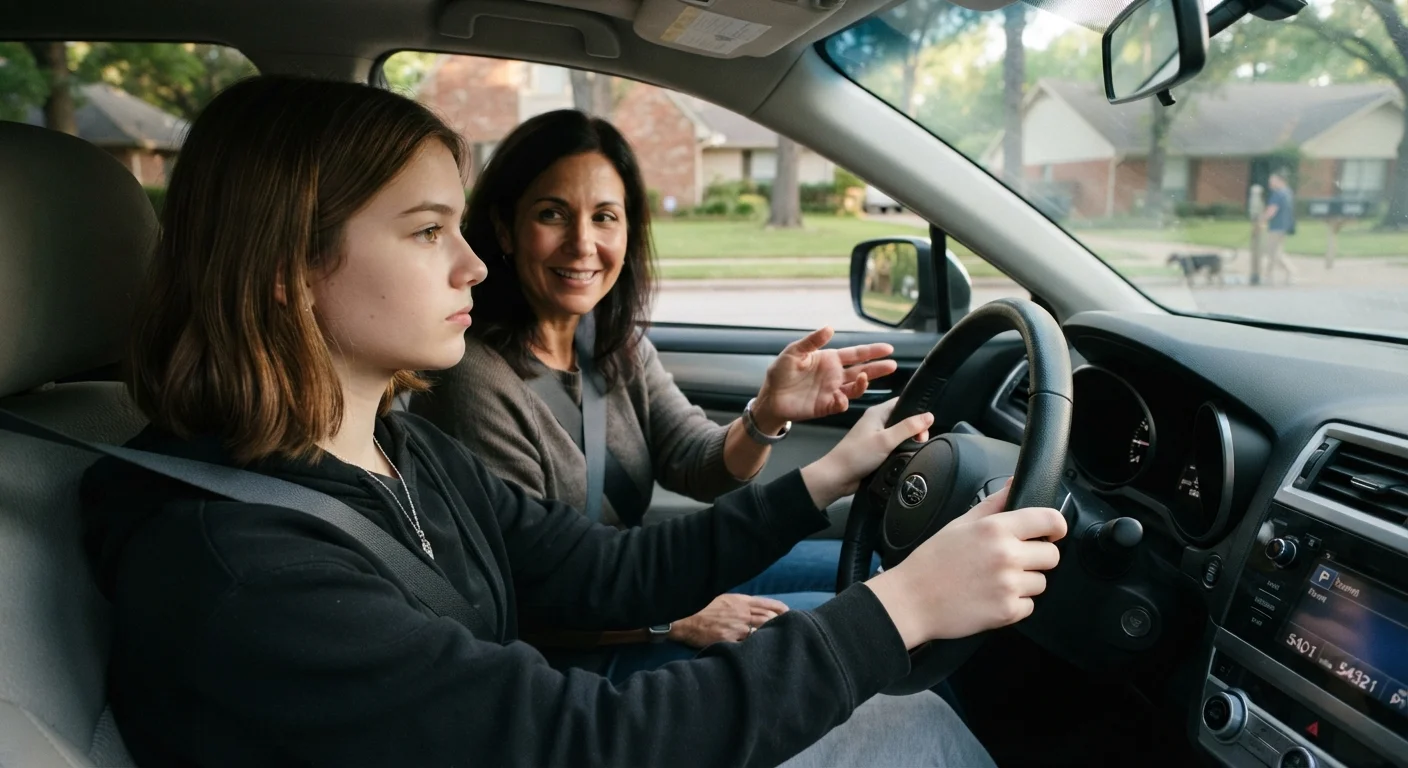
Supervised practice hours should be deliberate, not merely accumulated. Rather than logging miles on familiar routes, parents can use the learner permit phase to expose teens to a range of conditions: rain, unfamiliar roads, moderate traffic, and eventually highway driving. Good situational awareness - the habit of constantly scanning, predicting, and repositioning - is a skill developed through structured exposure. Our article on situational awareness for drivers outlines the specific habits worth developing early.
Intersection rules are another common knowledge gap. Reviewing right-of-way at roundabouts and four-way stops with your teen before they encounter these scenarios solo reduces confusion in the moment.
Make Practice Routes Progressively Harder
Start supervised sessions on quiet residential streets and systematically increase complexity - adding traffic, intersections, merging situations, and finally highway driving. Variety builds adaptability. A teen who has only ever driven familiar routes near home may be underprepared when they encounter new road conditions independently.
State-by-State Variation: What to Check
Because GDL laws differ meaningfully between states, parents should look up their specific state's rules rather than relying on generalizations. Key variables to confirm include:
- Minimum permit age
- Ranges from 14 in some rural states to 16 in others.
- Supervised hours required
- Typically 40-65 hours; some states require a documented log.
- Nighttime curfew start time
- Ranges from 9 p.m. to midnight depending on the state.
- Passenger restrictions
- Who counts as a permitted passenger varies - family definitions differ.
- Holding periods
- The time required at each stage before advancing varies from six months to a year or more.
State motor vehicle agency websites are the authoritative source. The IIHS also maintains a regularly updated summary of GDL provisions by state that can help parents do a quick comparison. Once you understand the framework, the goal shifts from compliance alone to using the system as it was designed - as a structured opportunity to help your teen become a genuinely capable, hazard-aware driver.