

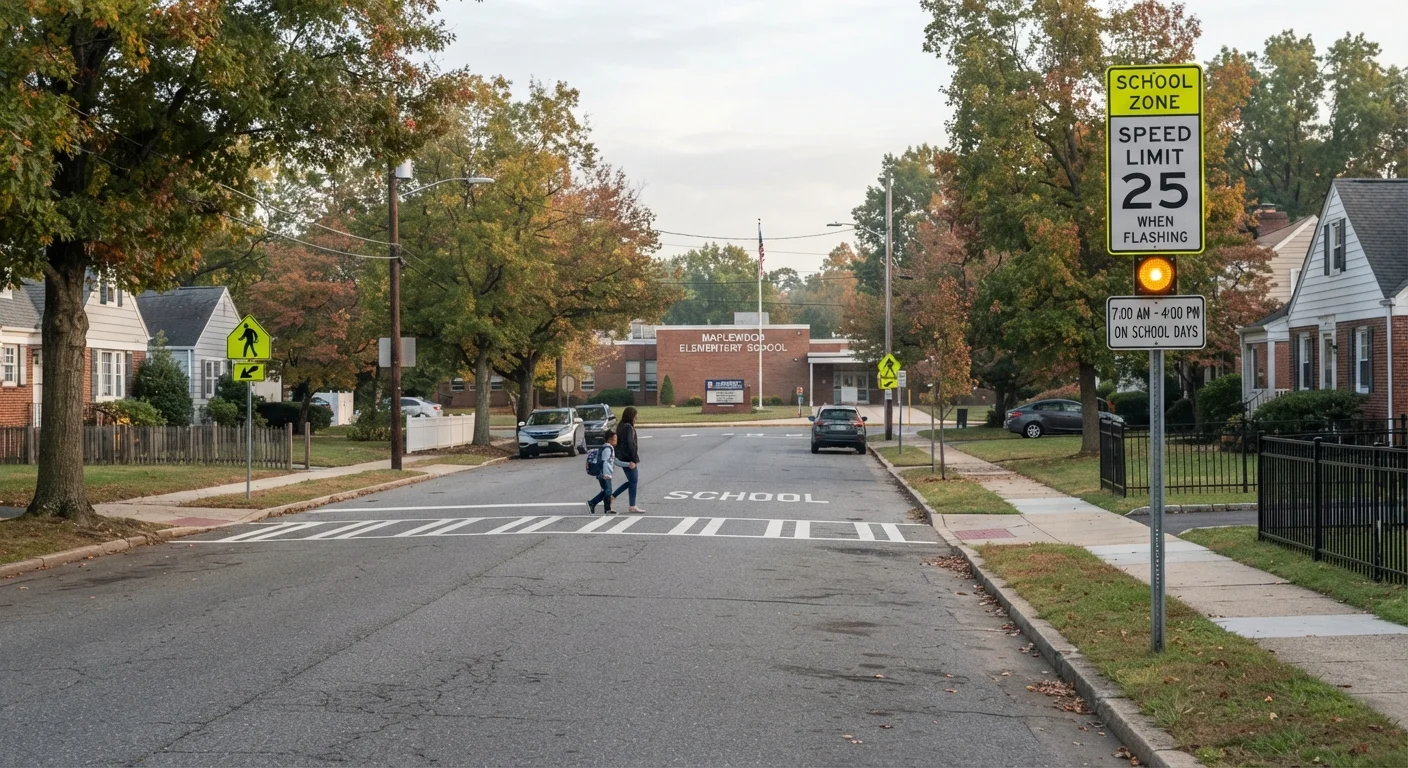
Key Takeaways
- Speed perception is inherently unreliable, and drivers routinely underestimate how fast they are traveling.
- School zone violations carry significantly higher fines and, in many states, doubled penalty points.
- Zone hours and activation triggers vary by jurisdiction - assuming you know the rules can be costly.
- Distraction and routine familiarity are the two leading reasons drivers speed through school zones unintentionally.
- Slowing early and looking for posted signage before entering a zone is the most reliable protective habit.
The Perception Gap: Why Your Speedometer Tells a Different Story Than Your Brain
Human speed perception is shaped by visual reference points - how quickly roadside objects pass, how far ahead we can see, and what traffic around us is doing. On wide, open roads, drivers consistently underestimate their speed. School zones are often located on exactly these types of arterial roads, where 35 mph feels like 20 mph simply because of road geometry. Research in traffic psychology has shown that drivers entering a zone from a higher-speed corridor take considerably longer to reduce speed than they believe they do.
The transition zone - that short stretch between a 45 mph road and a 20 mph school zone - is where most unintentional violations occur. The brain registers the sign, the foot eases off the accelerator, but the vehicle is still traveling well above the limit for several hundred feet. Larger vehicles, which have greater momentum and slower deceleration, are especially prone to this lag. Understanding that your felt speed and your actual speed are frequently misaligned is the first step toward correcting the habit.
For a broader look at how situational awareness shapes driving decisions, see our guide to reading traffic flow.
Common Mistakes Drivers Make in School Zones
The mistakes below aren't limited to reckless drivers. Many occur among experienced, generally careful motorists whose habits or assumptions lead them astray.
Applying the brakes at the sign rather than before it.
Why it happens: Drivers treat the posted sign as the trigger to slow down, not accounting for the distance needed to actually reach the required speed.
Assuming the zone isn't active because no children are visible.
Why it happens: Many drivers interpret an empty sidewalk or crosswalk as a signal that normal speeds apply, conflating activity with enforcement.
Matching speed with surrounding traffic rather than the posted limit.
Why it happens: Social speed-matching is deeply ingrained - if everyone around you is doing 30 in a 20, 30 feels correct. This behavior is particularly common on multi-lane roads.
Failing to account for zone hours that differ by day or session.
Why it happens: Drivers who use a route during weekday mornings may assume the same rules apply on early-release days, half-days, or after school events.
Underestimating stopping distance at even modest speeds.
Why it happens: Most drivers have an inaccurate sense of how far a vehicle travels before stopping - particularly at speeds between 20 and 35 mph.
The Legal and Financial Consequences You May Not Anticipate
2×-3×
School zone fine multiplier vs. standard speeding
Most U.S. states impose fines that are two to three times the standard speeding penalty when violations occur within a posted school zone.
~85 ft
Stopping distance at 25 mph
Under typical dry-road conditions, a standard passenger vehicle traveling at 25 mph requires approximately 85 feet to come to a full stop.
3-5 yrs
Insurance premium impact duration
A school zone speeding conviction can elevate auto insurance premiums for three to five years, depending on the insurer and state.
Traffic penalties in school zones are structured to be punishing by design. Most states impose fines that are double or triple the standard speeding rate within posted school zone hours, and many jurisdictions assign doubled penalty points to your driving record. Accumulating points accelerates the timeline to license suspension and almost always triggers an increase in auto insurance premiums - sometimes for three to five years after the violation.
Beyond fines, some municipalities use automated speed enforcement cameras in school zones. These systems issue violations based on photographic evidence alone, meaning you may receive a citation days after an incident you barely registered. Camera-based tickets are civil in most states, but they still carry financial penalties and, in certain jurisdictions, attach to your record if left unpaid.
Automated Camera Citations Don't Disappear
Speed cameras in school zones issue violations automatically, often without a police officer present. Ignoring a camera-based citation can lead to registration holds, additional late fees, or civil collections activity. Always verify the jurisdiction's response process if you receive one - requirements vary significantly by state and municipality.
Speed enforcement dynamics in school zones differ meaningfully from those in construction corridors. See how those two environments compare in our article on navigating construction zones safely.
Building Habits That Make Compliance Automatic
The most reliable strategy is anticipation rather than reaction. Identify school zones on your regular routes and treat the block before the posted sign as your preparation distance - begin decelerating there, not at the sign itself. If you drive a familiar commute, that familiarity can work against you: routine suppresses active attention, which is why experienced drivers are not immune to these errors. Treat each pass through a school zone as a conscious, deliberate act.
Check your state's specific rules for when school zone speed limits apply. Many states tie the reduced limit to flashing lights, school hours, or the presence of children - and those conditions aren't always obvious. Some jurisdictions enforce the limit whenever school is in session regardless of visible activity, while others activate limits only during arrival and dismissal windows. Assuming you know the rule without verifying it is itself a mistake.
If improving your broader situational awareness on the road is a goal, the habits described in our situational awareness article translate directly to school zone driving. Proactive scanning, early hazard identification, and deliberate speed management are skills, not instincts - and they can be developed with practice.