
The Truth About DIY Electrical Work: What's Legal, What's Dangerous, and What's Neither

Key Takeaways
- Homeowners can legally perform some electrical work in many states, but rules vary significantly by jurisdiction.
- Unpermitted electrical work can create serious insurance, resale, and safety complications down the line.
- Turning off a breaker is not the same as confirming a circuit is dead - always verify with a voltage tester.
- Tasks like replacing outlets and switches are often DIY-legal; adding new circuits usually is not.
- The National Electrical Code sets minimum standards, but local amendments frequently make requirements stricter.
Why Electrical DIY Is a Gray Area for Most Homeowners
Few home improvement topics generate more confusion than DIY electrical work. Some homeowners believe any wiring task is illegal without a license. Others assume everything inside their own home is fair game. The truth sits somewhere in between - and it shifts depending on where you live.
Electrical work in the U.S. is governed by a layered system: the National Electrical Code (NEC), adopted nationally as a model standard, combined with state statutes and local amendments that frequently override or add to it. Some states explicitly allow homeowners to do their own electrical work on their primary residence. Others restrict virtually all wiring to licensed contractors. Many municipalities add permit and inspection requirements on top of state law.
Before picking up a wire stripper, check with your local building department - not a neighbor, not a forum post. Local rules are the only rules that matter for your project. Our guide on home renovation permits explains how to navigate that process and what's at stake if you skip it.
Myth
It's always illegal for a homeowner to do their own electrical work.
Fact
In many U.S. states, homeowners are legally permitted to perform electrical work on their own primary residence, though rules and permit requirements vary widely by state and municipality.
This myth likely stems from the fact that electricians are licensed professionals - so the assumption is that only they can legally do the work. In practice, most states have homeowner-exemption provisions that allow owner-occupants to wire or rewire their own homes, provided they pull the required permits and pass inspections. However, these exemptions often come with conditions: the work may need to be on a single-family primary residence, rental properties may be excluded, and certain tasks (like panel replacement or service upgrades) may still require a licensed contractor regardless. Always verify your local rules before starting any project.
Myth
If the breaker is off, it's safe to work on the wiring.
Fact
Turning off a breaker reduces risk but does not confirm the circuit is dead - you must verify with a non-contact voltage tester before touching any wires.
Breakers can be mislabeled, circuits can be wired to multiple breakers, and some wiring configurations leave certain conductors energized even when the associated breaker is off. A non-contact voltage tester - an inexpensive, widely available tool - lets you confirm there's no live voltage present before you make contact with any conductor. This step should never be skipped. Additionally, if your panel has a main disconnect, others in the home can inadvertently flip breakers while you work. Lock or tag the breaker and communicate clearly before starting.
Myth
The National Electrical Code is the only standard you need to follow.
Fact
The NEC is a model code - states and municipalities adopt it with local amendments, and some areas have significantly stricter requirements than the base NEC.
The NEC, published by the National Fire Protection Association (NFPA), provides the national baseline for safe electrical installations. But it only becomes law when a jurisdiction officially adopts it - and most do so with modifications. Some cities require arc-fault circuit interrupter (AFCI) protection in rooms beyond what the base NEC mandates. Others require conduit where the NEC allows flexible cable. Your local building department is the authoritative source for what applies in your area. Relying on general NEC guidance without checking local amendments is a common and consequential mistake.
Myth
You can add a new circuit yourself without a permit since it's inside your own home.
Fact
Adding a new circuit almost always requires a permit and inspection, and in many jurisdictions must be done by a licensed electrician regardless of homeowner-exemption rules.
Even in states with generous homeowner-exemption provisions, new circuit installation typically requires a permit - meaning an inspector will need to verify the work before walls are closed. Adding circuits involves working in or near the main panel, which introduces risks that aren't present in simple device replacement. Improper panel connections can cause arc faults, overloading, or breaker failure. Beyond safety, unpermitted new circuits are a known red flag in home inspections and can complicate insurance claims. If you need additional circuits, consult your building department about what's allowed and required in your area.
Myth
Replacing an outlet or light switch is too risky for a homeowner to attempt.
Fact
Replacing like-for-like outlets and switches on existing circuits is among the lower-risk electrical tasks and is legal for homeowners in most jurisdictions, with proper precautions.
Swapping a failed outlet or standard toggle switch for a new one of the same type - same voltage, same amperage, same wiring configuration - doesn't require new wiring or panel access. The main risks (accidentally working on a live circuit, making a loose connection, using the wrong replacement device) are manageable with basic knowledge and tools. In most states this work doesn't even require a permit, though it's worth confirming locally. That said, upgrading to GFCI or AFCI outlets, adding new outlets where none existed, or working in panels crosses into territory requiring more expertise and often a permit.
Myth
If the lights work after DIY wiring, the job was done correctly.
Fact
A functioning circuit is not evidence of a safe installation - many dangerous wiring errors don't affect normal operation but can cause fires or shocks under specific conditions.
Loose wire-nut connections may hold under light use but arc under load. A reversed hot and neutral (called a "bootleg ground" or polarity reversal) will power devices normally but can energize the chassis of appliances. Missing or inadequate grounding won't affect everyday function but eliminates a critical fault-protection path. These are exactly the types of defects that building inspections are designed to catch - which is one reason permits and inspections exist for electrical work. "It works" is a beginning, not an end point, when evaluating electrical safety.
The Real Risks - and Where They Actually Come From
Electrical hazards are real, but they're often misattributed. The danger in DIY electrical work usually isn't that a homeowner touched a wire - it's that they did so without understanding the full system context, used the wrong materials, skipped an inspection, or left connections that would pass a visual check but fail under load years later.
Panel and Service Work: Don't DIY This
Main electrical panels, service entrance wiring, and meter connections involve components that remain energized even when your main breaker is off - only the utility can de-energize the service entrance. Work in or near these areas carries an extreme risk of fatal electrocution. In virtually all U.S. jurisdictions, this work legally requires a licensed electrician. Do not attempt panel replacement, service upgrades, or service entrance repairs as a DIY project under any circumstances.
The most commonly cited risks in residential electrical DIY include improper wire gauge for the circuit load, loose connections at junction boxes or panels, missing or inadequate grounding, and work that wasn't inspected and therefore wasn't caught before walls closed up. These aren't hypothetical concerns - they're the causes behind a significant portion of residential electrical fires.
That said, low-complexity tasks - replacing a faulty outlet on an existing circuit, swapping a standard switch, or installing a ceiling fan where a fixture already exists - carry far lower risk profiles when done carefully with the power confirmed off. Understanding that distinction is the foundation of responsible DIY electrical work. See our broader discussion in DIY renovation vs. hiring a contractor for a framework on assessing risk by project type.
~51,000
Home electrical fires per year in the U.S.
According to the U.S. Fire Administration, electrical fires account for roughly 51,000 home fires annually, resulting in nearly 500 deaths and over $1.3 billion in property damage.
~40%
Electrical fires linked to wiring and related equipment
The Electrical Safety Foundation International (ESFI) reports that wiring and related equipment are implicated in approximately 40% of home electrical fires.
Building Your Electrical Know-How Safely
If you're new to home improvement generally, electrical work is not the place to start. Get comfortable with lower-stakes projects first - patching drywall, painting, or basic plumbing - before working with live systems. Our Weekend Warrior's First Renovation guide is a good starting point for building those foundational skills.
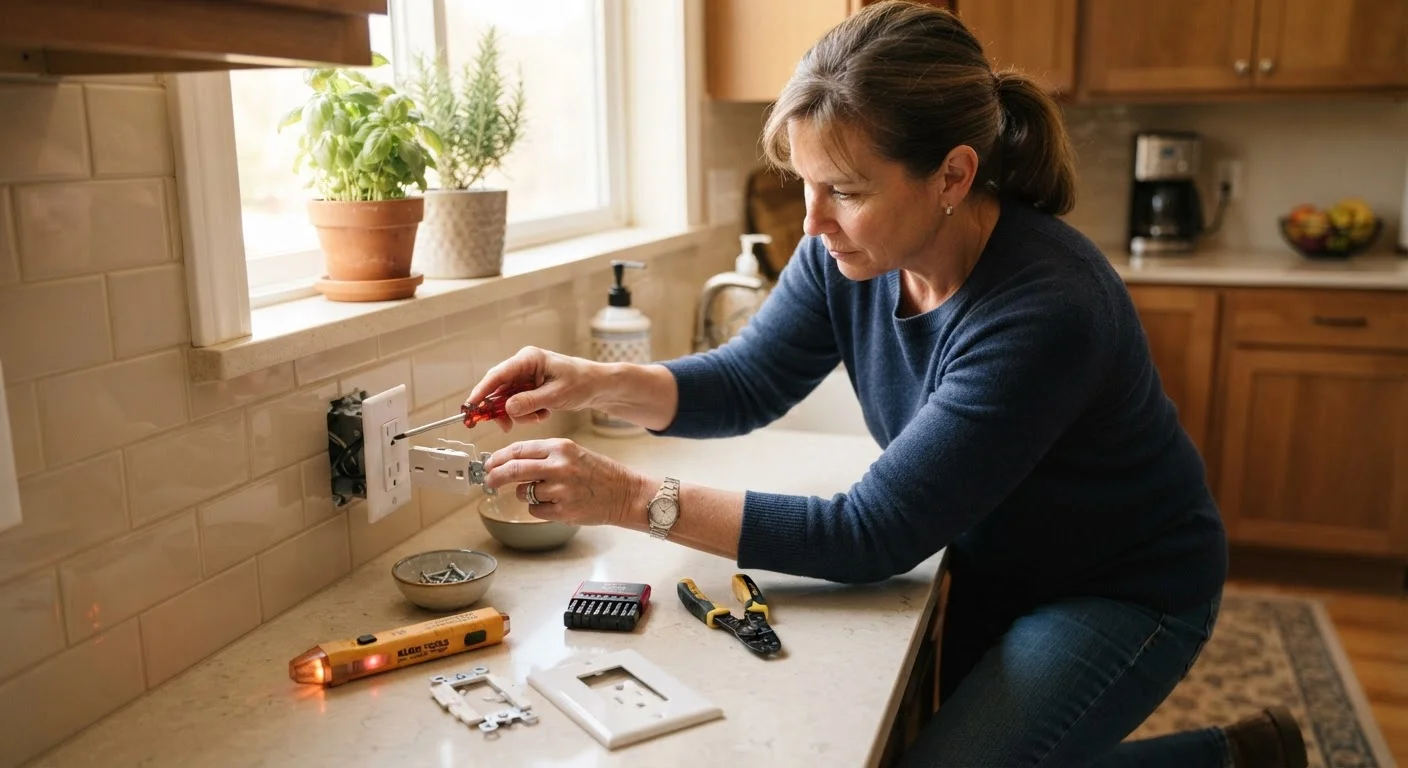
When you are ready to take on permitted electrical tasks, invest in the right safety tools: a non-contact voltage tester (to verify power is actually off), wire strippers rated for your wire gauge, and a reliable multimeter. Always work with the breaker off and the outlet or switch confirmed dead with a tester. Label the breaker so no one else flips it while you work.
Pull a permit when one is required - even for simple jobs. Inspection isn't bureaucratic friction; it's a free second set of eyes on your work from someone who does this every day. Unpermitted work that surfaces during a home sale can stall or collapse a transaction, and some homeowner's insurance policies exclude damage caused by unpermitted alterations.
When in doubt about scope, complexity, or legality, hire a licensed electrician. For major panel work, service upgrades, or anything involving your main breaker, that's not just prudent advice - in most jurisdictions, it's the law.