

Key Takeaways
- Debt consolidation combines multiple debts into one payment, but does not erase what you owe.
- A lower interest rate is the primary financial benefit-without it, consolidation offers little advantage.
- Extending your repayment term can lower monthly payments but increase total interest paid.
- It works best for people with stable income and a spending pattern they've already corrected.
- Consolidation can temporarily affect your credit score due to hard inquiries and account changes.
- It is general financial information, not personalized advice-consult a licensed professional for your situation.
Debt Consolidation
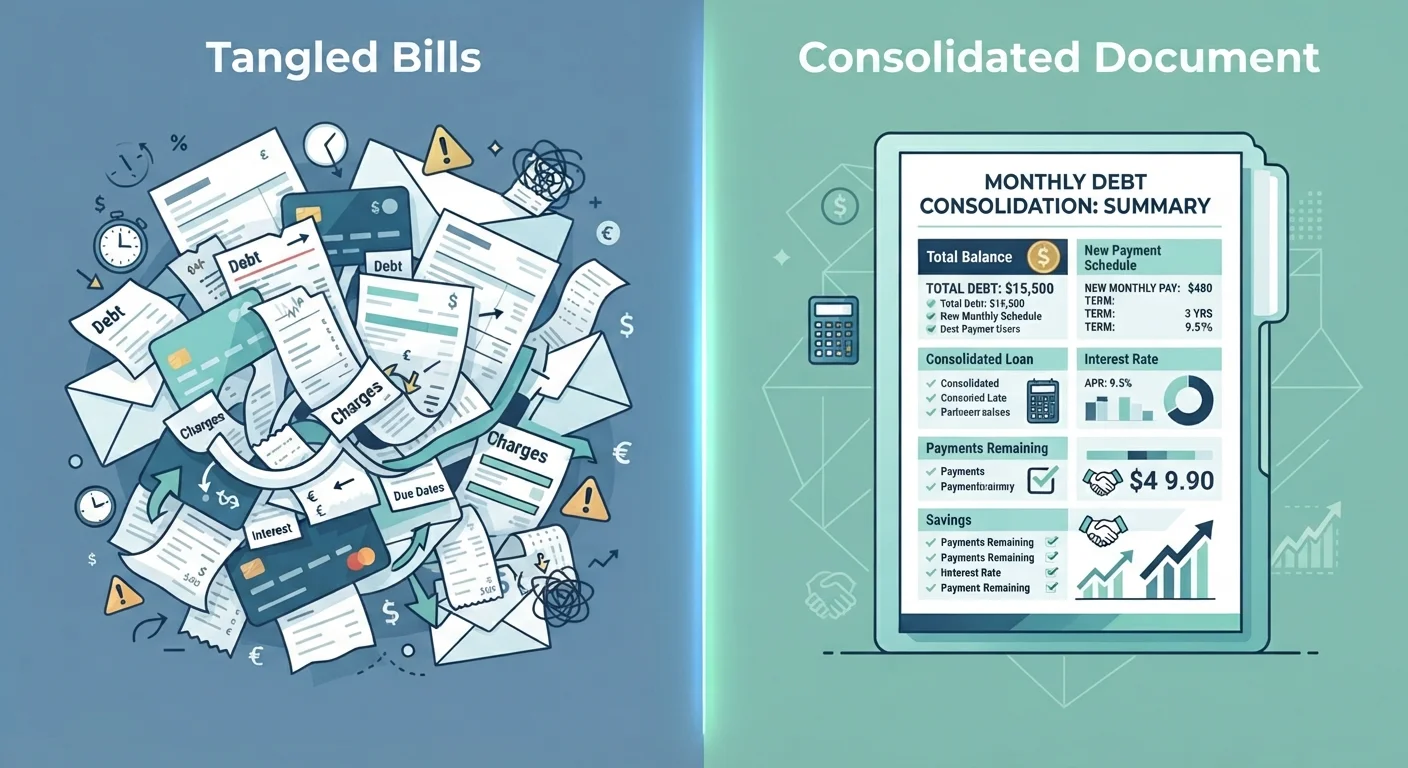
Debt consolidation is the process of combining multiple debts-such as credit card balances, medical bills, or personal loans-into a single new loan or credit product. The goal is usually to simplify repayment and, ideally, reduce the interest rate you're paying overall. Instead of managing several due dates and interest rates, you make one monthly payment to one lender.
Consolidation differs from debt settlement: it does not reduce the principal owed, and it does not directly negotiate with creditors. The new loan's APR (annual percentage rate) and repayment term determine whether it actually saves you money.
How Debt Consolidation Actually Works
When you consolidate debt, you're essentially taking out a new financial product-most commonly a personal loan or a balance transfer credit card-and using it to pay off your existing balances. After that, you owe money to a single lender, ideally at a lower interest rate than your previous debts carried.
There are several common consolidation methods:
- Personal loans: A fixed-rate loan from a bank, credit union, or online lender. You receive a lump sum, pay off existing debts, then repay the loan in fixed monthly installments.
- Balance transfer credit cards: Move existing credit card debt to a card offering a low or 0% introductory APR for a promotional period, typically 12-21 months.
- Home equity loans or HELOCs: Borrow against your home's equity at lower interest rates-but this converts unsecured debt into debt secured by your home, adding meaningful risk.
- Federal student loan consolidation: A separate government program that combines federal student loans into a Direct Consolidation Loan. See our overview of student loan repayment plans for how that works specifically.
Understanding the key debt terms like APR and amortization is essential before comparing consolidation offers-small differences in rate or term can meaningfully change the total cost.
When Consolidation Genuinely Helps
Consolidation is most effective in a specific set of circumstances. The primary win is a lower weighted average interest rate. If you're carrying several credit card balances at 20-29% APR and qualify for a personal loan at 12%, the math works in your favor-assuming you don't extend the repayment term so long that additional interest offsets the rate savings.
$7,236
Average U.S. credit card debt per borrower
According to Federal Reserve and TransUnion data cited in 2024 consumer credit reports, average credit card balances have risen meaningfully since 2021.
20%+
Average credit card APR in the U.S.
The Federal Reserve reports that average credit card interest rates have remained above 20% since mid-2023, making rate reduction through consolidation a meaningful opportunity for qualifying borrowers.
~1 in 3
Consolidators who re-accumulate card debt
Financial counseling research consistently finds that a significant share of borrowers who consolidate credit card debt without addressing spending patterns return to similar or higher balances within a few years.
It also helps with payment simplification. Managing five due dates increases the risk of a missed payment; one payment is easier to track and automate. And for people who've already addressed the habits that created the debt, consolidation can serve as a clean starting line.
Consolidation tends to suit borrowers who:
- Have a stable, reliable income to cover the new payment
- Qualify for a meaningfully lower interest rate than their current debts carry
- Have identified and changed the spending behavior that accumulated the debt
- Want to reduce complexity, not just kick the problem down the road
When Consolidation Falls Short
Consolidation doesn't fix the underlying behavior that created debt. If spending habits haven't changed, rolling balances into one loan often just frees up credit card space-which many people then refill. This is one of the most common ways people sabotage their own debt payoff progress.
“Debt consolidation is a tool, not a solution. If the behavior that created the debt doesn't change, consolidation simply resets the clock.”
— National Foundation for Credit Counseling, Nonprofit consumer credit counseling organization
It can also cost more in total. Stretching a $15,000 balance from a 3-year payoff to a 6-year loan at a marginally lower rate can mean paying more interest overall, even though monthly payments drop. Always calculate total repayment cost, not just the monthly figure.
Additionally:
- Poor credit scores may result in consolidation loan rates that are no better-or worse-than your existing debts.
- Using home equity to pay off unsecured debt converts a debt you could theoretically walk away from into one backed by your house.
- It doesn't address the compounding interest dynamic already working against you-review how compound interest works for and against you before deciding.
Consolidation vs. Other Debt Payoff Strategies
Consolidation is a structural tool-it reorganizes your debt. It's different from payoff strategies like the avalanche and snowball methods, which are behavioral frameworks for tackling existing balances without taking on new credit. Our comparison of the debt avalanche vs. debt snowball explains how those approaches differ and which mindset they suit best.
In practice, these aren't mutually exclusive. Someone could consolidate high-interest credit cards into a single personal loan, then apply avalanche logic to pay it off ahead of schedule. What matters is that the consolidation delivers a genuine rate advantage and that the repayment plan is followed consistently.
There are also common misconceptions worth clearing up-many people believe consolidation is the same as negotiating debt down, or that it will immediately repair credit. Our article on myths Americans believe about paying off debt addresses several of these head-on.
This article is for general informational purposes only and does not constitute personalized financial, tax, or legal advice. Consult a licensed financial professional before making decisions about your specific situation.