

Key Takeaways
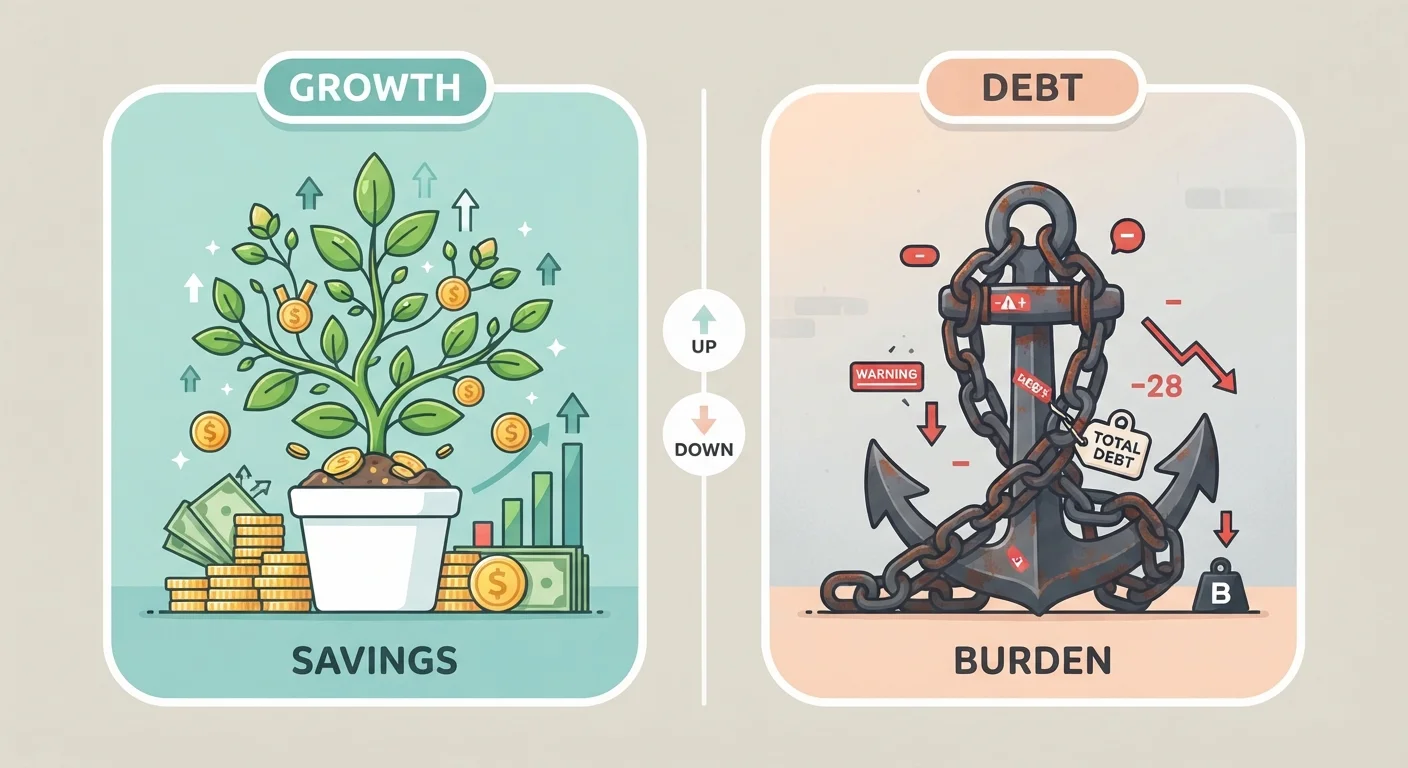
- Compound interest causes both savings and debt balances to grow exponentially, not linearly.
- Starting to save earlier produces dramatically larger balances than starting later, even with the same contributions.
- High-interest debt, such as credit cards, compounds rapidly and can make balances feel impossible to reduce.
- Paying more than the minimum on debt directly reduces the principal that interest is calculated on.
- Understanding both sides of compounding helps you prioritize where money does the most work.
Compound Interest
Compound interest is interest calculated on both the original principal and the interest that has already accumulated. Unlike simple interest, which only applies to the original balance, compounding means your interest earns interest - making the total grow faster over time. This effect works in your favor when you're saving or investing, and against you when you're carrying debt.
The frequency of compounding - daily, monthly, or annually - matters. More frequent compounding periods accelerate growth (or debt accumulation) because interest is added to the principal more often, giving it more time to generate additional returns.
The Core Mechanic: How Compounding Actually Works
Compound interest follows a straightforward but powerful logic: each period, interest is calculated on a balance that already includes previously earned interest. The result is that growth accelerates over time rather than moving in a straight line.
Consider a simple illustration. If you deposit $5,000 into an account earning 5% annual interest, compounded annually, you earn $250 in year one - giving you $5,250. In year two, you earn 5% on $5,250, not the original $5,000. That's $262.50. By year three, you're earning interest on $5,512.50. The amount added each year keeps increasing even though the rate stays the same. Over 30 years without adding another dollar, that $5,000 grows to roughly $21,600 - more than four times the original deposit.
The formula behind this is: A = P(1 + r/n)^(nt), where P is the principal, r is the annual interest rate, n is the number of times interest compounds per year, and t is the number of years. You don't need to run the math yourself, but understanding the variables helps: rate, frequency, and time all drive the outcome.
~$21,600
Growth of $5,000 at 5% over 30 years
Calculated using standard compound interest formula with annual compounding and no additional contributions - illustrating compounding's long-term multiplier effect.
20%-30%
Typical credit card APR range in the U.S.
According to the Consumer Financial Protection Bureau, average credit card interest rates have risen substantially in recent years, making carried balances increasingly costly.
Daily
How often many credit cards compound interest
Most major U.S. credit card issuers compound interest daily on outstanding balances, meaning even a few extra days before payment increases the total owed.
When Compounding Works For You: Saving and Investing
On the savings side, compound interest is one of the most reliable mechanisms for building wealth over time. The critical variable is time - not the size of your starting balance.
Someone who begins contributing to a tax-advantaged retirement account at age 25 and stops at 35 (10 years of contributions) can end up with a larger balance at retirement than someone who starts at 35 and contributes continuously until 65 - assuming the same annual contribution and rate of return. This counterintuitive result is entirely a product of compounding: the early saver's money has more years to multiply.
High-yield savings accounts, certificates of deposit (CDs), and investment accounts all harness this effect in different ways and at different risk levels. The stated interest rate matters less than many people think - consistency and time in the market or account tend to dominate. This is part of why financial educators consistently emphasize starting early, even with modest amounts. For a broader look at how saving habits interact with spending decisions, see how saving more doesn't always require spending less.
Start Early, Even With Small Amounts
Waiting until you have a larger sum to start saving costs you time - the most valuable ingredient in compounding. Even modest, consistent contributions to an interest-bearing account started in your 20s can outperform larger contributions started in your 40s. Automating contributions removes the decision from your monthly routine and keeps compounding uninterrupted.
When Compounding Works Against You: Debt
The same mechanism that grows your savings will methodically expand your debt if left unchecked. Credit card balances are the most common example. With annual percentage rates (APRs) frequently ranging from 20% to 30%, and interest compounding daily on many cards, carrying a balance month to month is expensive in ways that aren't always visible in a minimum payment.
A $3,000 credit card balance at 24% APR, with only minimum payments made, can take well over a decade to pay off - and cost more in interest than the original purchase. The compounding works against the borrower because every month the unpaid interest gets added to the principal, and next month's interest is calculated on that larger number.
Auto loans and mortgages also involve interest calculations, though they're typically structured as amortizing loans with fixed payment schedules. Even so, the early years of these loans are heavily weighted toward interest rather than principal - another form of compounding's influence on borrowing costs. Understanding the full cost of car ownership includes financing costs that compounding directly shapes.
The most effective countermeasure against compounding debt is reducing the principal directly. Every extra dollar applied to the principal shrinks the base that future interest is calculated on. For structured approaches to debt reduction, the debt avalanche and snowball methods offer two well-tested frameworks.
Using Both Sides Strategically
Understanding compound interest as a two-sided tool changes how you prioritize financial decisions. High-interest debt costs more than almost any savings account can earn, which generally means paying down high-rate debt aggressively before focusing on growing savings beyond an emergency fund.
At the same time, delaying savings contributions to focus entirely on debt means sacrificing years of compounding on the savings side. Many financial planners suggest a parallel approach: contribute enough to capture any employer retirement match (which is an immediate 100% return) while also directing extra funds toward high-interest debt. This isn't one-size-fits-all advice - individual circumstances vary, and consulting a licensed financial professional is worthwhile for significant decisions.
If managing multiple debts is the obstacle, debt consolidation can sometimes simplify repayment, though it comes with real trade-offs. And it's worth knowing that behavioral patterns can quietly undermine even a solid strategy - common missteps are covered in ways people accidentally sabotage their debt payoff progress.
This article is for general informational and educational purposes only and does not constitute personalized financial, investment, or tax advice. Consult a qualified financial professional for guidance specific to your situation.