

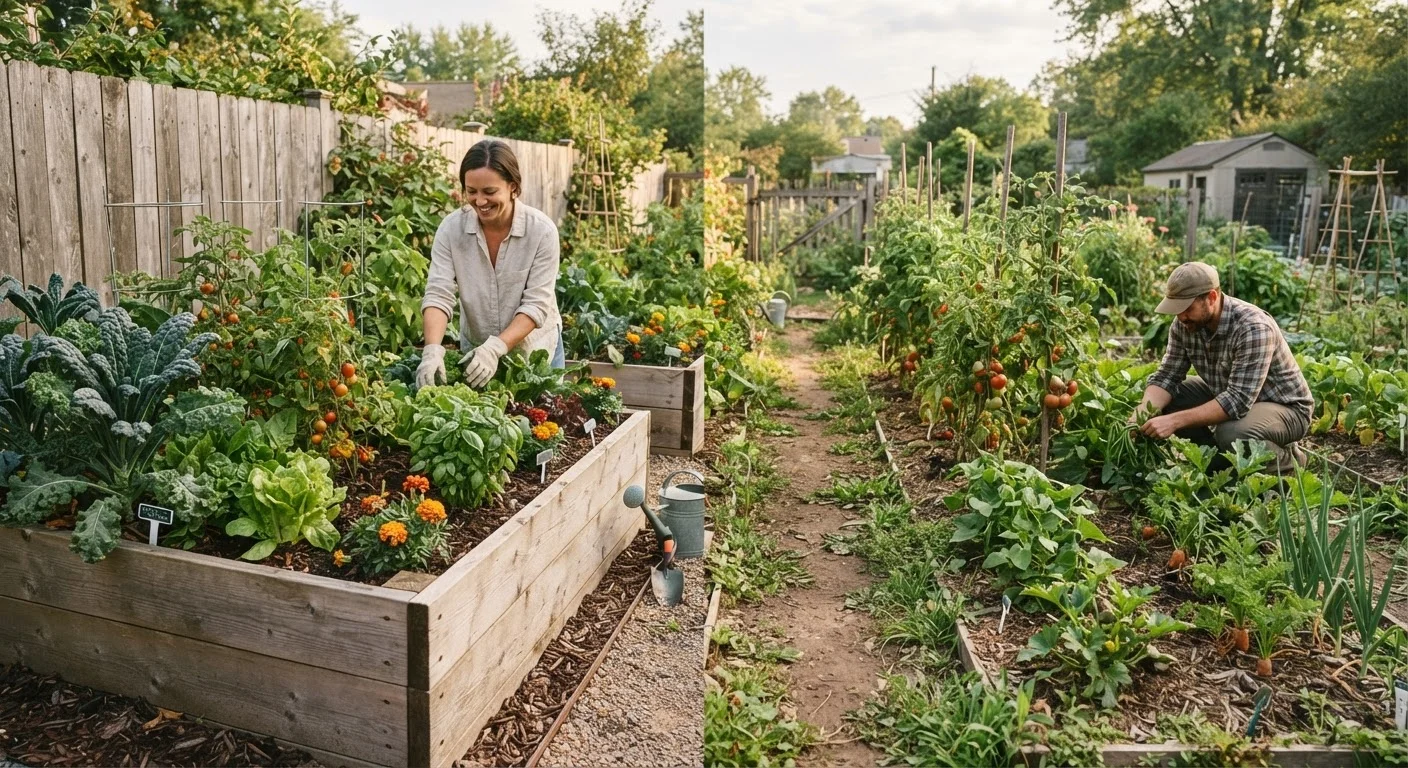
Key Takeaways
- Raised beds let you control soil quality from the start, which matters most in yards with clay-heavy or contaminated ground.
- In-ground planting costs significantly less to establish and works well when existing soil is healthy and deep.
- Raised beds typically drain faster and warm up sooner in spring, extending your growing season in cooler climates.
- In-ground gardens support larger root systems and are better suited to sprawling crops like corn, squash, and pumpkins.
- Accessibility and maintenance ease strongly favor raised beds for gardeners with physical limitations.
- Your local soil conditions, budget, and intended crops are the key factors in choosing the right setup.
Option A
Raised Beds
The controlled, accessible growing environment.
Best for: Homeowners with poor native soil, limited mobility, or compact yards who want fast-draining, customizable growing conditions.
Option B
In-Ground Planting
The traditional, low-infrastructure growing method.
Best for: Gardeners with decent native soil and larger plots who want to grow at scale with minimal upfront investment.
If your yard has poor, compacted, or potentially contaminated soil
Raised Beds
Raised beds let you fill with a custom soil mix, bypassing whatever challenges exist at ground level without expensive remediation.
If you're working with a large plot and a tight starting budget
In-Ground Planting
In-ground gardens require virtually no materials to establish beyond seeds, tools, and amendments - making scale far more affordable.
If you want an earlier spring start and better drainage
Raised Beds
The elevated soil mass warms faster than ground soil and sheds excess water more readily, reducing root rot risk and extending the planting window.
If you're growing space-hungry crops like corn, melons, or pumpkins
In-Ground Planting
These crops need extensive root spread and horizontal space that raised beds rarely accommodate efficiently or affordably.
If accessibility or reduced bending is a priority
Raised Beds
A raised bed built to 18-24 inches tall can be tended from a seated position or with minimal stooping, reducing physical strain significantly.
Soil Control: The Core Advantage of Raised Beds
One of the most practical reasons homeowners choose raised beds is the ability to start with a known, optimized soil mix. Native soil across much of the US is either too sandy, too clay-dense, or lacking in organic matter for vegetable growing. In some urban and suburban settings, soil may also carry residual contaminants from past land use - a concern that raised beds entirely sidestep.
With raised beds, you fill the frame with a blend of topsoil, compost, and amendments suited to what you're growing. That control is especially valuable in regions with heavy clay soils common to the Midwest and Southeast, where water logging can stunt root development. In-ground gardeners can improve native soil over time through regular amendment, but reaching that same quality typically takes several growing seasons of consistent compost addition and careful tilling. See our guide to mulching garden beds for techniques that accelerate in-ground soil improvement.
| Criterion | Raised Beds | In-Ground Planting |
|---|---|---|
| Upfront cost | Moderate to high (materials + fill soil) | Low (minimal materials needed) |
| Soil quality control | Full control from day one | Dependent on native soil; improvable over time |
| Drainage | Excellent; adjustable | Varies by site; can waterlog in clay |
| Spring warm-up speed | Faster - extends season | Slower in cooler climates |
| Accessibility | High at 18-24 inch height | Requires bending and kneeling |
| Crop size suitability | Best for compact, intensive crops | Handles large, sprawling varieties well |
| Scalability | Costly to expand | Easy and inexpensive to expand |
| Weed pressure | Lower initially; increases over time | Typically higher; managed with mulch |
Cost, Scale, and Long-Term Investment
Upfront cost is where in-ground planting holds a clear advantage. Breaking ground, amending soil, and planting seeds requires minimal materials. Raised beds, by contrast, require lumber, composite boards, or masonry - plus enough quality soil mix to fill the frame, which can run $50-$150 per bed depending on size and fill source.
That said, raised beds tend to reduce ongoing costs in some areas. Their defined footprint concentrates water, compost, and fertilizer where roots actually grow, reducing waste. Weed pressure is also typically lower in a freshly filled raised bed, at least in the early seasons.
For large-scale growing - think homesteaders or families relying heavily on garden produce - in-ground planting remains far more economical to expand. Adding 200 square feet of in-ground growing space costs mostly labor; adding the equivalent raised bed space could cost hundreds of dollars in materials alone. If space efficiency is your concern, container gardening and vertical gardening are worth exploring as complements to either approach.
What Each Method Does Best
Raised beds excel at intensive, small-footprint growing. Because you control depth, drainage, and soil texture, they're well suited to root vegetables, salad greens, herbs, and most garden vegetables. The contained environment also discourages burrowing pests like voles in some regions, though surface pests remain just as active.
In-ground planting shines with crops that spread or run deep. Corn, indeterminate tomatoes, winter squash, and sweet potatoes all benefit from unrestricted root and runner space that a 6-12 inch raised bed can't comfortably provide. Perennial vegetables and food-producing shrubs - asparagus, rhubarb, berry canes - are also better suited to in-ground placement since they'll occupy the space for years. See our guide to planning perennials and annuals for how to structure a mix of long-lived and seasonal crops.
6-8 in
Minimum raised bed depth for most vegetables
Most cooperative extension services recommend at least 6 inches of growing medium for shallow-rooted crops, and 12 inches or more for root vegetables.
2-4 weeks
Earlier planting window raised beds can provide
University extension research across northern US states suggests raised bed soil can reach workable temperatures 2-4 weeks ahead of surrounding ground soil in spring.
30-50%
Potential reduction in water use with intensive raised bed spacing
Square-foot and intensive planting methods used in raised beds are commonly cited by cooperative extension programs as reducing water needs compared to traditional row gardening.
Climate also plays a role. In short-season northern states, raised beds' faster spring warm-up can meaningfully extend what's possible. In hotter Southern climates, raised beds may dry out faster in midsummer, requiring more frequent irrigation than in-ground plantings insulated by surrounding soil mass.