

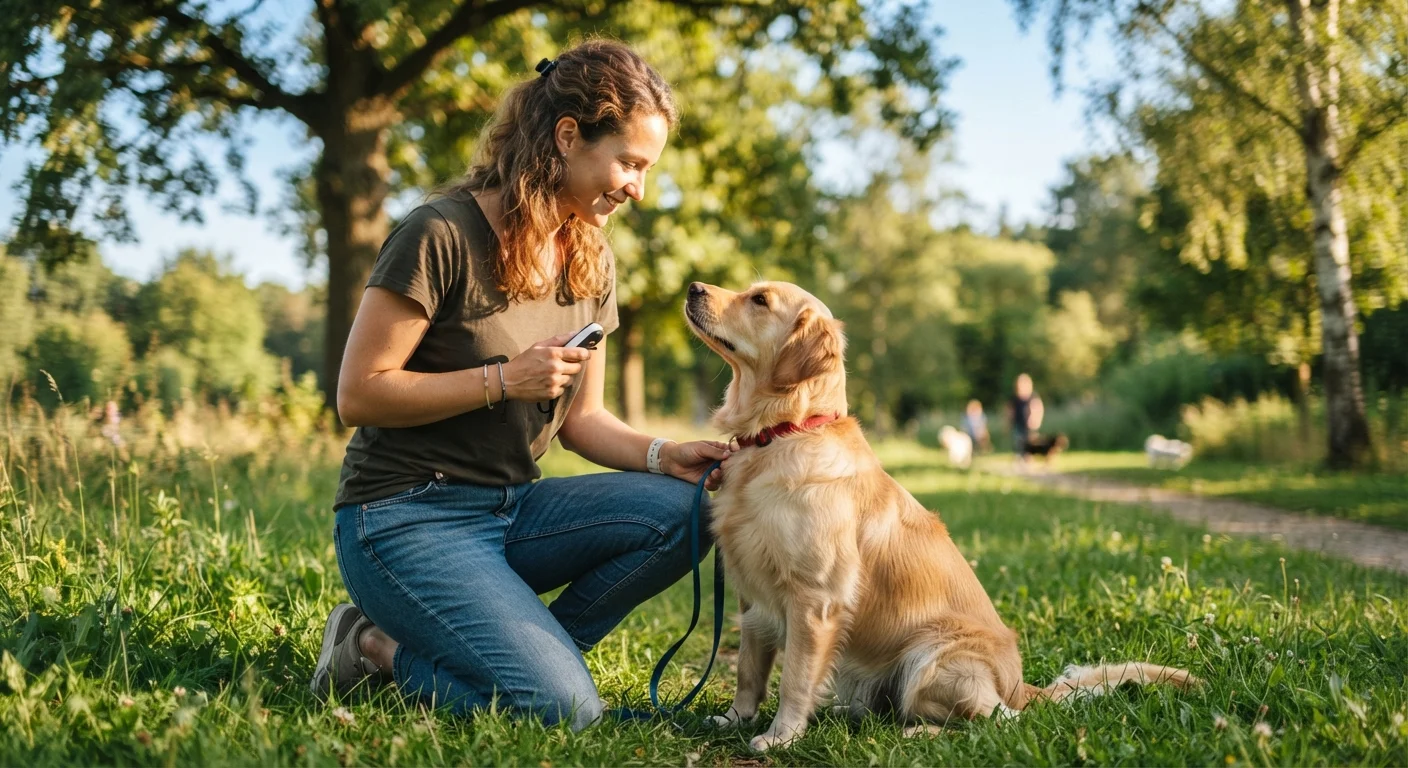
Key Takeaways
- Both methods use a marker - a precise signal - to tell a dog the exact moment it performed the correct behavior.
- Clickers produce a consistent, unique sound that is easier for dogs to distinguish from everyday noise.
- Verbal markers are always available and hands-free, making them practical in real-world situations.
- Timing is the most critical factor in either method; a delayed marker undermines learning regardless of which tool you use.
- Many trainers use both, starting with a clicker to build precision and transitioning to a verbal marker for daily life.
- Neither approach replaces the reward - the marker only predicts it; food or play reinforcement still drives learning.
Option A
Clicker Training
The precise, consistent mechanical marker.
Best for: Owners who want a highly distinct, emotionally neutral signal and are comfortable carrying a small device during sessions.
Option B
Verbal Marker Training
The hands-free, always-available alternative.
Best for: Owners who prefer a low-equipment approach or need to mark behaviors at a distance without reaching for a tool.
If you want the most consistent, emotionally neutral signal possible
Clicker Training
A clicker produces the same sound every time, removing any variation in tone or volume that a human voice naturally introduces.
If you frequently train in public or need your hands free
Verbal Marker Training
A word like 'Yes!' is always with you - no fumbling for a device when your dog nails a recall across the park.
If your dog is noise-sensitive or startles easily
Verbal Marker Training
A soft, familiar voice is less likely to startle anxious dogs than the sharp mechanical click of a traditional clicker.
If you are teaching complex or duration-based behaviors
Clicker Training
The clicker's sharp, brief sound pinpoints the exact moment of success, which is especially useful when shaping multi-step or precision behaviors.
If you want a single system to use from puppyhood through advanced training
Verbal Marker Training
A verbal marker scales naturally from early socialization through off-leash work without requiring you to carry extra equipment at every stage.
What a Marker Actually Does
Before comparing the two tools, it helps to understand the shared principle behind them. A marker is a brief, distinct signal - delivered the instant a dog performs the desired behavior - that communicates "that action earned a reward." It bridges the gap between the behavior and the treat, since fumbling for food after the fact is almost always too slow for a dog's learning window.
This concept comes directly from operant conditioning research, specifically the work on conditioned reinforcers. The marker itself starts as neutral; through repeated pairing with food or play, it becomes meaningful to the dog. Both clickers and verbal cues work this way. For a deeper look at the science underpinning reward-based approaches, see our article on positive reinforcement in pet training.
| Criterion | Clicker Training | Verbal Marker Training |
|---|---|---|
| Consistency of signal | Identical every time | Varies with tone and mood |
| Hands required | Yes - one hand free needed | No - fully hands-free |
| Equipment needed | Small clicker device | None |
| Distance marking | Limited by sound range | Effective at greater distance |
| Suitability for noise-sensitive dogs | May startle some dogs | Generally less startling |
| Ease for beginners | Moderate - requires coordination | Easier to start immediately |
| Precision for shaping | High - sharp, brief sound | Good with practice |
| Risk of signal dilution | Low - distinct sound | Higher if word used casually |
The Case for Clicker Training
A clicker's primary advantage is consistency. The mechanical click is always the same pitch, duration, and volume - something no human voice can replicate reliably across a full training session. When you are tired, excited, or distracted, your verbal tone shifts in ways you may not notice but your dog certainly does.
Clickers also carry no emotional charge. Dogs learn over time to associate words with context - "Yes" said warmly during play sounds different from "Yes" said briskly during a focused heel exercise. The click remains neutral, which can simplify early learning for dogs that are sensitive to human emotional cues.
The main limitation is practical: you need a free hand, and you need the device on you. During loose-leash walks, greeting strangers, or managing multiple dogs, the clicker can become awkward. Dropping it mid-session is a real disruption. Some dogs - particularly those with noise sensitivities - may also startle at the sound, though this can often be managed by muffling the clicker inside a pocket initially.
~0.5 sec
Ideal marker-to-behavior window
Animal learning researchers generally recommend marking within half a second of the target behavior for maximum precision.
2-3 days
Typical clicker conditioning period
Most dogs associate a new marker with reward after just a few short sessions of consistent pairing, according to applied behavior analysis principles.
1 marker
Recommended markers per training context
Professional trainers advise using a single primary marker per session to avoid confusion and preserve the signal's conditioned value.
The Case for Verbal Marker Training
A verbal marker - typically a short, sharp word like "Yes!" or "Good!" - is always available because you always have your voice. This makes it especially practical during foundational command work in everyday environments where carrying equipment is inconvenient.
For dogs that already respond well to their owner's voice, a verbal marker can feel like a natural extension of communication rather than an introduced tool. It also works at greater distances - you can mark a correct recall from across a yard without needing to click within a certain range.
The challenge is developing a consistent, high-value tone and committing to using the marker word only as a marker - not as general praise. Many owners accidentally dilute its meaning by saying "yes" casually throughout the day. Choosing a less common word, or even a nonsense syllable, can help preserve its signal value.
Timing: The Factor That Matters Most
Regardless of which marker you use, timing determines whether your dog actually learns what you intended to teach. Research in animal learning consistently shows that markers delivered more than one to two seconds after a behavior lose precision - the dog may associate the reward with whatever it was doing at the moment of the click or word, not the behavior you intended to reinforce.
Practicing your marker timing before adding it to real training sessions helps enormously. Some trainers recommend bouncing a ball and clicking or saying the marker word the instant it hits the ground - a simple drill that sharpens mechanical precision. Reading your dog's responses accurately is equally important; our guide to dog body language during training can help you interpret whether your sessions are landing as intended.
Conditioning Your Marker Before You Train
Whichever marker you choose, condition it before using it in real exercises. Click or say your marker word, then immediately deliver a small food reward - repeat 10-15 times across two or three short sessions. Once your dog's ears perk or their head turns at the sound alone, the marker is conditioned and ready to use. Skipping this step is one of the most common reasons markers fail to work as expected.
Choosing, Combining, or Switching Methods
Many professional trainers start dogs on a clicker to build a strong, precise conditioned reinforcer during early skill acquisition, then transition to a verbal marker once the dog understands the game. This approach captures the clicker's consistency for foundational work while leaving owners with a practical, equipment-free tool for long-term use.
If you are working through specific challenges - like a shaky recall or behavior shaped across multiple sessions - the clicker's precision can provide an edge. For casual reinforcement of known behaviors during daily life, a verbal marker is usually sufficient and more convenient.
What matters most is that you pick one primary marker per training context, condition it properly through repeated pairing with a valued reward, and apply it with consistent timing. Both tools, used correctly, support the kind of humane, force-free training that builds a trusting relationship between dog and owner. If you are weighing how to structure your sessions overall, our comparison of group classes versus private training may also help you find the right learning environment for your dog.