

Key Takeaways
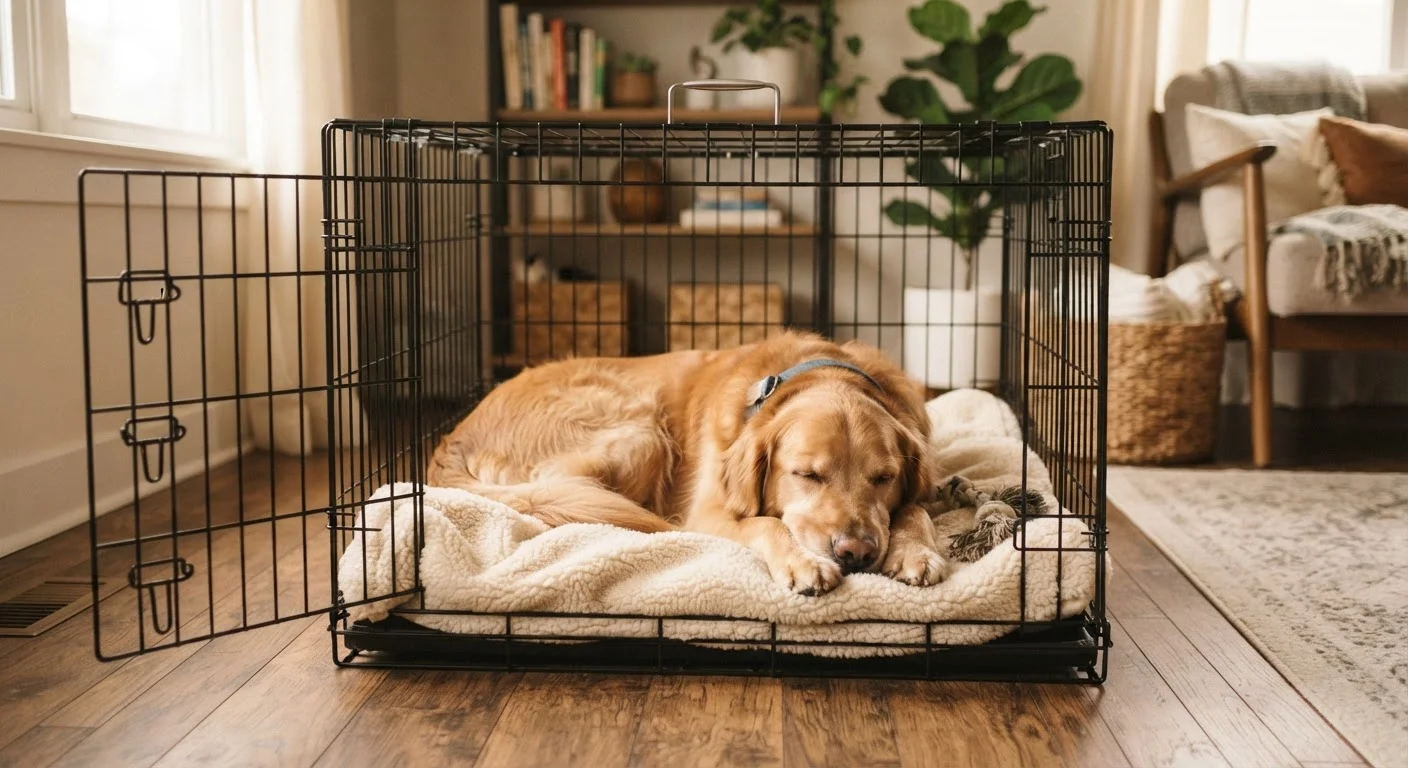
- A properly sized crate should allow your dog to stand, turn around, and lie down comfortably.
- Introduction must be gradual and positive - never use the crate as punishment.
- Puppies have limited bladder control; crate time should not exceed one hour per month of age.
- Whining at night often reflects adjustment anxiety, not defiance - patience and routine help most.
- Many adult dogs continue to use their crate voluntarily as a resting space long-term.
Why Crate Training Works
Dogs are den animals by nature. In the wild, canines seek out enclosed, sheltered spaces to rest safely - a behavioral tendency that domesticated dogs retain. A crate, when introduced humanely, taps into this instinct rather than working against it.
From a practical standpoint, crate training supports housebreaking because dogs instinctively avoid soiling their sleeping area. It also keeps unsupervised puppies and newly adopted dogs from accessing hazards in the home. According to the American Veterinary Society of Animal Behavior, positive confinement training - when done correctly - does not cause distress and can significantly reduce anxiety-driven destructive behavior.
Crate training also pairs naturally with other foundational work. If you're simultaneously teaching commands, see our guide to core commands for a complementary approach. Reading your dog's stress signals throughout any training process matters enormously - the dog body language reference is an essential companion to this guide.
72%
Dog owners who use a crate report fewer house-training accidents
Surveys of dog owners by veterinary behavior groups consistently find crate-trained dogs have fewer unsupervised accidents indoors during the first year.
1 hr/month
Maximum crate time per month of puppy age
Veterinary and humane society guidelines recommend puppies not be crated longer than one hour per month of age to prevent distress and accidents.
4-6 weeks
Typical crate acclimation period for most dogs
Most dogs show consistent comfort with crate confinement within four to six weeks of a gradual, positive introduction, according to animal behavior practitioners.
Choosing and Setting Up the Crate
Crate type and size both affect how quickly your dog accepts the space. Wire crates offer ventilation and visibility; plastic travel crates feel more den-like and enclosed. Either works well - choose based on your dog's temperament and your household's needs.
Sizing is critical. The crate should be large enough for your dog to stand without crouching, turn around fully, and lie on their side comfortably. It should not be so large that a puppy can eliminate in one corner and sleep in another - this undermines housetraining. If you have a puppy who will grow, purchase an adult-sized crate with a divider panel that you move back as they grow.
Placement matters too. Position the crate in a low-traffic but family-adjacent area - somewhere the dog can see household activity without being in the center of chaos. Add a washable blanket or crate mat, and consider placing an item with a familiar scent inside during the first week. Avoid bowls of water that tip easily; a clip-on water bottle or scheduled water breaks work better during active training.
Cover three sides of a wire crate with a blanket or crate cover to create a darker, more den-like atmosphere - many dogs settle faster in a partially enclosed space.
Reducing visual stimulation from multiple angles mimics the sheltered environment dogs instinctively seek for rest, which can shorten the time needed for the dog to relax and sleep.
Feed every meal inside the crate during the first two weeks of training, even if your dog is already comfortable entering - consistent positive associations build faster than intermittent ones.
Meal feeding leverages a primary reinforcer (food) on a predictable schedule, strengthening the dog's positive emotional response to the crate more reliably than treats alone.
Introducing the Crate Step by Step
Rushing the introduction is the most common mistake owners make. A dog that is forced into a crate before building a positive association may develop lasting resistance. The goal is for the dog to choose to enter - and eventually prefer - the space.
- Day 1-2: Place the crate in your chosen spot with the door open. Drop treats near the entrance, then just inside the threshold. Let your dog investigate at their own pace without any pressure.
- Day 3-4: Toss treats or a favorite toy inside. Feed meals near, then inside, the crate with the door open. Use a calm, consistent cue word like "crate" or "place" each time.
- Day 5-7: Begin closing the door briefly while your dog eats. Open it before they show any anxiety. Gradually extend closed-door time to five minutes, then ten.
- Week 2: Practice crating for 20-30 minutes while you are home and visible. Increase duration slowly. Introduce overnight crating only after your dog settles calmly during daytime sessions.
For new dog owners navigating the broader first weeks, the first-month training roadmap offers a structured timeline that integrates crate work alongside other early priorities.
Common Setbacks and How to Handle Them
Even with a careful introduction, setbacks happen. Knowing what drives them helps you respond without making things worse.
Whining or Barking at Night
This is extremely common in the first week, especially with puppies. The crate itself usually isn't the problem - separation from their litter and a new environment is. Move the crate to your bedroom temporarily so the dog can hear and smell you. Avoid letting the dog out in response to whining, which teaches that vocalizing opens the door. Wait for a brief pause in noise, then release calmly.
Refusing to Enter
If your dog backs away from the crate, the introduction moved too fast. Return to step one: door open, no pressure, high-value treats scattered at the entrance. Never push or lure the dog inside by force.
Accidents Inside the Crate
Accidents typically signal the dog was crated too long or the crate is too large. Puppies generally cannot hold their bladder longer than one hour per month of age (up to about four to five hours maximum). Re-evaluate duration and ensure the crate size is appropriate.
It's also worth reflecting on your training approach more broadly. Research documented in our article on punishment-based training underscores why using the crate as a penalty can produce lasting behavioral problems - the crate must always remain a neutral or positive space.
Never Use the Crate as Punishment
Sending a dog to the crate after scolding them destroys the positive association you've worked to build. If the dog begins to associate the crate with negative experiences, they may resist entering it even during neutral situations. The crate should always represent safety and calm - keep it entirely separate from any disciplinary response.
How Crate Use Evolves as Your Dog Matures
Crate training is not a permanent management strategy - it's a foundation. As your dog demonstrates reliable housetraining, calmer behavior when unsupervised, and no destructive tendencies, you can progressively expand their freedom in the home.
A common progression: crate when unsupervised → crate in one room with baby gate → full room access → full home access. Move through stages based on behavior, not age alone. Some dogs are ready for more freedom at eight months; others need management well into their second year.
Interestingly, many adult dogs continue to use their crate voluntarily - with the door left open - as a preferred resting spot. This is a sign the training worked well. There's no reason to remove the crate if the dog has developed a genuine attachment to the space.
For dogs with persistent anxiety that doesn't resolve with patient crate training, consultation with a veterinary behaviorist or certified applied animal behaviorist is appropriate. General anxiety management is outside the scope of crate training alone.
This article is for general informational and educational purposes only. It does not constitute veterinary or behavioral advice. Consult a qualified veterinarian or certified animal behaviorist for guidance specific to your dog's health and temperament.