

Key Takeaways
- The first three days should focus on decompression, not commands - let your dog adjust.
- Consistent daily routines reduce anxiety and accelerate learning in new dogs.
- Short, positive training sessions (5-10 minutes) outperform long, infrequent ones.
- Sit, stay, and come are the three commands worth mastering in the first month.
- Reading your dog's body language helps you time sessions for maximum success.
- Progress varies widely by dog - patience and consistency matter more than speed.
Start here
Days 1-3: Settling In Before Training Begins
Next
Week One: Establishing Rules and Routines
Then
Weeks Two and Three: Building Core Commands
Keep going
Week Four: Adding Challenges and Consistency
Foundation
Principles That Carry You Through Every Stage
Days 1-3: Settling In Before Training Begins
Bringing a dog home triggers a significant stress response, even in a calm, well-socialized animal. New smells, unfamiliar people, and a changed environment all require adjustment. Behaviorists often call this the decompression period, and honoring it pays dividends later.
For the first two to three days, resist the urge to introduce commands, invite guests, or overwhelm your dog with experiences. Instead, focus on:
- Showing your dog where to eat, drink, sleep, and relieve itself
- Keeping interactions calm and low-pressure
- Allowing your dog to explore at its own pace
See what to expect in your pet's first week at home for a detailed look at normal versus concerning behaviors during this window.
Decompression period
The adjustment phase - typically the first few days - when a new dog needs quiet time to process its new environment before training can be effective.
Positive reinforcement
A training method that increases a desired behavior by immediately following it with something the dog values, such as a treat, praise, or play.
Generalization
The ability of a dog to perform a learned command reliably in different locations and with varying levels of distraction, not just in the place where it was first taught.
Impulse control
A dog's learned ability to pause and wait rather than immediately acting on an instinct - for example, sitting before crossing a threshold instead of bolting.
Luring
A training technique where a treat or object is used to guide a dog's body into a desired position, such as moving a treat over the nose to prompt a sit.
CPDT-KA
Certified Professional Dog Trainer - Knowledge Assessed, a credential awarded by the Certification Council for Professional Dog Trainers based on experience and a standardized exam.
Week One: Establishing Rules and Routines
Once your dog appears relaxed - eating well, sleeping, and making eye contact - you can begin building structure. Consistency is the foundation of every training system: your dog learns fastest when the same action reliably produces the same outcome.
Priorities for week one:
- Feeding schedule: Feed at the same times each day. This also regulates bathroom timing, which is essential for house training.
- Potty routine: Take your dog outside first thing in the morning, after meals, after naps, and before bed. Praise immediately when it eliminates outside.
- Sleep spot: Decide where your dog will sleep and be consistent. Introducing a crate gently at this stage can be very effective - see our full crate training guide for step-by-step setup advice.
- Boundaries: Decide which furniture, rooms, and behaviors are allowed. Every family member should enforce the same rules.
Keep Everyone on the Same Page
Post a simple household 'house rules' list somewhere visible - a sticky note on the fridge works fine. When every person in the home uses the same commands, rewards, and boundaries, your dog learns significantly faster. Mixed signals from different family members are one of the most common causes of slow progress.
Weeks Two and Three: Building Core Commands
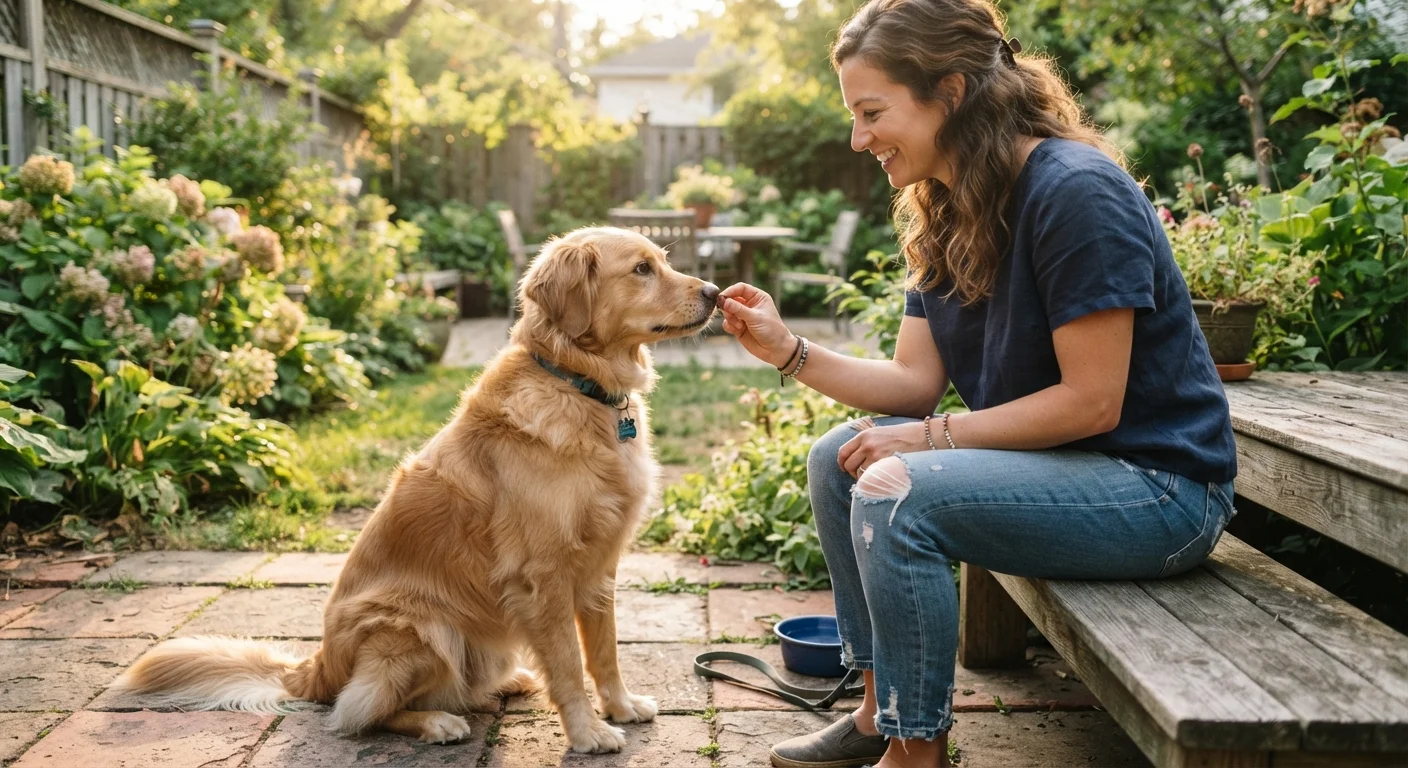
With a routine in place, your dog's brain is ready to learn. This is the time to introduce the commands that form the backbone of a well-behaved dog. Animal training research consistently supports positive reinforcement - rewarding desired behaviors with treats, praise, or play - as the most effective and humane approach.
Work on these three commands in short, focused sessions:
- Sit - the easiest starting point; teaches your dog to offer a calm default behavior
- Stay - builds impulse control; start with just one or two seconds before gradually increasing duration
- Come - the most critical safety command; always reward this generously, never use it to end play abruptly
For clear, step-by-step instruction on each, see teaching sit, stay, and come.
Pay attention to how your dog communicates. Yawning, lip-licking, looking away, or tucking the tail are signs of stress. Knowing these signals helps you adjust your approach - dog body language every owner should recognize is a useful companion resource here.
Week Four: Adding Challenges and Consistency
By the fourth week, your dog should have a grasp of at least one or two commands in a quiet indoor setting. Now it's time to generalize those skills - meaning your dog can perform them in different environments, with distractions present.
Practical ways to add challenge:
- Practice sit and stay in the yard, on walks, or in a quiet park
- Ask for a command before placing the food bowl down - this reinforces manners around meals
- Practice come with a long leash in an open space
- Introduce short separation periods to build confidence and reduce the risk of separation anxiety
Avoid Punishment-Based Methods
Techniques that rely on intimidation, physical correction, or fear - such as alpha rolls, leash jerks, or shouting - can damage your dog's trust and increase anxiety or aggression. Major veterinary and behavior organizations, including the American Veterinary Society of Animal Behavior, recommend against the use of punishment-based training. If something isn't working, simplify the task rather than applying more pressure.
Track what's working and where your dog struggles. Regression is normal - if your dog suddenly seems to forget a command, simplify the exercise, remove distractions, and rebuild from there. Consistency, not pressure, is what creates durable learning.
Principles That Carry You Through Every Stage
Training is not a one-month project - it's an ongoing relationship. These core principles apply whether you're on day five or year five:
- Short sessions, high frequency
- Five minutes of focused training twice a day beats a 40-minute session once a week.
- End on success
- Always finish with something your dog can do well. This keeps motivation high for next time.
- Timing matters
- Reward within one to two seconds of the desired behavior. Delayed rewards confuse dogs about what they're being praised for.
- Manage the environment
- Set your dog up to succeed by removing temptations and reducing opportunities to practice unwanted behaviors.
If you reach a plateau or feel uncertain, a certified trainer is a worthwhile investment. Look for credentials such as CPDT-KA (Certified Professional Dog Trainer - Knowledge Assessed) or a veterinary behaviorist board certification (DACVB) when seeking professional help.
This article provides general educational information about dog training. It is not a substitute for personalized guidance from a certified trainer or veterinary professional, particularly for dogs showing signs of fear, aggression, or anxiety.
Certification Council for Professional Dog Trainers (CCPDT)
The CCPDT maintains a searchable directory of certified dog trainers across the U.S. Use it to find a credentialed professional in your area who uses science-based methods.
American Veterinary Society of Animal Behavior (AVSAB)
AVSAB publishes free position statements on humane training methods, socialization, and behavior management - useful reading for any new dog owner who wants to understand the science behind the guidance.
Dog Training Session Log Template
A simple session log helps you track which commands your dog has learned, where it struggles, and how long each session lasts - making it easier to spot patterns and adjust your approach.